SOCKS5 and HTTP Proxies: What’s the Difference and Which Option to Choose
 ·September 3, 2026·4 min read
Proxies of the same general class can differ significantly in how they handle traffic, which protocols they support, and which tasks they are better suited for. That is why comparing HTTP and SOCKS5 proxies as interchangeable solutions is not entirely accurate: they solve different technical problems. One type is convenient where control, filtering, and work specifically with web requests matter. The other is preferable where universal traffic transmission, support for different protocols, and stable operation of applications beyond a typical browser-based scenario are required.
What Is an HTTP Proxy
An HTTP proxy works with HTTP and HTTPS traffic and is primarily oriented toward web-related tasks. It acts as an intermediary between the client and the website: it receives the request, processes it, and forwards it on its own behalf. Because this type of proxy understands the structure of HTTP requests, it can analyze and modify traffic at the application level.
This gives an HTTP proxy a number of practical capabilities. It can cache responses, speeding up repeated requests to the same resources. It can filter content, restrict access to specific websites or request types, keep logs, manage headers, and use access control mechanisms. As a result, HTTP proxies are often used in environments where predictability, manageability, and precise configuration of web traffic are important.
This format is especially convenient for tasks related to the large-scale processing of web pages: monitoring search engine results, price analysis, collecting public data, checking how content is displayed in different regions, and other scenarios where the main traffic goes through browsers or HTTP clients.
At the same time, the scope of HTTP proxies is limited by the protocol itself. If the task goes beyond HTTP(S), their capabilities may no longer be sufficient.
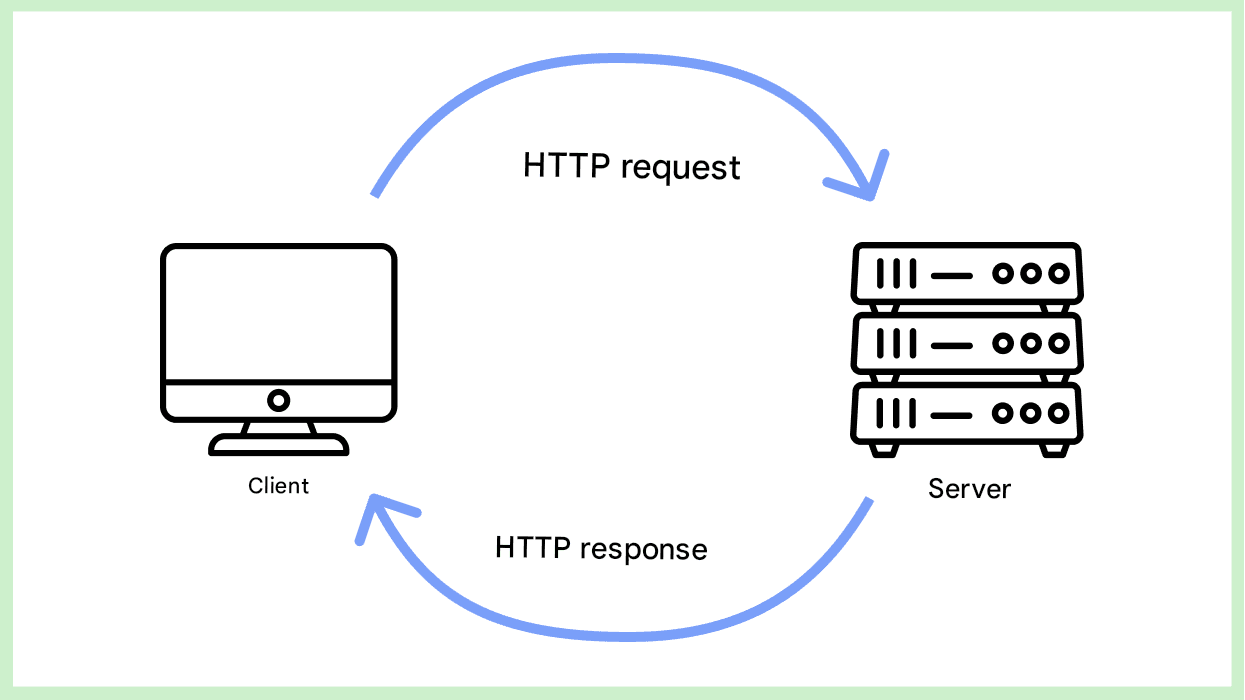
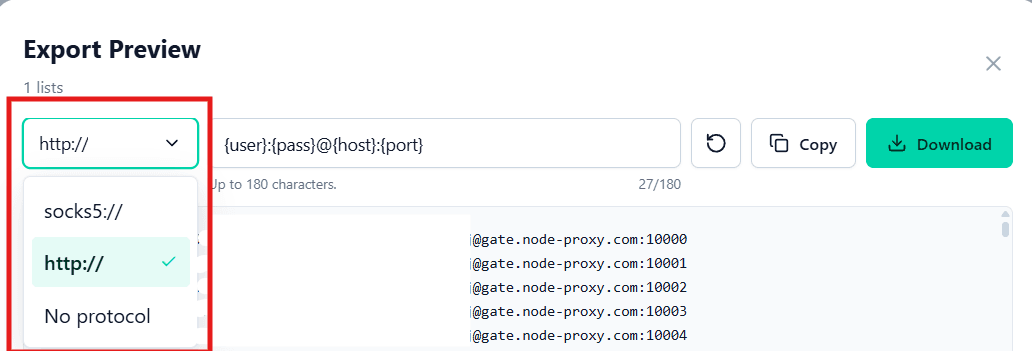
HTTP or SOCKS5 — You Choose
Node Proxy supports both protocols for different tasks and applications.
What Is a SOCKS5 Proxy
SOCKS5 works differently. Unlike an HTTP proxy, it does not analyze the contents of requests or interfere with the structure of the transmitted data. Its task is simply to pass traffic between the client and the server without altering packets along the way.
The main advantage of SOCKS5 is versatility. It supports not only TCP but also UDP, which makes it suitable not only for web traffic but also for a much broader range of applications and network scenarios. This makes it useful where non-standard protocols are used, real-time data exchange is required, or work with high-load network streams is needed.
SOCKS5 is used for streaming, video communication, online gaming, transferring large files, certain types of automation, as well as for applications for which HTTP routing alone is not sufficient. Because it interferes minimally with data, this type of proxy usually introduces less overhead when processing traffic.
It is also worth noting separately that SOCKS5 is specifically a transport mechanism. It does not provide the functions typical of HTTP proxies: there is no built-in caching of web pages, filtering of HTTP headers, or content management at the web request level.
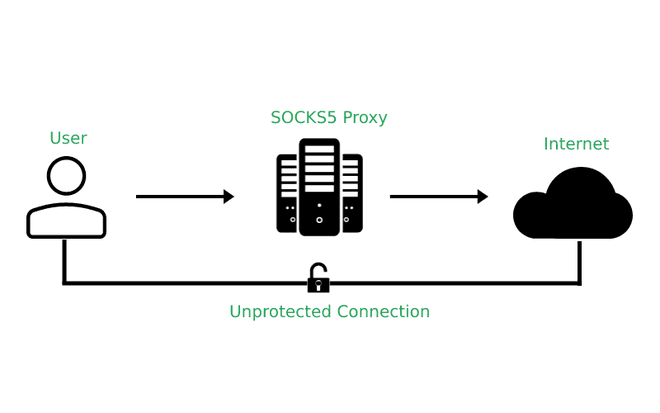
How SOCKS5 Differs from SOCKS4
Although SOCKS4 can still be encountered in use, in practice SOCKS5 is chosen more often because it is noticeably more flexible.
SOCKS4 is designed only for TCP connections. That is sufficient for basic tasks, but as soon as UDP traffic is required, its capabilities end there. SOCKS5 supports both TCP and UDP, so it is better suited for services where responsiveness and real-time data transmission matter.
In addition, SOCKS5 offers more modern addressing and authentication mechanisms. It supports IPv4, IPv6, domain names, and username/password authentication. In SOCKS4, these capabilities are either absent or implemented much more simply. Therefore, when choosing between the two versions, it usually makes more sense to focus on SOCKS5 in most cases.
Key Differences Between HTTP and SOCKS5
1. Supported Protocols
An HTTP proxy is designed for HTTP and HTTPS. It is a good choice for browser traffic, web scraping, page monitoring, and other tasks where all communication is built around web protocols.
SOCKS5 is not limited to the web. It can carry almost any traffic over TCP and UDP, so it is used in a much wider range of applications.
2. Traffic Handling
An HTTP proxy understands the structure of web requests and can work with them: modify headers, filter requests, cache responses, and restrict access.
SOCKS5 does not perform such actions. It does not analyze the contents of traffic but forwards it as is. This makes it more universal, but it lacks specialized web traffic management functions.
3. Performance
In web scenarios, an HTTP proxy can be effective thanks to caching and optimization of repeated requests. If many requests are made to the same resources, this reduces load and speeds up operation.
SOCKS5 usually performs better in tasks where high throughput, minimal additional processing, and stable transmission of different types of traffic are important. This is especially noticeable in streaming, large file transfers, and real-time applications.
4. Application Compatibility
HTTP proxies are supported by virtually all browsers, many system utilities, and a large number of web tools. They are usually easier to configure.
SOCKS5 requires the application to be able to work with this type of proxy. Today such support is common, but not universal, and it is not always enabled without additional configuration.
5. Additional Features
HTTP proxies are stronger where caching, filtering, logging, rate limiting, and web traffic control are needed.
SOCKS5 is preferable where content management is less important than universal data routing without unnecessary interference.
DNS, IPv6, and Authentication: Important Nuances
In practical selection, not only the basic differences between HTTP and SOCKS5 often matter, but also additional configuration parameters.
SOCKS5 supports remote DNS resolution when configured correctly. This is useful in cases where it is important for domain name resolution to occur on the proxy side rather than locally. SOCKS5 is also inherently better suited to working with IPv6.
From the point of view of authentication, both proxy types may require authorization, but they do so differently. HTTP proxies usually use standard HTTP authentication mechanisms. SOCKS5 supports authentication at the protocol level itself, including username and password authentication.
These details become especially important in corporate environments, when integrating with infrastructure, and in projects where compatibility and predictable configuration are top priorities.
When to Choose an HTTP Proxy
An HTTP proxy is suitable in cases where the main work is specifically related to web traffic and additional tools for processing it are needed.
It is appropriate if the task includes:
• collecting and processing data from web pages;
• monitoring search engine results and prices;
• checking how websites and advertisements are displayed;
• caching frequently requested pages;
• filtering and controlling access to web resources.
This is a logical choice for browsers, SEO tools, scrapers, content filtering systems, and internal network environments where manageability of HTTP(S) traffic is important.
When to Choose a SOCKS5 Proxy
SOCKS5 is better used when traffic is not limited to HTTP or when the application needs a more universal transport layer.
It is suitable for:
• services that use TCP and UDP;
• streaming data transmission;
• online games and voice services;
• transferring large files;
• applications with non-standard network protocols;
• scenarios where minimal traffic processing along the way is important.
If the task goes beyond web pages and a regular browser, SOCKS5 is often more practical than an HTTP proxy.
What to Choose in the End
HTTP and SOCKS5 are not directly competing solutions in the pure sense, but tools for different classes of tasks.
An HTTP proxy is better suited to web scenarios where filtering, caching, request management, and compatibility with browsers and HTTP clients are important. It is a specialized tool designed specifically for working with web traffic.
SOCKS5 is a more universal option. It does not interfere with packet contents, supports TCP and UDP, and handles applications better when what is needed is not web filtering but flexible routing of network traffic.
Therefore, the choice between them does not depend on which type is “better overall,” but on which type better matches the specific workload. For web tasks, an HTTP proxy is usually the more reasonable option. For heterogeneous traffic, real-time applications, and non-standard network scenarios, SOCKS5 is the better choice. You can purchase high-quality residential proxies that support both HTTP and SOCKS5 protocols on our website.