UDP Proxies: How They Work, Where They Are Used, and When They Are Truly Needed

What UDP Proxies Are
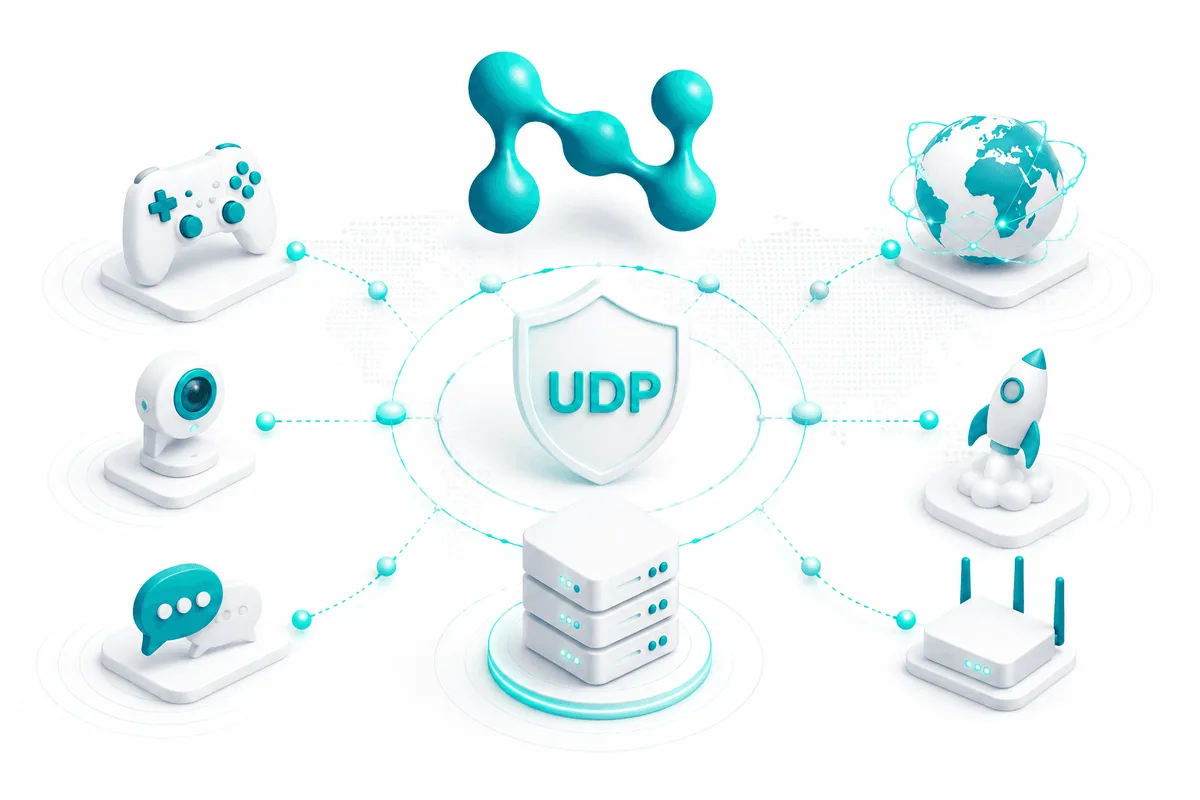
A UDP proxy is an intermediary server between a client and a destination node that receives UDP packets, forwards them further, and returns responses back. For the destination server, the source of the traffic becomes the proxy’s IP address rather than the client’s IP address.
The key feature here is connected not so much with the proxy itself as with the nature of UDP. It is a connectionless transport protocol. It does not require delivery acknowledgments, does not guarantee packet order, and does not automatically retransmit data when packets are lost. As a result, overhead is reduced and transmission becomes faster.
That is exactly why UDP proxies are needed in cases where partial packet loss is acceptable, but additional latency is undesirable. For time-sensitive tasks, this is often more important than the perfect integrity of every fragment of data.
How UDP Differs from TCP
The difference between UDP and TCP also determines the difference between proxy types.
- TCP works on a confirmation-based model: data transmission is accompanied by connection establishment, delivery control, order verification, and retransmission of lost segments. This approach increases reliability but adds latency.
- UDP is structured more simply. It sends packets without prior coordination and without mandatory return verification. This makes it faster, but less predictable in terms of delivery.
In practice, this means the following: if it is more important for a system that data arrive completely and in the correct sequence, TCP is usually chosen. If it is more important to transmit information as quickly as possible, UDP is more often used.
Premium Residential Proxies for Any Task
Trusted residential IPs, a vast GEO coverage network, pay-as-you-go traffic pricing, and a high connection success rate.
How a UDP Proxy Works
The operating mechanism of a UDP proxy is relatively simple. The client sends a UDP packet not directly to the destination server, but to the proxy’s address and port. The proxy receives this packet, determines the destination parameters, and forwards it further. When the destination server forms a response, it sends it to the proxy, and the proxy then passes the packet back to the client.
A typical scheme looks like this:
1. The client sends a UDP packet to the proxy server.
2. The proxy receives the packet and reads its address information.
3. The proxy forwards the packet to the destination server.
4. The destination server sends a response to the proxy.
5. The proxy returns the response to the client.
In the process, the proxy may rewrite addresses and ports in order to correctly maintain routing between the parties. From the outside, the interaction looks as though the exchange is going through an intermediate node rather than directly.
Operation Without Full State
One of the important features of UDP proxies is the absence of a classic connection model. In TCP proxies, there is a clear, persistent connection between the parties. In UDP, this does not exist: packets are processed separately, without a mandatory long-lived session.
In practice, a UDP proxy server usually stores only minimal temporary information: for example, the mapping between the client address, port, and routing direction. This is enough to return the response to the correct client, but not enough to speak of a full-fledged connection in the TCP sense.
This approach reduces the load on the server and simplifies scaling. The proxy does not need to maintain a large number of long-lived connections, so it handles an intensive flow of short packets better.
What Functions a UDP Proxy May Have
Although UDP proxies are oriented toward fast forwarding, they can also perform a number of supporting tasks. Depending on the implementation, the server often supports:
• logging of IP addresses, ports, and traffic volume;
• basic filtering by addresses, ports, and traffic types;
• rate limiting for protection against overload;
• simple access control mechanisms;
• routing according to predefined rules;
• load balancing;
• operation in schemes with NAT and segmented networks.
However, it is important to understand that the depth of traffic processing in such solutions is usually lower than in HTTP proxies. UDP proxies were not created as a tool for complex analysis of web requests, page content filtering, or management of application headers.
Advantages of UDP Proxies
Low Latency
The main advantage of UDP proxies is latency minimization. The absence of handshakes, acknowledgments, and retransmissions reduces packet transit time. In real-time systems, this produces a noticeable effect.
Lower Overhead
Since UDP does not require complex service logic, the server spends fewer resources servicing each exchange. This helps use bandwidth more efficiently and process a large flow of small packets.
Good Scalability
Minimal state and the absence of long-lived connections simplify horizontal scaling. As the load grows, new nodes can be added without complex connection maintenance at the level of each client.
Support for Non-Web Traffic
HTTP proxies are well suited for web requests, but they do not solve the task of transmitting UDP traffic. UDP proxies, by contrast, are applicable where work with DNS, gaming traffic, telemetry, voice communication, and other scenarios outside the ordinary web stack is required.
Convenience for Specialized Networking Tasks
Such proxies can be used as an intermediate layer in infrastructure where it is necessary to relay packets, organize communication through NAT, separate network segments, or centrally direct UDP traffic through controlled nodes.
Where UDP Proxies Are Used
Online Games
Game engines and network mechanics in multiplayer projects often use UDP precisely because of its low latency. For games, response speed and prompt delivery of state updates are critical, even if individual packets are sometimes lost. Under such conditions, UDP proxies are better suited than solutions oriented toward TCP.
VoIP and Video Communication
Voice and video communication do not tolerate latency well. For a call, the natural pace of conversation is usually more important than flawless delivery of every packet. A small loss of some audio data is less noticeable than constant pauses caused by waiting for acknowledgments. That is why UDP proxies are often used in VoIP and video communication infrastructure.
Streaming and Interactive Media Services
In streaming data transmission, it is important to deliver the next portions of content quickly. In live broadcasts, interactive media, and a number of audio and video scenarios, extra latency degrades perception more than occasional packet loss. Here, UDP proxies help reduce route latency.
DNS
DNS queries have traditionally often been transmitted over UDP because they are short and require a quick response. Proxies at this level can be used for relaying DNS traffic, centralized routing, or separating network segments.
IoT and Monitoring
In many IoT systems and monitoring systems, devices regularly send small telemetry packets. For this model, simplicity and transmission speed are important. UDP proxies make it possible to centralize this traffic and redirect it through the necessary infrastructure without unnecessary overhead.
Operation Through NAT and Restricted Networks
UDP proxies are also used as an auxiliary networking mechanism where direct exchange between nodes is complicated by NAT, firewalls, or routing specifics. In such cases, the proxy server becomes an intermediate packet transmission point.
How UDP Proxies Differ from HTTP and TCP Proxies
1. Supported Traffic Type
HTTP and HTTPS proxies are oriented toward web traffic. They understand HTTP requests and can work with headers, routes, methods, and other application-layer features. This is the right choice for browsers, APIs, web scraping, and other HTTP tasks.
TCP proxies are suitable for reliable data transmission in various applications, but standard implementations are not designed for UDP traffic.
UDP proxies are created specifically for UDP. They do not try to analyze application content as deeply as HTTP proxies do, but instead focus on forwarding packets at the transport layer.
2. Reliability Versus Speed
TCP and HTTP proxies are stronger where delivery accuracy matters. They are better suited for file downloads, work with web pages, API requests, and other scenarios where data corruption or loss is unacceptable.
UDP proxies, by contrast, are oriented toward speed and low latency. But the price for this is the absence of guaranteed delivery and more limited traffic control capabilities.
3. Area of Application
HTTP proxies are a tool for web tasks.
TCP proxies are a solution for applications where reliable transmission matters.
UDP proxies are an option for real-time systems and network services.
4. Depth of Traffic Processing
HTTP proxies can filter, cache, modify, or analyze traffic at the level of requests and responses. UDP proxies usually do not provide such deep application-level processing, because their main task is fast packet transmission.
When UDP Proxies Are Truly Suitable
The use of UDP proxies is justified in cases where the priorities are:
• low latency;
• high transmission speed;
• processing of a large number of small packets;
• support for UDP traffic as such;
• operation with real-time applications.
Typical examples include online games, VoIP, video communication, streaming, DNS services, telemetry, IoT infrastructure, some monitoring systems, and specialized networking scenarios.
When It Is Better to Choose Another Type of Proxy
UDP proxies are not a universal solution. For many tasks, they are simply unsuitable.
It is better to use HTTP, HTTPS, TCP, or SOCKS proxies when dealing with:
• web browsing;
• work with websites and browsers;
• API requests;
• web scraping;
• uploading and sending files;
• services where complete and correct data delivery is important;
• scenarios that require advanced traffic filtering and control.
In other words, if an application is built around web exchange or is sensitive to data loss, UDP proxies usually give way to more suitable alternatives.
Limitations of UDP Proxies
For all the advantages, this approach also has clear limitations.
First, UDP does not guarantee packet delivery. This means that some data may fail to reach the destination, and the proxy itself will not correct this characteristic of the protocol.
Second, UDP does not ensure delivery order. For real-time applications, this is often acceptable, but for a number of scenarios it is not.
Third, not all clients, services, and tools are able to work with UDP proxies directly. Support for this type of routing is noticeably narrower than for HTTP solutions.
Fourth, traffic control and analysis capabilities here are usually limited. If the task requires detailed processing at the application level, it is better to look toward other types of proxies.
How to Choose a UDP Proxy Provider
When choosing a provider, what matters is not general marketing promises, but specific technical parameters.
Explicit UDP Support
This is a basic requirement. Not every proxy provider actually offers infrastructure for UDP traffic, so the availability of such support must be verified separately.
Latency and Stability
For UDP scenarios, channel quality is more important than many other factors. It is necessary to evaluate not only service availability, but also route stability, bandwidth, and latency predictability.
Node Geography
If traffic is sensitive to routing, server location directly affects the result. The closer the proxy is to the required exchange point, the lower the potential latency.
Speed and Traffic Limits
It is important to understand how the provider handles limits, rate limiting, and the permissible intensity of packet transmission. In real-time systems, overly strict limits quickly become a bottleneck.
Network Quality Under Profile-Specific Load
For UDP services, what matters most is not simply server availability, but the network’s ability to operate stably under load with packet traffic. Therefore, when making a choice, it is useful to evaluate profile-specific indicators rather than only general service characteristics.
Conclusion
UDP proxies are a tool for a narrow but important class of network tasks. Their strong side is fast forwarding of UDP traffic with minimal latency and minimal overhead. That is why they are in demand in gaming, voice communication, streaming, DNS, IoT, and other real-time systems.
But they should not be considered a universal replacement for HTTP or TCP proxies. They are not designed for typical web tasks, do not provide guaranteed delivery, and do not offer the depth of control required when working with HTTP traffic or transmitting critical data. You can purchase high-quality residential proxies on our website.