HTTP Proxy: What It Is Used For and What Role It Plays in Web Traffic
 ·July 30, 2026·6 min read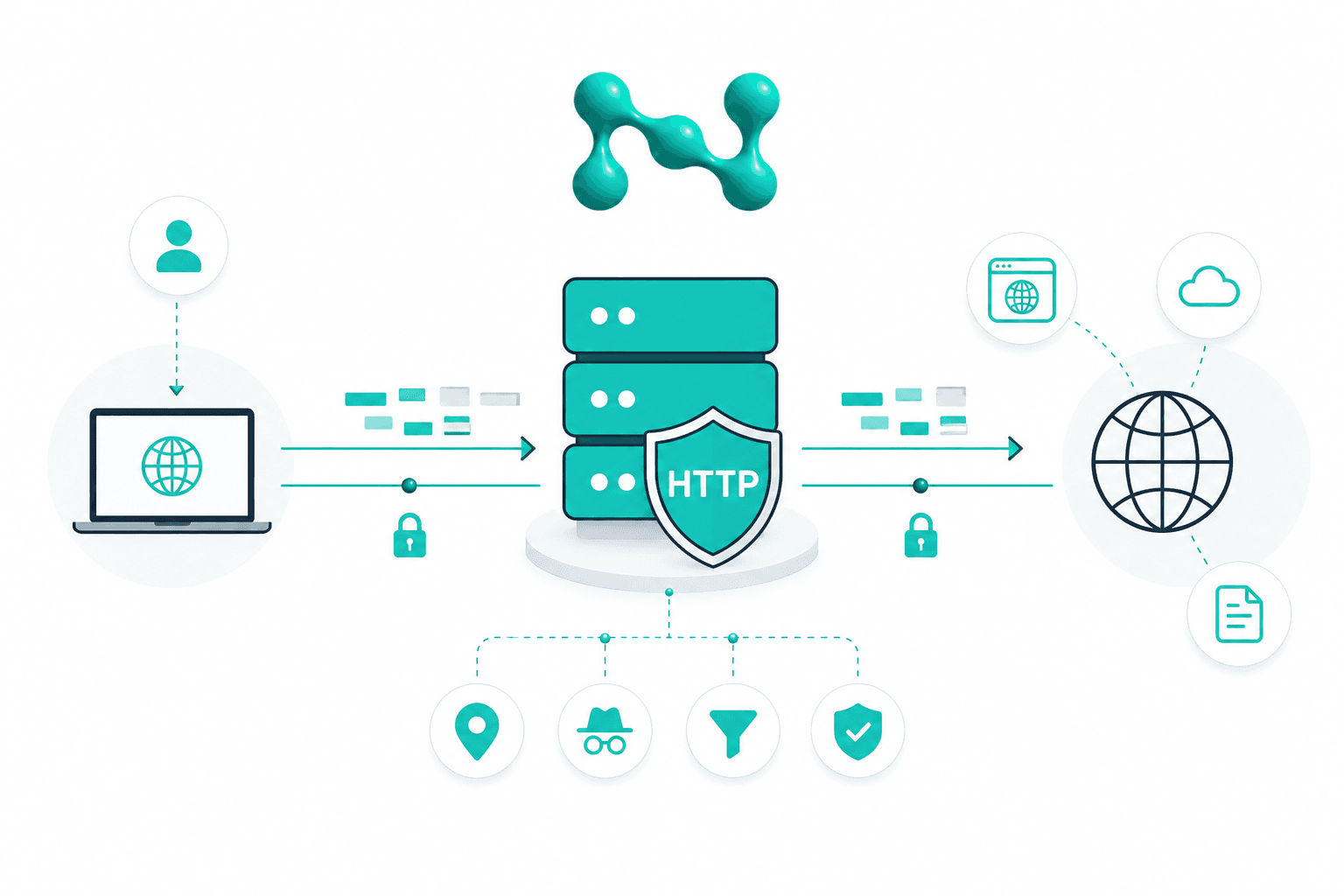
What an HTTP Proxy Is
At its core, an HTTP proxy is an intermediary server between the client side and the web server. When a user opens a website, the request may go not directly to the resource, but first to the proxy. It analyzes the request, applies the configured policies, and then either forwards the request further or stops it.
As a result, the proxy becomes a point where web exchange can be centrally managed. It is convenient to use it to introduce restrictions, apply security rules, speed up the delivery of recurring content, and reduce the load on the main servers.
How a Request Passes Through an HTTP Proxy
The operation of an HTTP proxy follows a fairly clear pattern:
First, the browser or application forms a request to a website or web service. This request is sent to the proxy server. Then the proxy checks the destination address, headers, parameters, and other elements of the request. If the request complies with the established rules, it is sent to the target server. After that, the server returns a response, which again reaches the proxy. At this stage, the proxy may pass the data on unchanged, deliver a stored copy from the cache, compress the response, or perform other предусмотренная processing.
The point of this architecture is not simply to add another intermediate stage, but to gain control over web traffic at a separate point.
What Tasks an HTTP Proxy Solves
Handling Only Web Traffic
An HTTP proxy is designed to work with requests related to websites and web applications. It is a specialized tool that does not replace full-fledged network gateways for all types of protocols. That is why it is most often used where access to websites, APIs, and browser-based services needs to be managed.
Looking for HTTP proxies?
Get premium residential HTTP and SOCKS5 proxies with top-tier performance and reliability.
Request Filtering
One of its key functions is checking and processing requests before they reach the target server. The proxy can block certain addresses, prohibit unwanted file types, restrict specific categories of resources, and apply rules to the contents of the request.
Content Caching
If the same resource is requested regularly, the proxy can store a copy of it and deliver it again without contacting the source server. This reduces response time and helps lower the load on external resources.
Data Compression and Optimization
In some scenarios, the proxy reduces the amount of transmitted information or decreases the number of unnecessary requests. This approach makes it possible to save network resources and maintain more stable operation of web services.
Centralized Rule Enforcement
Instead of configuring restrictions on each device separately, a company or organization can use a proxy as a single access management mechanism. This is convenient in environments where uniform rules for internet use are important for all users on the network.
Why HTTP Proxies Are Used in Practice
An HTTP proxy is in demand not because it simply forwards requests, but because it makes it possible to influence how they pass through the system.
Control of Internet Requests
In corporate and educational networks, a proxy is often used to manage access to web resources. It makes it possible to restrict visits to certain websites, define rules for using external services, and centrally control outgoing traffic.
Faster Access to Repeating Content
When users access the same pages or objects, caching through a proxy reduces loading time and decreases the number of repeated requests to external servers.
Reduced Infrastructure Load
On the server side, a proxy can take on part of the incoming requests, filter out unnecessary traffic, and distribute requests among internal nodes. This is especially important in high-load systems.
An Additional Layer of Protection
A proxy often acts as an intermediate protective layer. Through it, suspicious requests can be blocked, access to unwanted resources can be restricted, and direct contact between clients and internal system components can be prevented.
What Types of HTTP Proxies Exist
Forward Proxy
A forward proxy operates on the client side. It receives outgoing requests from a user or application and forwards them to the external internet. This option is used where outgoing web traffic needs to be managed and where filtering and caching are required.
Reverse Proxy
A reverse proxy is located in front of web servers and receives incoming requests from users. Its main role is to serve the server side: distribute the load, hide the internal structure of the infrastructure, filter requests, and improve the resilience of services.
Transparent Proxy
A transparent proxy is built into the routing scheme in such a way that the user may not notice its presence at all. Such solutions are often used within organizations to control traffic and enforce network policies without manually configuring each client.
How a Forward Proxy Differs from a Reverse Proxy
These concepts are often confused, although they relate to different sides of network interaction.
A forward proxy serves the client. It helps manage requests that go from the user to external web resources. A reverse proxy serves the server side. It receives incoming traffic and then decides on its own which internal server to send the request to and how to process it.
Strengths of an HTTP Proxy
The main advantage of an HTTP proxy is that it moves web traffic processing into a separate managed layer. This provides several practical effects at once.
A proxy makes it possible to centrally apply access rules, speed up operation through caching, restrict unwanted requests, reduce server load, and improve the resilience of web services. If a reverse proxy is being used, these capabilities are supplemented by load distribution across multiple internal nodes.
What Limitations Need to Be Considered
An HTTP proxy has not only advantages, but also objective limitations.
First, it is a specialized tool for web traffic, not a universal solution for all network tasks.
Second, the additional processing stage can increase latency. If the proxy is overloaded, configured incorrectly, or poorly placed in terms of the network route, access speed to websites may decrease.
Third, configuration errors can lead to incorrect behavior of individual resources, especially if the proxy actively interferes with headers, routing rules, or request processing.
It should also be taken into account that low-quality proxy infrastructure can itself become a source of instability, timeouts, and an increased number of errors.
Where HTTP Proxies Are Used Most Often
In Corporate Networks
This is one of the most common scenarios. Through a proxy, it is convenient to establish uniform internet access rules for employees, restrict unwanted resources, monitor requests, and reduce risks when working with external websites.
In Content Delivery Systems
The caching mechanism characteristic of proxies is actively used in content delivery infrastructure. The essence of the approach is to provide users with data from the nearest or already prepared point, rather than contacting the source server every time.
In Web Application Protection
Many security solutions operate according to reverse proxy logic. They receive HTTP requests, analyze them before passing them to the application, and filter out unwanted requests at an early stage.
In Load Balancing
When a web service runs on multiple servers, a reverse proxy can distribute incoming requests among them. This helps withstand growing load and makes the system more resilient to failures.
In Administrative and Educational Networks
Transparent proxies are often used where web traffic needs to be centrally restricted or directed without separate manual configuration on each user device.
What Problems Arise Most Often
When working with an HTTP proxy, the same difficulties are usually encountered:
- server overload and timeouts;
- authorization errors;
- speed degradation;
- incorrect address or port;
- incorrect request routing;
- problems when processing secure connections;
- blocking of individual websites or unstable access to them.
As a rule, the cause turns out to be either an incorrect configuration, poor quality of the proxy infrastructure itself, or overly strict filtering rules.
When the Use of an HTTP Proxy Is Justified
An HTTP proxy is needed when web traffic must not simply be transmitted, but controlled. If the task involves request filtering, caching, load distribution, access segmentation, or protection of server infrastructure, a proxy becomes a useful and logical architectural element.
If the task goes beyond web interaction and affects other types of traffic, an HTTP proxy alone is no longer sufficient. In that case, the solution should be chosen based on the specific protocols, load model, and infrastructure requirements.
Conclusion
An HTTP proxy is a web request management tool, not just an intermediary server. It makes it possible to inspect and filter requests, cache content, reduce infrastructure load, distribute incoming traffic, and establish uniform rules for working with web resources.
Its practical value is especially noticeable where control, stability, and predictability of request processing are important. When implemented properly, an HTTP proxy becomes an important part of network architecture rather than a secondary technical addition. You can purchase high-quality residential proxies on our website node-proxy.com.