Traffic Arbitrage in Social Media: How Earnings Are Structured, What Skills Are Needed, and What Risks Specialists Face
 ·September 23, 2026·6 min read
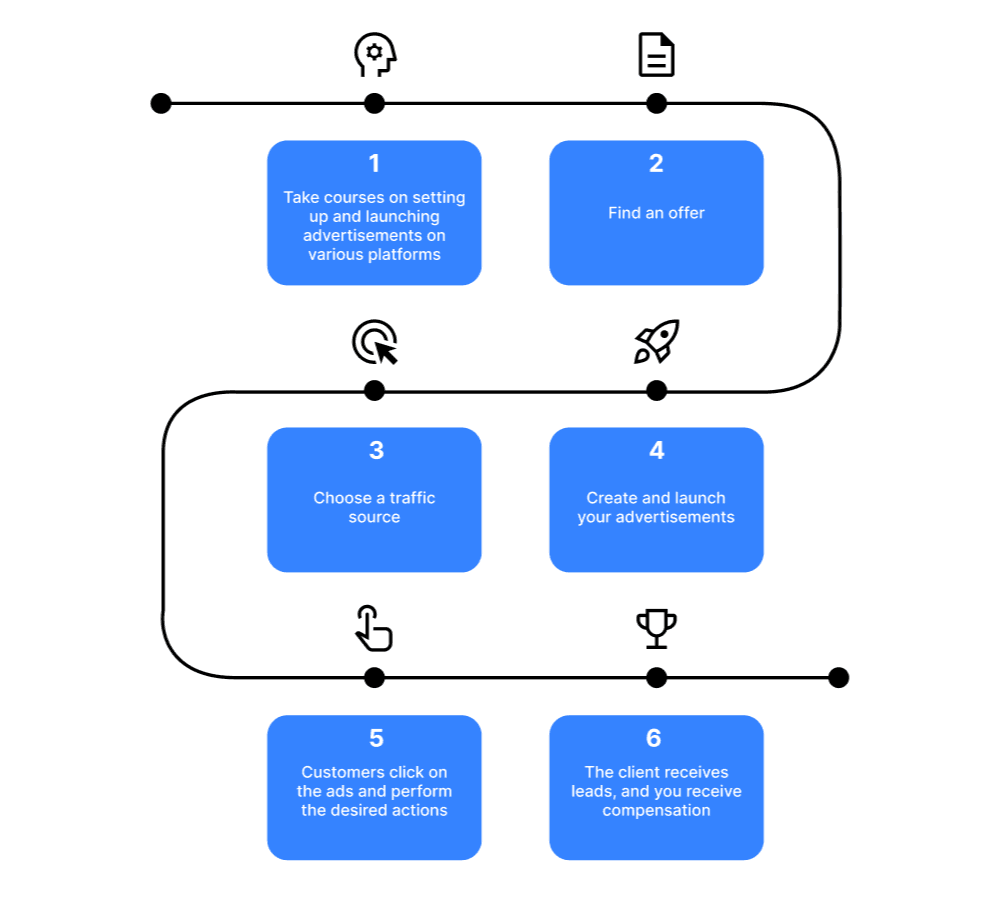
Traffic arbitrage in social media is a promotion model in which a specialist independently buys or attracts traffic, directs it to an offer, and earns money from users’ target actions. Their income is formed not from a fixed payment for the work, but from the difference between the costs of attracting an audience and the payout from the advertiser or affiliate network.
In essence, an arbitrage specialist acts as an independent media buyer. They look for a traffic source, select an offer, test advertising bundles, analyze audience behavior, and scale working campaigns. If the bundle turns out to be profitable, they earn money. If not, the costs fall on them personally.
How traffic arbitrage works
The working model is built around three participants: the advertiser, the arbitrage specialist, and the affiliate platform, if it is used as an intermediary. The advertiser is interested in sales, leads, or other user actions. The arbitrage specialist delivers that result at their own expense. The affiliate network helps find offers, gain access to statistics, and build interaction between the parties.
The mechanics look simple only at first glance. The specialist chooses an offer, studies the requirements, defines the target audience, prepares advertising materials, and launches traffic. Then they track how much money was spent on advertising, how many users completed the required action, and whether the costs are paying off.
For example, if the payout for one lead is $40, and a $300 advertising campaign brought in 15 customers, the total revenue will be $600. After deducting expenses, the net profit will be $300. But the same model can also work in the opposite direction: with poor ad setup or a weak offer, the expenses will not pay off.
How an arbitrage specialist differs from a marketer
Traffic arbitrage is often compared with the work of a marketer or a targeting specialist, because online promotion lies at the core in all cases. However, the operating principle here is different.
A marketer usually works within the tasks of a company or client, uses an allocated budget, and receives fixed compensation. An arbitrage specialist, by contrast, works for results and risks their own funds. They are not limited to one client, but they also do not have a stable income. They are personally responsible for choosing traffic sources, testing hypotheses, and the final profitability of campaigns.
That is why independence, discipline, and the ability to make quick decisions based on numbers rather than assumptions are especially important in arbitrage.
More IP Choices
Datacenter IPv4 and residential proxies available with Node Proxy.
What skills are necessary for the job
Arbitrage cannot be reduced to simply launching ads. It is practical work at the intersection of marketing, analytics, and advertising campaign management.
A specialist needs a basic knowledge of marketing: an understanding of the target audience, funnel principles, offer logic, and the factors that affect conversion. It is equally important to be able to work with advertising platforms and test ads, audiences, creatives, and landing pages.
In addition, the following are useful in arbitrage:
Understanding traffic sources
It is necessary to understand where users can be attracted from, how paid and conditionally free channels differ, how audiences behave across different sources, and what restrictions apply on specific platforms.
Analytical skills
Without numerical analysis, arbitrage quickly turns into chaotic spending. A specialist must track cost per click, cost per lead, conversion rate, return on investment, and understand which elements of the bundle influence the result.
Knowledge of the specifics of social networks
Each platform has its own audience, its own ad formats, and its own moderation rules. What passes on one platform may be rejected on another. That is why universal solutions are almost never available here.
Ability to test
A working bundle is rarely found on the first attempt. Profit usually appears after a series of checks: creatives, wording, audience segments, presentation approaches, and the offers themselves are changed.
What types of traffic exist
Arbitrage works not only in social media, although that is often the main source of users. Depending on the channel, several types of traffic can be distinguished.
Direct traffic appears when a user enters a website address manually. Organic traffic comes from search engines. Referral traffic is formed through transitions from other websites, applications, and partner platforms. Paid traffic is generated through advertising campaigns. Traffic from social networks is distinguished separately, where users come through posts, ads, recommendations, and other mechanisms within platforms. There is also traffic with an undefined source, when the analytics system cannot accurately determine its origin.
For an arbitrage specialist, it is important not only to understand the classification, but also to assess the quality of each source. The same volume of traffic can produce completely different conversion rates depending on the platform, the presentation format, and the audience.
What earnings are based on
Income in arbitrage is not fixed. It depends on several factors at once: the quality of the offer, the accuracy of ad setup, the cost of traffic, the level of competition, the conversion rate of the landing page, and the specialist’s ability to turn off ineffective campaigns in time.
Theoretically, the earning range is almost unlimited, but in practice the result is directly related to experience. One arbitrage specialist may reach profitability on the first tests, while another may spend the budget and fail to recoup the investment. The reason is usually not the model itself, but the quality of preparation, understanding of the audience, and the ability to work with analytics.
It is also important that profit here is rarely linear. Even successful campaigns burn out over time: the audience gets tired of the creatives, advertising costs increase, and platform rules change. Therefore, earnings in arbitrage are constant work involving the updating of bundles and the search for new working solutions.
Main risks and limitations
Arbitrage is often perceived as a way to quickly reach a high income, but in practice it is work with a high level of uncertainty.
One of the main risks is the lack of guarantees. The specialist invests their own money and cannot know in advance with certainty whether a test will pay off. Even with a good offer, a bundle may fail because of a weak creative, an audience error, or poor launch timing.
The second problem is dependence on the advertiser’s or affiliate program’s terms. An offer may have strict requirements regarding traffic sources, presentation, geography, ad format, and acceptable promotion methods. If these rules are violated, the traffic may not be counted.
The third risk area is the quality of lead tracking. Sometimes disputes arise over how targeted the delivered traffic was and whether it is subject to payment. Therefore, before launching, it is important to check the reputation of the affiliate network, the terms of the offer, and the payout logic.
A separate practical issue is related to the working infrastructure. When managing several advertising accounts and profiles, specialists try to separate working environments so as not to mix data, sessions, and technical parameters. In such tasks, proxies may be used when it is necessary to distribute the connection across different accounts and reduce the risk of technical conflicts. However, this tool does not replace compliance with platform rules: the key factors remain proper workflow organization, careful campaign setup, and compliance with the requirements of a specific platform.
There is also a reputational factor on the business side. A company that works with arbitrage traffic does not always fully control where and how exactly its offer is promoted. If the advertisement appears in an inappropriate context, this can negatively affect brand perception.
Why arbitrage requires continuous learning
In this field, it is not enough to study the basics once and work for years according to one model. Advertising accounts, ad formats, moderation rules, audience behavior, and traffic costs change. Working approaches become outdated quickly.
That is why growth in arbitrage is usually built on constant practice. Theory provides the foundation, but real understanding comes only through tests, error analysis, and working with numbers. Training can take different forms: self-study, courses on individual tools, or comprehensive programs covering advertising, analytics, and the logic of building bundles. The most sustainable result is usually produced by a combination of theory and regular practice.
Why proxies are needed in traffic work
Working with multiple advertising accounts, traffic sources, and different promotion regions almost always runs into the technical limitations of platforms. One of the basic tools that helps build such work in a stable way is proxies.
The role of proxies in launch infrastructure
When all activity comes from one IP address, advertising systems and related services detect unnatural load more quickly: multiple logins, account creation, and frequent actions from a single connection point. As a result, the risk of restrictions increases: problems may arise with authorization, ad launching, registration of new profiles, and further work with them.
Proxies solve this issue at the infrastructure level. They make it possible to separate connections across accounts, sources, and work processes. This reduces the likelihood that different actions will be perceived by the platform as suspicious activity originating from a single address.
Why limitations arise without proxies
If you work without proxies, other limitations quickly appear as well.
First, it becomes difficult to scale processes. One IP address is suitable for a limited number of actions, and as the volume of work grows, it begins to create additional risks for the entire bundle of accounts.
Second, the choice of platforms and promotion scenarios is reduced. Many advertising systems take the connection region into account. If the actual location does not match the target market, this may interfere with campaign setup, moderation approval, or full-fledged work in the required geo.
Third, manageability suffers. When the entire infrastructure is tied to a single connection, any problem affects several processes at once. In more complex work, this creates unnecessary dependence and makes it harder to maintain a stable setup.
Why choosing the type of proxy matters
For ongoing work, paid solutions are usually chosen, primarily dedicated residential proxies. They are used not because of formal status, but because of practical advantages: such addresses raise fewer questions from platforms, are better suited for long-term work, and provide more control over connection quality.
The key point here is predictability. If proxies are used as part of the working infrastructure, they must ensure a stable connection, acceptable speed, and a minimal number of technical failures. That is why saving money on this element often leads to greater losses in terms of accounts, launches, and team time.
Why free proxies are not suitable
Free and shared proxies look like a way to reduce costs, but in practice they more often create additional problems.
Being blacklisted
Many free addresses are already known to advertising platforms and services. If an IP has long been used by a large number of people, the probability that it appears on various restriction lists is noticeably higher. This reduces the chances of normal registration, login, and the launch of advertising activity.
Unstable speed
Shared proxies are often overloaded. When different people use the same address at the same time, the connection becomes slow and unpredictable. For day-to-day work, this means delays, interface failures, problems loading accounts, and unnecessary time losses.
Insufficient reliability
Free solutions usually lag behind in service quality and overall level of control. This affects both connection stability and the security of work processes. For tasks where predictability and careful access organization matter, such an option is rarely justified.
What conclusion follows from this
Proxies in traffic work are not an additional option, but a technical foundation for stable launch, scaling, and work with different regions. They help distribute activity, reduce the load on a single IP address, and build a more resilient infrastructure for advertising tasks.
At the same time, it is not the mere fact of using proxies that matters, but their quality. Free solutions more often create new limitations than remove old ones. Therefore, in working scenarios, paid dedicated proxies designed for постоянная load and predictable performance are usually chosen. It is this approach that makes it possible to reduce the number of technical problems and avoid putting accounts and advertising processes at risk.
You can buy high-quality residential and datacenter proxies on our website, node-proxy.com.
Conclusion
Traffic arbitrage in social media is not a ready-made scheme for quick earnings, but an applied model of digital promotion in which income depends on the quality of decisions and the accuracy of calculations. The specialist independently looks for working bundles, invests money in advertising, analyzes the result, and earns only if the attracted traffic delivers the required actions.
Entry into this field is possible without extensive experience, but it is not worth expecting stable results without training and practice. At the start, scale is less important than understanding the processes: how offers are structured, how profit is calculated, how hypotheses are tested, and why the same ad can produce different results on different platforms. This is what distinguishes systematic work from random attempts to make money from traffic.