SEO Proxies in Search Analytics: Where They Are Useful and How to Use Them
 ·September 19, 2026·6 min read
Search engine optimization has long ceased to be a separate marketing task and has become part of the ongoing technical work on a website. To understand why some pages receive search traffic while others lose positions, specialists have to regularly collect and compare large volumes of data: site structure, meta tags, search results, regional differences in results, technical errors, and the page parameters of competitors.
As long as the scope of work is small, some of these tasks can be handled manually. But when working with large projects, multi-regional promotion, and continuous monitoring, the manual approach quickly stops being practical. For this, SEO tools, parsers, crawlers, and automation systems are used. And along with them — SEO proxies.
What SEO Proxies Are
SEO proxies are proxy servers used in search analytics and automated data collection tasks. They are needed where an SEO specialist or service has to perform a large number of requests to search engines, competitor websites, their own projects, or third-party web resources.
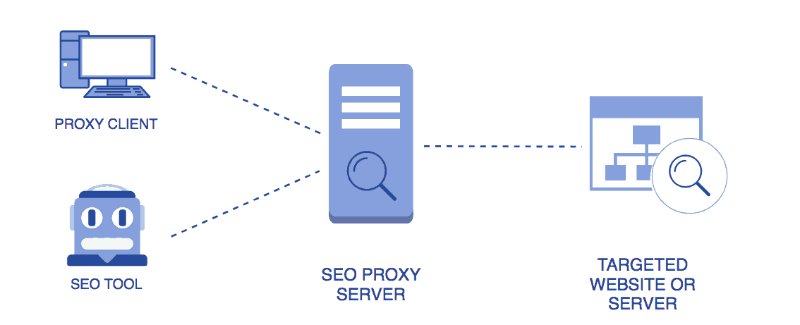
In essence, such proxies act as an intermediary between the data collection tool and the target website. This makes it possible to distribute requests, scale parsing, run several processing threads simultaneously, and reduce the risk of process interruptions due to limitations on the resource side.
SEO proxies are usually used together with desktop utilities, cloud platforms, custom scripts, and parsers. They are especially in demand in projects that require regular technical audits, search results analysis, and data comparison across different regions.
More IP Choices
Datacenter IPv4 and residential proxies available with Node Proxy.
Why They Are Needed in SEO
In SEO, not only content and links matter, but also the quality of the technical data on which decisions are based. To collect this data, it is often necessary to crawl thousands of pages, extract markup elements, check indexing, track rankings for queries, and analyze websites from different geographic points.
Without automation, such tasks take too much time. But automation alone does not solve the problem: during intensive data collection, many websites and search engines limit repeated requests, especially if they come from a single IP address. As a result, processes slow down, some data is lost, and some checks have to be restarted.
This is exactly where SEO proxies become a working tool. They help distribute requests, maintain the stability of automated processes, and scale analysis without constant failures when dealing with large volumes of data.
What Tasks SEO Proxies Solve
SEO proxies are not an independent promotion tool. Their value lies in the fact that they support the infrastructure of SEO work and make it possible to perform labor-intensive operations on a large scale.
Website Data Collection
One of the basic tasks is the technical audit of large websites. If a project consists of thousands of pages, manually checking the table of contents, description, headings, status codes, internal links, duplicates, and empty meta tags is almost impossible. A parser goes through the site structure, builds a map of pages, and collects the necessary parameters automatically.
If the website limits intensive requests, proxies make it possible to perform such a check faster and more consistently by distributing the load across different addresses.
Search Results Analysis
SEO proxies are often used to collect data from SERPs (Search Engine Results Pages): tracking rankings, analyzing competitors, checking snippets, and studying how often certain pages appear for key queries. This is especially important in regular monitoring, when data needs to be collected not once, but on a schedule.
Competitor Research
To assess the strengths and weaknesses of competitors, it is necessary to analyze the structure of their pages, their set of key queries, meta tags, internal linking, technical errors, loading speed, content patterns, and other parameters. If there are many such websites, automated data collection is indispensable.
Checking Local Search Results
Search results differ depending on the region, and sometimes even the city. For a business that is promoted in several markets, this is critical. Proxies help view search results the way a user from the required location sees them and compare differences in rankings, snippets, and the composition of competitors.

Parallel Task Execution
When data needs to be collected simultaneously for several projects, segments, or regions, proxies make it possible to parallelize processes. The same tool, or several tools, can work in parallel without being limited by a single IP.
What Advantages SEO Proxies Provide
The main advantage is the ability to support large SEO processes where, without request distribution, they become too slow or unstable. But in practice, there are more useful effects.
First, proxies make automation scalable. A specialist can collect data faster, check more pages, and update analytics more frequently.
Second, they help work more accurately with local search. For projects with regional promotion, this is no less important than for international websites.
Third, proxies simplify integration with SEO software. Many modern services allow proxies to be connected through a port, an API, or a preconfigured filter without changing the logic of the workflows themselves.
Fourth, they help reduce time lost to failures, repeated checks, and manual restarts of tasks.
Finally, the use of proxies increases the manageability of the entire data collection system: it becomes easier to track traffic, distribute tasks between tools, and understand which processes actually consume more resources.
Which Proxies Are Most Often Used in SEO
For SEO tasks, two parameters are especially important: resistance to limitations on the part of websites and the accuracy of geographic targeting. That is why rotating proxies are more often chosen for complex scenarios.
In practice, several types of solutions are usually considered for SEO.
- Residential proxies are suitable for tasks where resilience and flexibility in locations are important. They are more often used in search results collection and local market analysis (such proxies can be purchased on our website node-proxy.com).
- Mobile proxies are also used in tasks where high resilience and address rotation are required, although their use depends on the specific tool and budget.
- Datacenter proxies are usually faster, but in a number of scenarios they are easier to restrict, especially when it comes to regular parsing of search engines.
From the protocol perspective, HTTP/HTTPS proxies are the most common. In some cases, SOCKS is used if required by specific software or the traffic transmission scheme.
Why Accurate Geolocation Matters for SEO
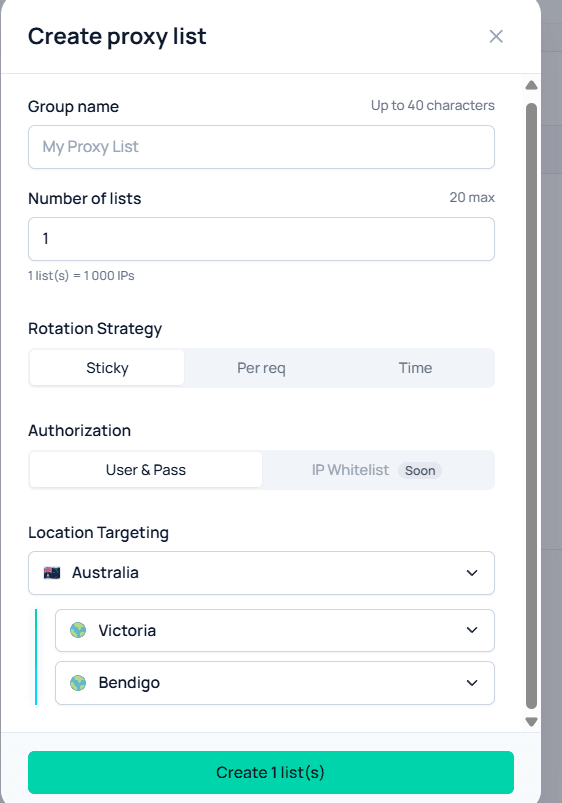
Modern search results are increasingly dependent on the user’s location. This is especially noticeable for commercial queries, local services, regional websites, and multilingual projects. The same query may show a different set of results, different blocks, and different leading pages depending on the city or country.
Therefore, in SEO it is important not just to choose a proxy in the required country, but, whenever possible, to work with more precise targeting. The closer the testing conditions are to the real user scenario, the more useful the data obtained will be.
This applies not only to SERP analysis, but also to website testing: how pages are displayed in the local market, which content versions are available, how CDNs work, and how quickly the site loads from a specific region.
How SEO Proxies Are Integrated Into the Workflow
Proxy connection depends on which tool is used. In older programs, the work is usually built around lists of IP addresses: they are imported, checked, sorted, and rotated within the application itself.
Modern services more often work differently. Instead of long lists, a single connection point is used — a proxy port, proxy endpoint, or back-connect server. For the SEO tool, this is one stable address, while the logic of IP selection, geotargeting, and rotation is configured in the provider’s panel.
Usually, the following are required for connection:
• proxy address or connection filter;
• port;
• login and password;
• in some cases, a whitelist of the device’s IP addresses if the software does not support authorization.
This approach is convenient because the integration only needs to be done once, while further configuration of rotation and working conditions is managed centrally.
Best Practices for Using SEO Proxies
Even a large proxy network does not guarantee stable operation by itself. The result depends on how carefully the data collection process itself is built.
Requests should not follow an overly predictable pattern. If a parser sends them at identical intervals and at the same pace, this looks like automated activity and leads to restrictions more quickly.
One address should not be overloaded with too many requests. It is better to configure the rotation logic so that the load is distributed evenly.
It is important to control HTTP headers, especially the user-agent. Websites often use them to determine the client type and identify typical parsing scenarios.
For dynamic websites, a headless browser is often required. If content is loaded through JavaScript, ordinary HTML parsing may be insufficient.
Server errors, logs, and the causes of failures need to be monitored. They show exactly where the process is working inefficiently: in proxy rotation, thread configuration, headers, or the tool itself.
If a website or service provides an official API, it is better to use it. This is usually more reliable than direct data collection from pages.
Even well-configured SEO proxies cannot guarantee uninterrupted data collection. We cover the most common scraping errors and how to build a more reliable process in this article.
Free and Paid SEO Proxies
Free proxies are sometimes used for simple tests or low-load tasks. Their advantage is obvious: they require no initial costs. But such a solution almost always has limitations — instability, low speed, overload, short address lifespans, and weak quality.
For regular SEO work, especially when large volumes of data are involved, paid solutions are usually used. They provide higher stability, are better suited for automation, allow more accurate geography and rotation settings, and also offer tools for traffic monitoring and cost control.
If proxies are involved in ongoing processes — technical audits, search results checks, rank monitoring, competitor analysis — reliability and manageability prove more important than saving money at the start.
What to Look at When Choosing SEO Proxies
The choice depends not on an abstract service rating, but on the tasks you are solving. For one project, a wide choice of cities is more important; for another, rotation for each request; for a third, convenient integration through an API.
The main things to evaluate are:
• the quality and stability of the address pool;
• the depth of geotargeting;
• rotation support;
• compatibility with your software;
• the authorization method;
• the availability of statistics and traffic usage control;
• the convenience of configuring proxy ports or filters;
• support for parallel work scenarios.
If the project involves a large volume of parsing, it is useful to understand in advance how monitoring will be organized: which tasks consume traffic, which tools create the greatest load, and where errors appear.
Conclusion
SEO proxies are an infrastructure tool for tasks where search analytics requires automation, scale, and precise control over data collection conditions. They help perform technical audits of large websites, analyze competitors, check local search results, track rankings, and run parallel processes without constant failures.
Their role is not to replace SEO strategy, but to make its technical implementation possible at the required level of quality. The greater the volume of data, the higher the frequency of checks, and the wider the geography of promotion, the more noticeable the importance of properly selected and correctly configured SEO proxies becomes.