Proxy Firewall: How Protection Works at the Application Layer
 ·September 24, 2026·5 min read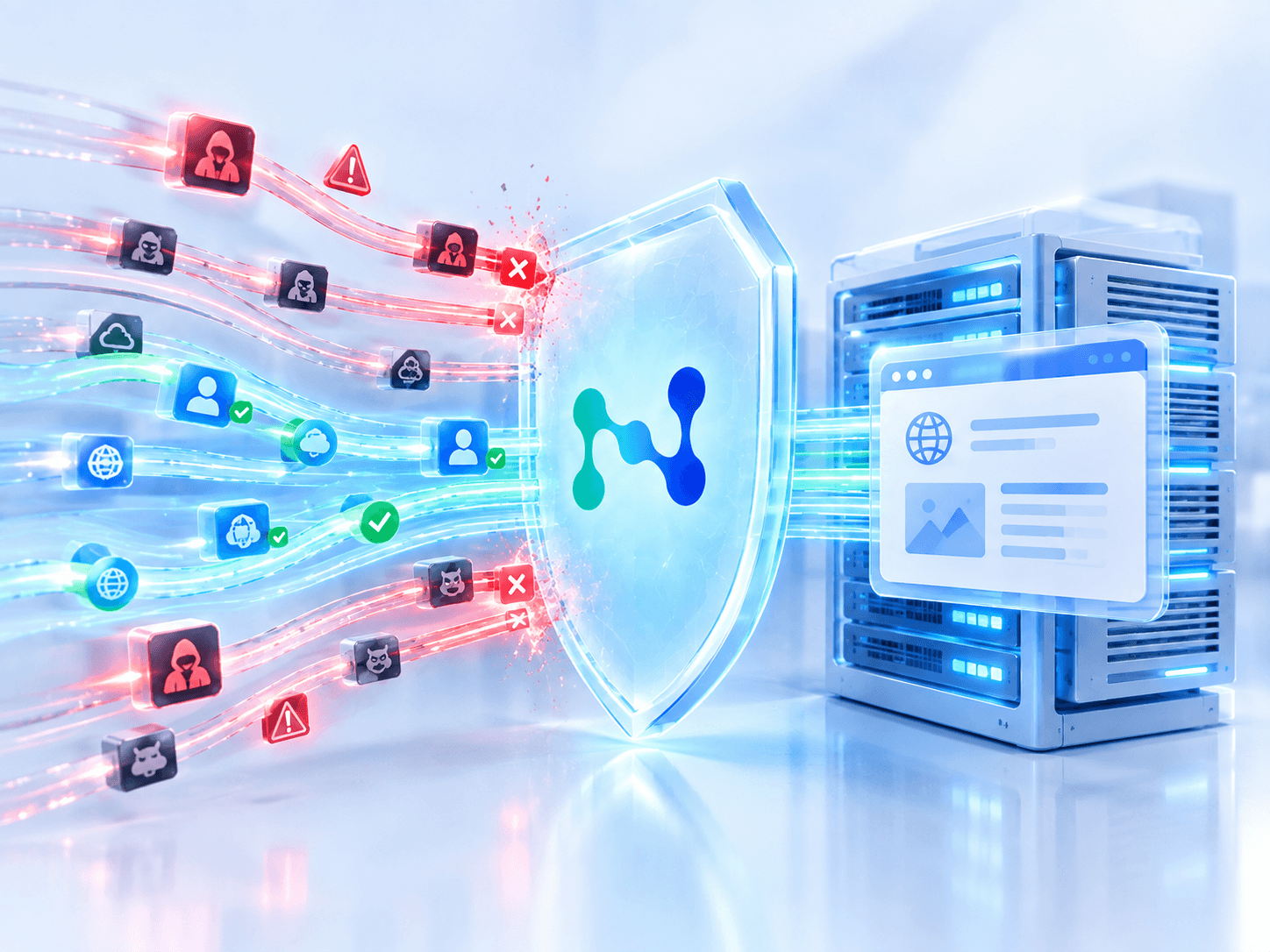
A proxy firewall is a firewall that does not merely allow or block traffic based on formal attributes, but inspects its content at the application layer. It functions as an intermediary between the internal network and external resources: it receives a request, analyzes it, checks it against security policies, and only then passes it on. This approach provides a higher level of control than traditional packet filtering and helps identify threats that a conventional firewall may miss.
What a Proxy Firewall Is
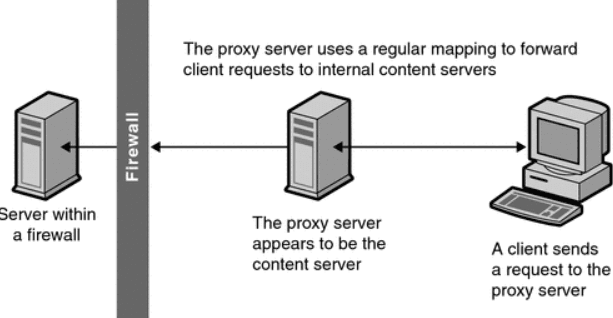
In a traditional model, a client machine establishes a connection with an external resource directly, while the firewall only checks whether such an exchange is permitted based on the address, port, or session state. A proxy firewall is structured differently. It terminates the connection itself, acts as an intermediary, and then interacts with the external server on its own behalf.
As a result, it is able to analyze not only network parameters but also the application traffic itself. For an organization, this means more precise inspection of HTTP, FTP, SMTP, DNS, and other protocols, as well as centralized enforcement of uniform access and filtering rules.
In essence, a proxy firewall is an application-layer gateway through which controlled data exchange between the internal network and the external environment takes place.
How It Works
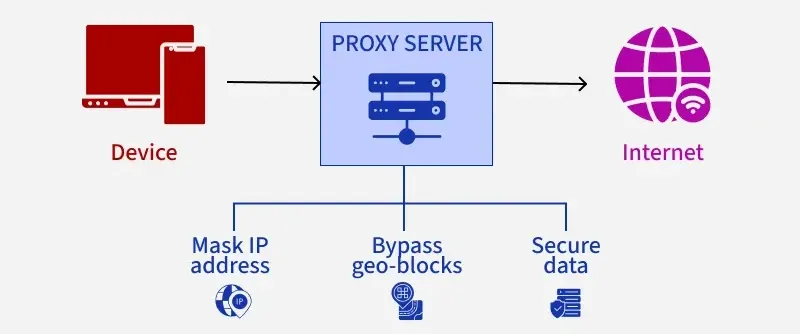
A proxy firewall operates according to a sequential model. A user request is first sent not to the external service, but to the proxy node. After that, the system performs several stages of verification.
First, the request itself is analyzed: its structure, content, compliance with permitted scenarios, and adherence to corporate rules. If the request does not violate the security policy, the proxy creates a separate connection to the external server and forwards the data. The response from the external resource is also returned not directly to the user, but again passes through the proxy, where it may be additionally inspected, filtered, or stored in the cache.
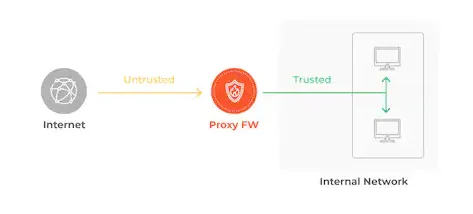
This architecture produces an important effect: the internal network does not interact directly with external systems. All exchange passes through a controlled point where content inspection, antivirus mechanisms, access rules, and logging can be applied.
Datacenter IPv4 and Real Residential IPs
Two solutions for different connection scenarios.
What Tasks a Proxy Firewall Solves
The main value of a proxy firewall lies in the fact that it combines protection, control, and traffic management at a single point. In practice, this makes it possible to solve several tasks at once.
Deep Traffic Inspection
Unlike solutions that rely only on addresses, ports, and connection state, a proxy firewall inspects the content of packets and application messages. This increases the chances of detecting malicious code, suspicious attachments, unusual commands, and other dangerous elements hidden inside traffic that appears ordinary at first glance.
Content Filtering and Access Rules
A proxy firewall makes it possible to block requests to undesirable resources, restrict the download of certain file types, define separate policies for departments, and apply uniform requirements across the entire organization. This approach is especially useful where it is important to standardize access to external services and reduce the risk of user-side errors.
Centralized Control
All requests and responses pass through a single processing point. This simplifies auditing, incident investigation, and monitoring compliance with internal rules. The administrator gets a complete picture of network activity rather than fragmented data from different infrastructure segments.
Caching and Load Reduction
Many proxy firewalls support caching of frequently requested pages and files. If the same content is regularly used by several employees, the system can serve it from the local cache instead of requesting it again from outside. This reduces bandwidth consumption and speeds up access to repeatedly used resources.
How a Proxy Firewall Differs from a Traditional Firewall
A conventional firewall usually operates faster and is simpler to deploy because its tasks are limited to basic traffic filtering. It checks addresses, ports, connection direction, session state, and other network parameters. This is sufficient for many standard scenarios in which performance and basic access control remain the priority.
A proxy firewall operates at a deeper level. It processes traffic at the application layer, establishes connections itself, evaluates the content of requests and responses, and may also apply additional inspection mechanisms. As a result, it is better suited for infrastructures where it is important not only to restrict access but also to analyze the transmitted content itself.
The difference between the two approaches comes down to the balance between speed and depth of control. A traditional firewall usually performs better in terms of throughput and simplicity, while a proxy firewall performs better in terms of inspection level and flexibility in applying security policies.
Where Such Solutions Are Used
Proxy firewalls are in demand where traffic must not simply be passed through, but controlled in detail. Most often, these are organizations working with sensitive data, distributed infrastructure, or strict internal regulations.
For example, a law firm may use a proxy firewall to inspect uploaded documents and centrally control access to external resources. An online store may use it to filter requests to payment and customer services. A large company with branch offices may use it to unify access and security rules across all offices. In research or corporate environments, such solutions are also used to separate policies by department, application type, and user category.
Advantages of a Proxy Firewall
This approach has a number of strong points that make it востребованным in complex network environments.
First, it provides more thorough traffic inspection. A proxy firewall is capable of seeing what is invisible under ordinary packet filtering because it analyzes the application layer and checks not only connection parameters but also the content of the exchange.
Second, it makes it possible to isolate the internal network from direct interaction with external systems. This reduces risks and simplifies control over how exactly data exchange is organized.
Third, a proxy firewall makes it possible to configure security rules more precisely. Access can be segmented by applications, resource categories, file types, user groups, or departments.
Fourth, centralized logging simplifies auditing and incident investigation. When all activity passes through a single controlled point, it is easier to reconstruct the chain of events and understand where the problem arose.
Finally, when configured properly, a proxy firewall can not only strengthen protection but also optimize network operation through caching of frequently used content.
Limitations and Disadvantages
Despite its advantages, a proxy firewall cannot be considered a universal solution without trade-offs. Deep inspection requires computing resources, so under high load the system may slow down traffic processing.
Additional complexity is associated with the architecture. Since the proxy acts as a central processing point, its failure or misconfiguration can affect the operation of a significant part of the network. In addition, support for some applications and protocols may require separate modules, specialized configuration, or additional exceptions.
There is also an administrative factor. Such a solution is more difficult to implement, maintain, and integrate with other security tools. If the policies are too strict, false positives are possible, when legitimate traffic is blocked. This increases the burden on administrators and requires constant adjustment of rules.
The cost of a proxy firewall is usually higher than that of simpler filtering schemes, since full operation requires high-performance hardware, policy configuration, and regular maintenance.
What Is Important to Consider During Implementation
The effectiveness of a proxy firewall depends not only on the solution itself, but also on how competently it is integrated into the infrastructure. At the implementation stage, it is necessary to determine in advance which protocols and applications will pass through the proxy, where full content inspection is required, and where preserving performance is more important.
It is also necessary to plan redundancy so that the central processing point does not become a single point of failure. Policy configuration is no less important: excessively strict rules create obstacles to operations, while overly soft rules reduce the practical value of the entire system.
In many organizations, a proxy firewall does not replace other security tools but complements them. In such a model, it takes responsibility for controlling application traffic, while other components handle network segmentation, intrusion detection, endpoint protection, and event monitoring.
Conclusion
A proxy firewall is a tool for deep filtering and traffic control at the application layer. It terminates connections itself, inspects requests and responses, applies security policies, keeps logs, and, when necessary, caches frequently used resources. Compared with traditional firewalls, it requires more resources and more complex administration, but in return it provides more detailed control and a higher level of inspection.
Such a solution is especially justified where standard filtering by IP addresses and ports is no longer sufficient. If content control, uniform access policies, and centralized management of network exchange are critical for an organization, a proxy firewall becomes an important part of the security architecture. You can buy residential and datacenter IPv4 proxies on our website.