Proxy Servers: Types, Operating Principles, and Choosing the Right Option for Different Tasks
 ·September 24, 2026·6 min read
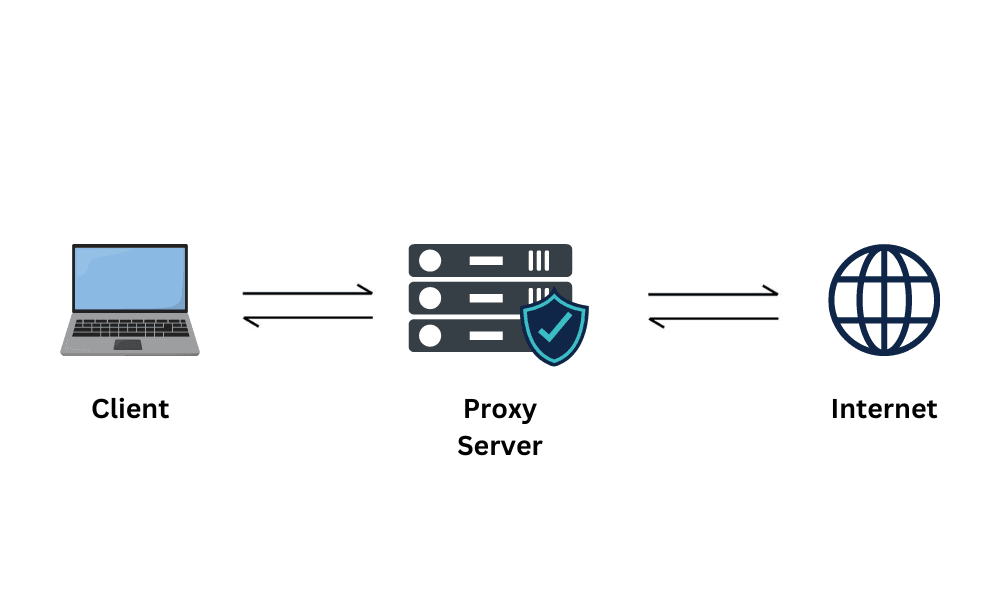
A proxy server is an intermediary node between a user's device and a target website or online service. Instead of sending a request directly to the resource, the request is first sent to the proxy and only then to the required server. The response follows the same path in the opposite direction. This model is used in both user and corporate scenarios: for access control, load distribution, infrastructure protection, web data operations, and network interaction optimization.
Understanding the differences between proxy types matters not in itself, but because the result depends on it: connection speed, operational stability, application compatibility, level of control, and the likelihood of restrictions from websites. There is no universal solution here. One type is suitable for regular web traffic, another for server infrastructure, a third for tasks where a highly credible IP address is important, and a fourth for large-scale automated work.
How a Proxy Server Works
When a device accesses a website directly, the server sees the source of the request and processes it without intermediaries. When a proxy is used, an additional link appears between the client and the website. It receives the request, forwards it further, gets the response, and returns it to the user.
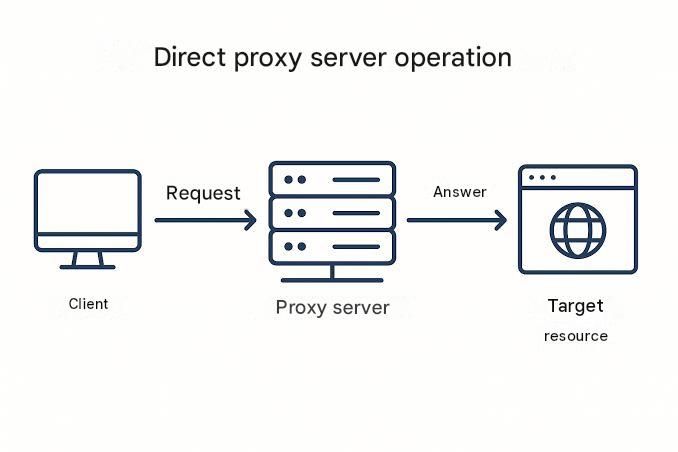
In practice, this provides several capabilities. A proxy can filter traffic, restrict access to specific resources, redistribute requests, cache part of the content, compress data, and serve as a control point between the user and the internet. In a corporate environment, this is convenient for enforcing internal access policies. In server architecture, it is used for protecting web resources and balancing load. In application-level tasks, it is used for working with different IP addresses and distributing network activity.
Manage Accounts Through Residential and Datacenter IPs
Flexible GEO and rotation options for social media workflows.
Main Types of Proxies by Role in the Network
Forward Proxy
A forward proxy operates on the client side. It receives outgoing requests from users and forwards them to the external network. This format is often used within companies, educational institutions, and other organizations where it is necessary to control employees’ or students’ access to internet resources.
A forward proxy is useful where centralized management, traffic filtering, network activity tracking, and restricting access to certain websites are important. This is the basic and most familiar proxy format in user-facing scenarios.
Reverse Proxy
A reverse proxy is placed in front of one or more web servers and operates on the infrastructure side rather than the client side. The user sends a request not directly to the application server, but to the reverse proxy, which decides exactly where to route the traffic next.
This approach is used for three key tasks: improving security, distributing load across servers, and managing incoming traffic. A reverse proxy helps hide the internal structure of the server side, reduce the load on individual nodes, and simplify project scaling. For websites, services, and web applications, this is one of the standard elements of modern architecture.
We wrote about the difference between explicit and transparent proxy types in one of our previous blog articles.
Classification by IP Address Source
Datacenter Proxies
Datacenter proxies are provided by the infrastructure of hosting or specialized providers and are not associated with ordinary home internet connections. Their main advantage is high speed and relatively low cost. They are suitable for tasks that require fast responses, a large number of addresses, and predictable performance.
Their weak point is lower naturalness from the perspective of checks performed by websites. Such IP addresses are more often recognized as belonging to server infrastructure, so in some scenarios the likelihood of restrictions is higher.
Residential Proxies
Residential proxies use IP addresses assigned by internet providers to ordinary users. Because of this, they appear more natural to websites and are usually better suited to tasks where the credibility of the network origin of the request matters. You can purchase such proxies on our website node-proxy.com
That is why they are often chosen for ad display verification, regional testing, data collection from resources sensitive to IP reputation, and other tasks where a regular datacenter address may trigger restrictions. The drawback of this option is predictable: the price is usually higher.
You can buy residential and datacenter proxies on our website.
Mobile Proxies
Mobile proxies are based on IP addresses assigned by mobile operators. Such traffic goes through a mobile network rather than through home internet or a datacenter. This is a separate class of proxies that is in demand in cases where the mobile type of connection itself is important.
The use of mobile proxies is not justified in every scenario: they are more expensive, more difficult to organize, and are not always necessary for typical tasks. But in a number of cases, a mobile IP is exactly the most suitable format of network access.
ISP Proxies
ISP proxies occupy an intermediate position between residential and datacenter solutions. They combine the high speed of server infrastructure with IP addresses associated with internet providers. This format is often chosen as a compromise between performance and stability.
If a datacenter proxy is too noticeable to the target website, and a residential one is too expensive, an ISP solution may prove to be the most balanced option.
Types of Proxies by Protocol
HTTP Proxies
An HTTP proxy is intended for working with regular web traffic. This is the most common format, compatible with most websites and browsers. It is easy to configure and suitable for basic web page use cases.
The limitation of an HTTP proxy is that it is designed specifically for web requests and is not universal for other types of network traffic.
HTTPS Proxies
An HTTPS proxy works on the same principle as HTTP, but with support for a secure connection. This makes it more suitable for interacting with websites where the transmission of sensitive data and secure information exchange are important.
This option is usually chosen for secure work with web resources. The trade-off is a slight decrease in speed compared to simpler schemes due to the additional connection processing.
SOCKS5 Proxies
SOCKS5 is a more flexible protocol that supports different types of traffic, including TCP and UDP. Because of this, it is suitable not only for browsers, but also for applications, games, VoIP services, and other programs that require a non-standard network route.
It is precisely this versatility that makes SOCKS5 a востребованным solution when the same proxy must serve different applications rather than only opening websites in a browser.
SSH Proxies
An SSH proxy is used less often, but remains a useful option in situations where a secure tunnel through an SSH connection is required. This is not a mass-market consumer format, but rather a technical tool for specialists and infrastructure tasks.
Its advantages are a high level of traffic protection and configuration flexibility. Its disadvantages are more complex deployment and a narrower scope of application.
Classification by Access Method
Public Proxies
Public proxies are usually available free of charge and distributed through open lists. Their main advantage is the absence of upfront cost. The advantages almost end there.
Open proxies often operate unstably, fail quickly, are overloaded with users, and may provide neither speed nor a sufficient level of reliability. For continuous operation, business tasks, and any scenarios where stability matters, this option is usually unsuitable.
Shared Proxies
Shared proxies are used by several clients simultaneously. This is a compromise between cost and quality. They are cheaper than dedicated solutions, but the resources and IP address reputation are shared among several users.
This format may be suitable for moderate tasks without high requirements for channel exclusivity and consistent performance.
Private or Dedicated Proxies
A dedicated proxy is provided to a single user. This gives more control, a more predictable load profile, and no competition for resources with other clients. This format is usually chosen where stability, manageability, and clear operating conditions are required.
Rotating Proxies: When They Are Needed
Rotating proxies should be highlighted separately. This is not so much a separate IP source as a way of assigning addresses: the IP can change with every request, at a specified time interval, or with a new session.
Rotation helps distribute the load and reduce the risk of restrictions when there is a large number of similar requests. That is why such solutions are often used in data collection, price monitoring, search results checking, advertising campaign testing, and other automated processes. If a task involves a large number of requests from one direction, rotation often turns out not to be an additional option, but a basic requirement.
What the Use of Proxies Provides
Proxy servers are used not because of the technology itself, but because of the practical effects it provides.
First, it is an additional layer of network control. It becomes possible to centrally manage access to websites, restrict undesirable resources, analyze activity, and set internet usage rules within an organization.
Second, it is traffic optimization. Some proxies can cache content and serve previously requested data again without contacting the website each time from scratch. This reduces channel load and can speed up the opening of heavy pages.
Third, it is more flexible routing. When the proxy is located closer to the target server than the user’s device, latency can be reduced in certain scenarios. This is especially noticeable in distributed network tasks where the geography of the connection affects response speed.
Fourth, it is the ability to use automated processes more safely and steadily if the task is associated with a large number of requests. Websites react negatively to abnormal activity from a single IP, so in this case a proxy helps distribute traffic and avoid overloading a single network source.
How to Choose a Proxy for a Task
The choice of a proxy should begin not with the name of the type, but with the answer to four questions: what traffic will pass through the proxy, how important speed is, whether a natural-looking IP address is needed, and whether a separate channel is required for one user.
For regular work with websites, HTTP or HTTPS proxies are most often sufficient. If traffic does not go only through a browser and support for different applications is needed, it is more logical to look toward SOCKS5.
If the key criterion is speed and price, datacenter proxies are more often chosen. If resistance to restrictions and the natural appearance of the IP address are more important, residential proxies are more often used. When a compromise between these two extremes is needed, it makes sense to consider ISP proxies.
A forward proxy is suitable for corporate filtering and control. A reverse proxy is suitable for web server protection, load distribution, and incoming request management. For large-scale automated work, rotating solutions are appropriate. For continuous and predictable operation, dedicated proxies are preferable to public lists.
Conclusion
A proxy server is not a single tool, but an entire group of solutions with different application logic. Some options are suitable for corporate traffic control, others for server protection, others for working with web data, and still others for tasks where connection geography, IP address type, and scalability are important.
A competent choice begins with understanding the task. If a fast and inexpensive option is needed, datacenter proxies are more often suitable. If natural-looking IPs and high stability are important, it is better to consider residential or ISP solutions. SOCKS5 is convenient for universal application traffic, HTTP and HTTPS for web scenarios, a reverse proxy for server infrastructure, and rotation for mass requests.