Dedicated Proxies: When They Are Truly Needed, How They Differ from Shared Ones, and Which Limitations Matter
 ·September 3, 2026·6 min read
Dedicated proxies are needed in cases where predictable performance, session stability, control over IP reputation, and minimal dependence on the actions of other users matter. That is why such solutions are in demand in automation, website monitoring, testing, working with multiple accounts, and other tasks where failures, blocks, and instability directly affect the result.
Unlike shared proxies, a dedicated proxy is assigned to a single user. This means that only one client operates through a specific IP, and therefore its performance and reputation do not depend on someone else’s activity. This approach costs more, but in a number of scenarios it justifies the expense through greater reliability.
What is a dedicated proxy
A dedicated proxy is a proxy server with an IP address that is provided to one user for exclusive use. All traffic passing through it is routed through that address, and it is not used simultaneously by other clients of the provider.
From a practical standpoint, this provides the main advantage: predictability. If the IP is not shared among dozens or hundreds of users, the risk is reduced that a website will restrict access because of someone else’s spam, aggressive scraping, or other undesirable activity. The user determines exactly how the address is used, and this is precisely what makes dedicated proxies востребованными in sensitive and long sessions.
The terms dedicated proxy and private proxy are often used as synonyms. But on the market, they are not always the same thing. For some providers, private really does mean full exclusivity; for others, it only means restricted access by password or use of the IP by a small group of clients. Therefore, when choosing, it is important to look not at the name of the plan, but at the actual address allocation model.

A Global Residential IP Network
One platform for working with IPs across countries and regions.
How a dedicated proxy works
The operating mechanism here is standard for proxy services: an application, browser, or script sends a request not directly to the target site, but through an intermediate server. The proxy receives the request, forwards it onward, and returns the response back to the user.
The key difference of the dedicated option is not in the routing scheme itself, but in the fact that the IP address through which the traffic passes is assigned to only one client. Because of this, throughout the entire session the requests appear consistent: the site sees a stable traffic source rather than alternating addresses with an unpredictable history.
Two authentication methods are usually used for access. The first is IP whitelisting, when the provider allows connections in advance from the specified user address. The second is login-and-password authorization, which is more convenient for remote work, mobile connections, and distributed teams.
In terms of protocols, HTTP(S) and SOCKS5 are most commonly available. The former is suitable for browser traffic, website monitoring, SEO tasks, and most web automation scenarios. SOCKS5 is more universal: it is convenient where not only web requests but also other network traffic must be proxied.
How dedicated proxies differ from shared ones
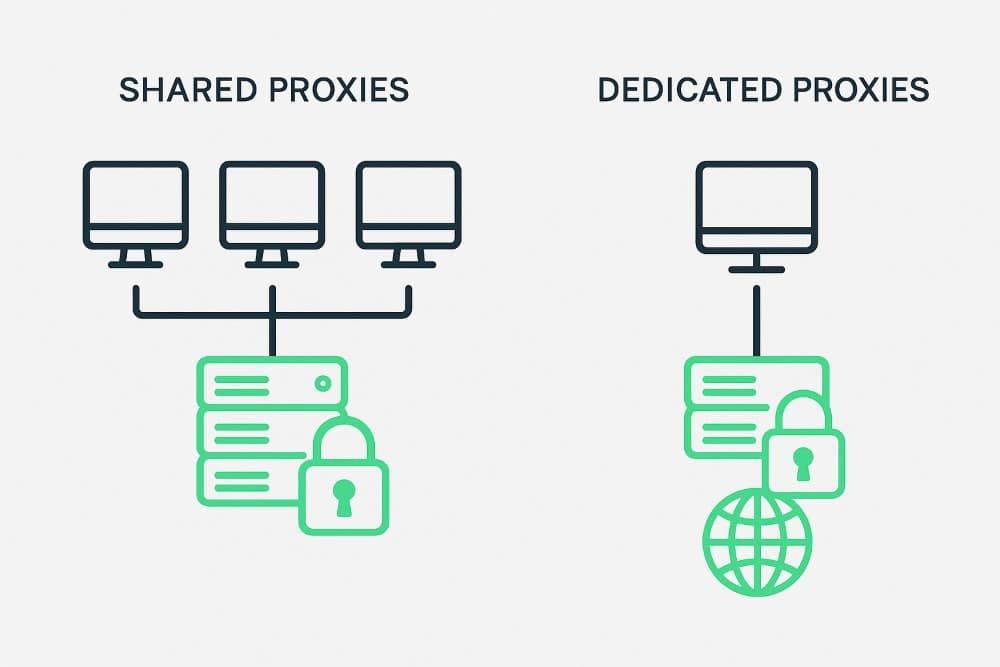
The difference between shared and dedicated proxies comes down not to the connection method, but to the distribution of IP addresses.
Shared proxies are used by multiple clients at the same time. This is cheaper, but it creates the typical “bad neighbor” problem: if someone has already caused a block, restrictions, or a drop in IP reputation, everyone working through the same address faces the consequences. In addition, when resources are shared, speed and stability can fluctuate noticeably.
Dedicated proxies, by contrast, eliminate this dependence. The user gets a separate IP, does not share it with others, and controls how its reputation is formed. As a result, the probability of sudden failures decreases, the number of blocks is reduced, and performance becomes more consistent.
That is why shared proxies are more often suitable for simple and less sensitive tasks, while dedicated ones are better suited for processes where stable access, long sessions, precise routing, and repeatable results matter.
Dedicated and static IP: not the same thing
In practice, two characteristics are often confused: exclusivity and immutability of the address. These are different properties.
- A dedicated IP means that at a specific point in time, the address is used by only one user.
- A static IP means that the address does not change over a long period of time.
The same proxy can be static but not dedicated if it is used by several clients. Conversely, an address can be dedicated but not necessarily intended for long-term constant use without replacement. The best option for long sessions is a static dedicated IP, which is both assigned to one user and not rotated.
This is especially important in tasks where a sudden IP change looks suspicious from the target platform’s perspective: when working with dashboards, accounts, internal panels, services with multi-factor protection, and any tools where a consistent network profile is valued.
Main types of dedicated proxies
Dedicated proxies differ by the origin of their IP addresses and, accordingly, by cost, speed, and resistance to filtering.
Dedicated datacenter proxies
Datacenter proxies provide IPs from server infrastructure rather than from internet service provider networks for home users. Their main advantages are high speed, good bandwidth, and relatively affordable pricing. They are suitable for large-scale technical tasks, batch request processing, monitoring, and other scenarios where performance and scalability come first.
Their weak point is that such addresses are easier to identify as server-based. For ordinary websites, this is not always critical, but on platforms with strict anti-bot systems, datacenter IPs are blocked more quickly than residential ones.
Dedicated residential proxies
Residential proxies use IPs associated with the address space of internet service providers and user connections. As a result, the traffic looks closer to ordinary user behavior, and the probability of immediate filtering is lower.
When it is specifically a dedicated residential proxy, the provider assigns such an address to one client. This is especially useful in tasks where session stability must be combined with a higher level of trust from websites. But this class of proxies comes at a higher cost, and availability by region and number of addresses is usually lower than with datacenter solutions.
Dedicated mobile proxies
Mobile proxies operate through cellular carrier networks. Such IPs are often perceived by platforms as natural for mobile traffic. They are in demand in mobile testing, working with apps, and certain tasks related to platforms that are sensitive to the type of connection.
At the same time, mobile proxies are usually among the most expensive solutions. In addition, they are more difficult to scale and are not always suitable for tasks that require a large pool of addresses.
When dedicated proxies are truly justified
Dedicated proxies are not needed by default. They are chosen when the advantages of an exclusive IP outweigh the higher price.
Account management
If you need to work with multiple accounts, a constant and separate IP for each of them reduces the probability of additional checks, repeated authorizations, and restrictions associated with inconsistent network behavior. This is especially important where the system tracks login stability and connection geography.
Web scraping and monitoring
For regular data collection, price tracking, SERP monitoring, and other automated request scenarios, stable speed and controlled IP reputation matter. If the address is used by only one client, the risk that it has already been damaged by someone else’s activity is noticeably lower. On less sensitive websites, datacenter proxies are suitable for this; on more protected ones, residential proxies are preferable.
Geo-testing and results verification
When you need to see a site, interface, advertising, or local content the way a user in a specific country or city sees it, a dedicated proxy helps provide a more consistent picture without the influence of other users’ requests from the same IP.
Tasks with long sessions
If the workflow requires a long connection without changing the IP, a dedicated proxy with a static address becomes a more reliable option than a shared or rotating one. This applies to management interfaces, personal accounts, internal systems, and other environments where the session must appear continuous.
Advantages of dedicated proxies
The main advantage of dedicated proxies is control. The user does not share the IP with others and does not depend on their behavior. But in practice, the advantages appear on several levels at once.
More stable speed
Since bandwidth is not distributed among multiple clients, the connection usually operates more consistently. This is especially noticeable during long sessions, regular requests, and tasks that are sensitive to performance fluctuations.
Predictable reliability
A dedicated IP does not suffer from someone else’s load. If, on a shared proxy, someone is simultaneously generating intensive traffic, this can affect everyone. In the dedicated model, this problem does not exist.
Control over IP reputation
This is perhaps one of the most important arguments. If the address is used only by you, its history is formed only by your actions. This reduces the risk of encountering an already damaged IP and simplifies diagnostics: if restrictions arise, it is clear what they are connected with.
Better conditions for stable sessions
For processes where it is important that logins occur from the same address, dedicated proxies are significantly better suited than shared and rotating solutions. They provide continuity, which is often critical for platforms with strict security logic.
More convenient integration
Support for standard protocols and typical authentication methods makes such proxies compatible with browsers, bots, parsers, monitoring systems, and specialized applications without complex infrastructure modifications.
Disadvantages and limitations
Despite the obvious advantages, dedicated proxies cannot be considered a universal choice. They have very specific limitations.
Higher price
Exclusivity costs more. If an IP is assigned to only one user, the provider cannot distribute its cost among several clients. That is why dedicated proxies almost always cost noticeably more than shared ones.
Difficulties with scaling
If a project needs dozens, hundreds, or thousands of addresses, especially in one location, the dedicated model quickly becomes expensive and is not always available in the required volume. Shared and rotating solutions scale much more easily.
Smaller selection of addresses and locations
A provider may offer a wide global pool overall, but the number of specifically dedicated IPs in particular countries and cities is often limited. The narrower the geographic requirements, the higher the probability of shortage.
A previous IP history is possible
Even a dedicated address is not necessarily new in the absolute sense. Sometimes a user may receive an IP that has already been used before and has managed to come under restrictions on certain websites.
What to choose: dedicated, shared, or alternative solutions
The choice depends on the nature of the task.
If you need inexpensive access to a large pool of IPs and there are no strict requirements for session persistence, it is often more reasonable to use shared or rotating proxies.
If reliable access, the same address over a long period of time, resistance to restrictions, and full understanding of who exactly forms the IP reputation are important, dedicated proxies look preferable.
Semi-dedicated models can be an intermediate option when a compromise between cost and load is needed. Mobile and residential solutions are suitable where websites are more sensitive to the origin of the address. Datacenter ones are suitable where speed and budget come first.
Conclusion
A dedicated proxy is a solution for tasks where not just an external IP and access to a site matter, but stability, consistency, and control. Its main value lies not in traffic routing itself, but in the exclusive use of the address, which reduces dependence on other users’ activity, evens out performance, and simplifies work with long sessions.
Such an option is not always economically justified. For large-scale data collection requiring a large pool of addresses, or for simple tasks without requirements for connection persistence, it may prove excessive. But where the cost of error is high and reliability is more important than scale, dedicated proxies usually turn out to be a more practical choice than shared solutions. You can purchase high-quality residential proxies on our website node-proxy.com.