IPv4 and IPv6 in Gaming: A Comparison of Protocols
 ·July 30, 2026·5 min read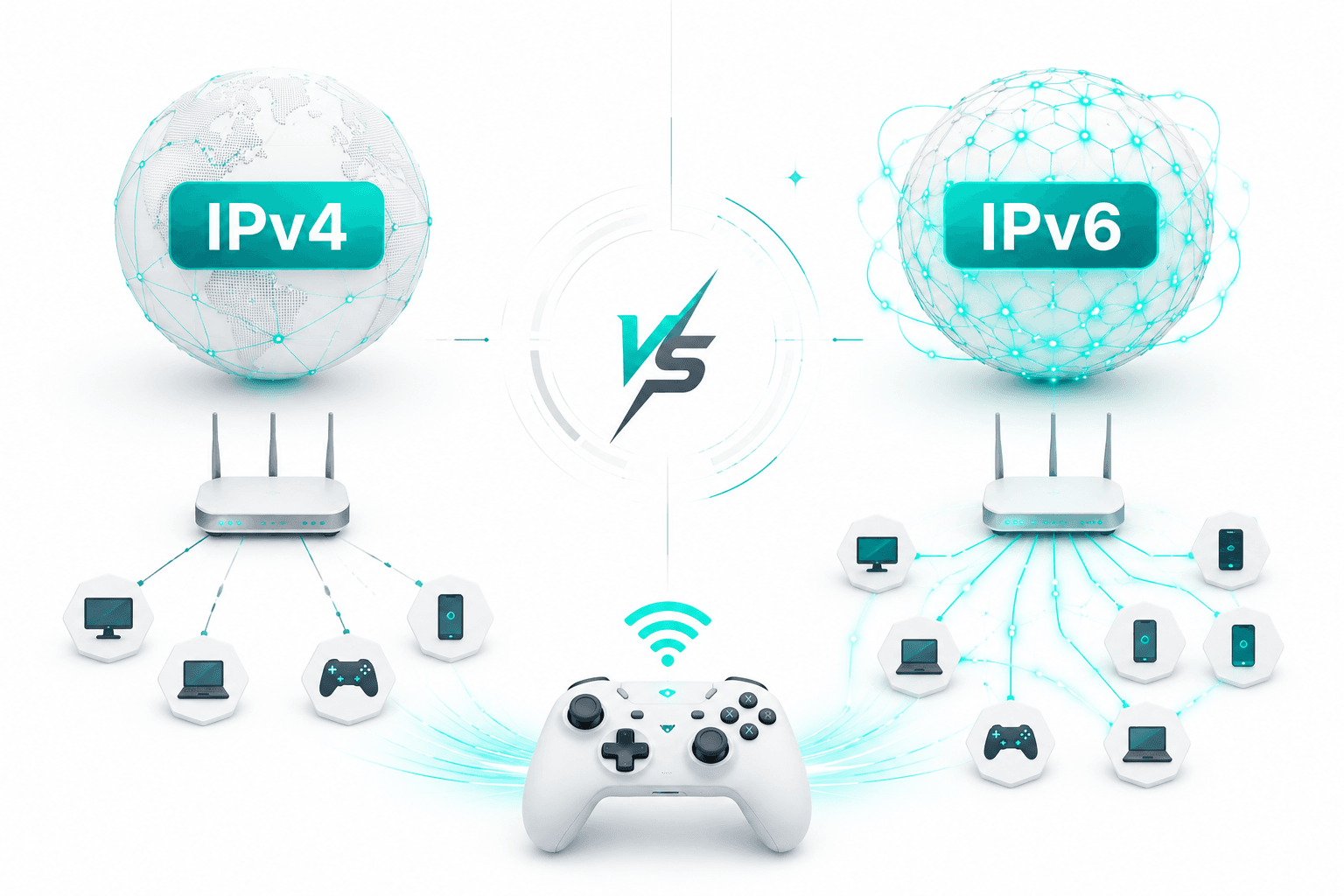
Basic Difference Between IPv4 and IPv6
IPv4 uses a 32-bit address space. Theoretically, that is about 4.3 billion addresses, which has long been insufficient for a global network with massive multi-user addressing. The shortage of public addresses is compensated for by NAT and CGNAT. This solution made it possible to scale the internet without immediately abandoning IPv4, but at the same time it complicated inbound connections, peer-to-peer interaction, and transparent addressing of end nodes.
IPv6 uses 128-bit addressing and practically removes the limitation on the number of unique addresses. As a result, each device can be assigned its own globally unique address, and the need for NAT as a mechanism for conserving address space disappears. This distinction is what matters most for networked games: IPv6 changes not only the address format, but also the interaction model between nodes.
At the header level, IPv6 is also structured differently. It uses a fixed base header of 40 bytes, whereas the IPv4 header is variable, from 20 to 60 bytes. IPv6 has no header checksum, and fragmentation is not performed by routers: if necessary, only the sender handles it. This model simplifies packet processing at transit nodes, but in itself does not guarantee lower latency. The advantage appears only when the entire infrastructure along the path is correctly optimized for IPv6.
Why the IP Version Affects Games
A networked game is sensitive not simply to bandwidth. Four parameters are critical: latency, jitter, packet loss, and connection establishment success. The IP protocol affects all four, but in different ways.
Latency depends on route length, the number of transit nodes, the quality of inter-network exchange, network load, and the overhead of traffic processing. Jitter reflects latency variation and is especially noticeable in shooters, fighting games, and other timing-sensitive genres. Packet loss occurs because of congestion, interference in the wireless medium, queue overflow, or routing errors. Connection establishment success depends on whether the game can build the required session between the client and server or between two clients.
It is precisely this last point that most strongly distinguishes IPv4 from IPv6 in gaming scenarios. When a game uses a direct connection between participants, the presence of NAT in IPv4 stops being a minor detail and becomes a systemic limitation.
NAT as the Main Factor Behind the Differences
In user networks, IPv4 is almost always accompanied by NAT. A home router translates the internal private addresses of devices into a single public address. In provider networks, CGNAT is often layered on top of that, where several subscribers already share one external address on the operator’s side. For ordinary web traffic, this is acceptable because the connection is almost always initiated by the client from inside the network. For games, the situation is more complicated.
Many game mechanisms require either inbound connections or predictable UDP traffic exchange between end nodes. When one or more layers of NAT stand between a device and the external network, the game is forced to use bypass mechanisms: STUN, hole punching, relay servers, UPnP, manual port forwarding. If that fails, the user encounters NAT-type restrictions such as Open, Moderate, or Strict. In practice, this means problems connecting to sessions, creating lobbies, voice communication, hosting matches, and finding players.
In IPv6, the NAT layer itself is not needed in a typical scenario. The device gets its own address, which means the need for translation as a mandatory intermediate layer disappears. This simplifies the establishment of direct connections, reduces the number of failures at the session negotiation stage, and usually eliminates the need for manual port forwarding. From an engineering standpoint, this, rather than the abstract “newness of the protocol,” is the main practical advantage of IPv6 for gaming.
Impact on P2P Architecture and Games with Dedicated Servers
The effect of protocol choice depends heavily on the game’s network architecture.
- If a game uses dedicated servers, the client mainly establishes a connection with a central node. In this case, the advantages of IPv6 in terms of direct addressing are less pronounced. The client does not need to accept arbitrary inbound connections from other players: it only needs to reliably reach the server. Here, route quality, channel load, and provider policy come to the forefront, rather than the mere presence of NAT.
- If a game uses a peer-to-peer or hybrid model, the situation changes. Each additional translation layer makes it harder to build a direct channel between two participants. In such an architecture, IPv6 can provide a quite measurable benefit: fewer connection failures, a lower probability of lobby and voice issues, and less dependence on UPnP and manual router configuration.
Therefore, the statement “IPv6 is better for gaming” is correct only for some gaming scenarios. It is especially true where there is direct client-to-client traffic or sensitivity to NAT type.
Can IPv6 Reduce Latency
Theoretically, yes. Several factors contribute to this.
First, IPv6 eliminates NAT processing on the home router and, in some cases, part of the indirect overhead in the provider network. Second, IPv6 has a simpler base header and fewer service operations at transit nodes. Third, in certain segments of the internet, IPv6 routes do in fact turn out to be less congested or more logically organized.
But these advantages do not always appear. In practice, latency is determined not by the theoretical efficiency of the header, but by the quality of routing from the client to the game node. If the provider implemented IPv6 through tunneling, a remote gateway, or suboptimal peering, ping may increase. If routing tables and inter-operator interconnects are better optimized for IPv4, then IPv4 will provide the shorter and more stable path.
Therefore, IPv6 is not a guarantee of lower RTT. It can reduce latency, but only with native and high-quality implementation in the access network and at the inter-network level.
Jitter, Bufferbloat, and Queue Processing
For gaming traffic, not only average latency matters, but also its predictability. Even with an acceptable average ping, high jitter makes the game visually and tactically unstable: stuttering, desynchronization, and delayed action registration appear.
The magnitude of jitter is affected by router queues, competing traffic, Wi-Fi characteristics, and the quality of buffer management. At this point, the difference between IPv4 and IPv6 is usually overstated. The protocol choice itself is rarely the main source of jitter. However, IPv6 may indirectly help if the router performs less unnecessary work and processes the flow faster without address translation.
SQM or properly configured QoS has a much greater impact on the outcome. If downloads, streaming, cloud synchronization, and gaming traffic are happening simultaneously on the network, queue overflow will have a far stronger negative effect than any theoretical gain from IPv6. From a practical standpoint, dealing with bufferbloat is almost always more important than manually choosing between IPv4 and IPv6.
Compatibility: Provider, Router, Platform, Game
Even a technically more successful protocol is useless if the infrastructure supports it inadequately. For a gaming network, compatibility is critical at four levels.
The first level is the provider. IPv6 support is required. If the provider uses transition mechanisms, remote tunnel endpoints, or unstable IPv6 routes, there will be no advantage.
The second level is the router. It must correctly handle dual-stack, RA, DHCPv6 where necessary, firewall rules for IPv6, and address distribution within the network. Cheap or outdated equipment may behave unstably even if an IPv6 option is present in the interface.
The third level is the platform. Modern operating systems usually support dual-stack without problems, and consoles can automatically choose the available stack. But support may be uneven: one part of the system traffic goes over IPv6, while another remains on IPv4.
The fourth level is the game itself and its server infrastructure. Even if the device and provider are ready for IPv6, a particular game may rely on services that effectively use IPv4, or switch back to IPv4 whenever there is any doubt about connection quality.
When Proxies Can Affect Gaming Traffic
Proxies do not improve gaming traffic by themselves and do not replace proper routing on the provider side. In most home scenarios, they either produce no noticeable effect or add an unnecessary intermediate node and thereby increase latency. Such solutions have practical value only in cases where the provider’s route to a specific game node is poorly built and an alternative exit point genuinely shortens the path or makes it more stable.
From a technical standpoint, proxies and other intermediate nodes can change not the IPv4 or IPv6 protocol itself, but the traffic path. Therefore, any potential effect is tied not to the IP version as such, but to whether the path to the game server becomes shorter, more stable, and less congested. If that does not happen, the additional network hop only makes the connection worse.
For gaming, such solutions should be considered only as a specific tool for diagnostics or fine-grained route optimization, not as a universal way to improve the network. The baseline result almost always depends more heavily on the quality of the provider connection, router configuration, traffic queues, and connection type than on the use of intermediate network services.
Premium Residential Proxies for Any Task
Trusted residential IPs, a vast GEO coverage network, pay-as-you-go traffic pricing, and a high connection success rate.
Dual-Stack as the Real Working Model
In a consumer gaming environment, the best mode is almost always dual-stack. The system supports IPv4 and IPv6 simultaneously and chooses the appropriate route depending on availability and priority. This approach removes the need to manually force one stack in all cases.
The practical value of dual-stack is that it makes it possible to use IPv6 for those services and games where it truly provides a benefit, while preserving compatibility with older services and infrastructure oriented toward IPv4. For the player, this means less manual configuration and less risk that disabling one of the stacks outright will break part of the network functionality.
Abandoning dual-stack only makes sense for diagnostics. For example, if you need to compare ping, matchmaking stability, or the behavior of a specific game in IPv4-only and IPv6-enabled modes. But as a permanent user strategy, this is usually less effective than leaving both protocols active.
When It Makes Sense to Keep IPv6 Enabled
It makes sense to keep IPv6 active if the provider has native support, the router operates stably in dual-stack mode, and the games show no regressions in latency, stability, or compatibility. This is especially useful in cases where the user has encountered NAT problems in an IPv4 environment: restrictions on joining lobbies, voice chat failures, or difficulties hosting sessions.
When It Makes Sense to Return to IPv4 as the Priority
A manual fallback to IPv4 is justified when enabled IPv6 leads to specific problems: ping increases, routes become unstable, jitter grows, matchmaking starts working worse, or sessions drop for no clear reason. This usually points to implementation problems on the provider side or in intermediate infrastructure.
In such cases, IPv4 often turns out to be more stable simply because the corresponding route is better tuned. For the user, this matters more than any theoretical argument.
Conclusion
Technically, IPv6 gives a gaming network an important advantage: it removes the mandatory dependence on NAT and simplifies direct interaction between nodes. This is especially useful in peer-to-peer scenarios, console multiplayer, and any situations where IPv4 creates problems with NAT type, inbound connections, and session negotiation.
However, IPv6 should not be regarded as a universal accelerator. Lower latency is possible, but only with high-quality native implementation and correct routing. In real networks, IPv4 often remains more predictable because of infrastructure maturity, compatibility, and route stability.