JSON and CSV: Which Data Format to Choose for Storage, Exchange, and Analysis
 ·July 30, 2026·5 min read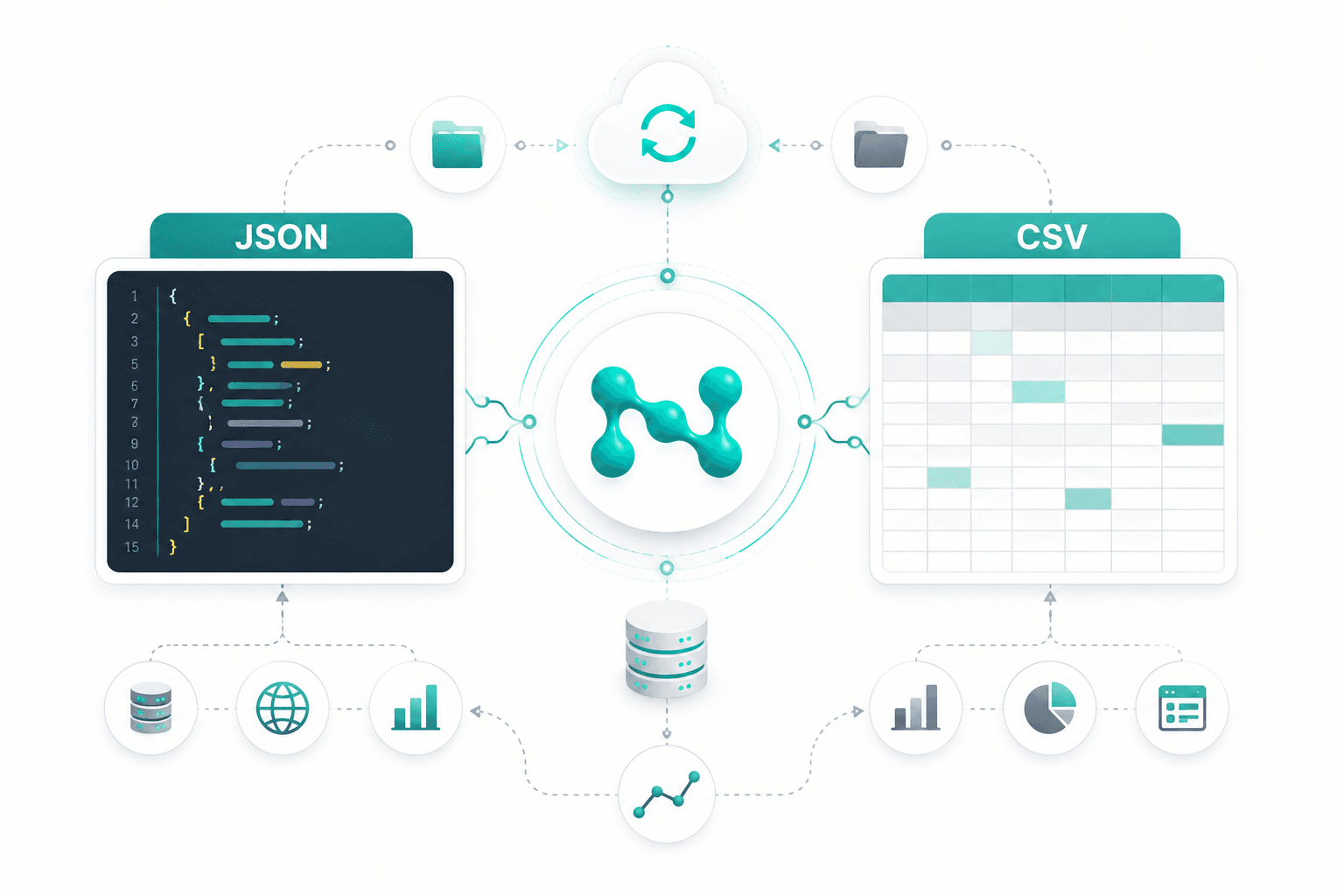
What JSON and CSV Are
JSON is a text-based data exchange format built on “key-value” pairs. It supports objects, arrays, numbers, strings, boolean values, and null. This makes JSON convenient to use where data has an internal structure: nested entities, lists, groups of parameters, and related objects.
CSV is a text format for tabular data in which each line corresponds to a record and values are separated by a chosen delimiter, most often a comma or semicolon. Its main strength is simplicity. CSV works well where data can naturally be represented as rows and columns without nesting or complex relationships.
The Main Difference Lies in the Data Structure
The key difference between the formats lies in how they describe data.
JSON is inherently designed for hierarchy. In a single document, you can store an object, inside it an array, and inside that array other objects, without any additional techniques. This makes the format convenient for APIs, configuration files, integrations between services, and applications where relationships between entities matter.
CSV is structured differently. It describes data as a flat table. Each record must fit into a fixed set of columns. As soon as the data contains nested lists, multiple levels of attributes, or repeating groups of values, the format begins to require workarounds: duplicating rows, merging lists into text, or artificially “flattening” the structure. This is acceptable, but it leads to a loss of clarity and sometimes to the loss of part of the meaning.
Which Format Is Easier to Read
If the data is tabular, CSV is perceived more quickly. It is convenient to open in Excel, Google Sheets, BI systems, and any tools that work with rows and columns. For reports, exports, registries, catalogs, and analytical tables, this is a natural presentation format.
JSON is easier to read when the structure itself is important. Indentation and nesting show which fields belong to each other, where an array is located, and where a nested object is. For configurations, API responses, and structured records, this is more convenient than trying to represent the same information in a flat table.
But JSON also has a downside: with large volumes of data, it becomes visually heavier. Repeating keys, brackets, and nesting increase the length of the document. In such cases, CSV often looks more compact, especially if the dataset structure is simple.
File Size and Processing Speed
CSV is usually more compact. It does not contain field names for every record, curly or square brackets, or additional structural markup. As a result, such files often take up less space and are processed faster in tasks involving bulk reading, import, and export.
JSON is generally larger. The reason lies not only in service characters but also in the repetition of key names. With the same number of records, a JSON file often turns out to be larger than its CSV counterpart. This affects transmission volume and parsing time, especially in large data streams.
At the same time, size in itself is not a decisive criterion. If the data is complex and contains nesting, switching to CSV for the sake of saving space may lead to a deterioration of structure and complicate further processing.
Support for Data Types
One of JSON’s important advantages is its explicit handling of different data types. It can distinguish strings from numbers, boolean values from empty ones, and arrays from objects. This simplifies data exchange between applications and reduces ambiguity during parsing.
CSV does not provide this capability. At the format level, all values are essentially represented as text fields. How exactly to interpret a number, date, boolean value, or empty field is decided by the program that reads the file. Because of this, ambiguities arise more often in CSV: where there is a string, where there is a number, what should be considered an empty value, which delimiter is used, and how commas and periods in numbers should be interpreted.
Reliable Residential Proxies
High-trust IPs • Extensive GEO coverage • Pay per traffic used • Exceptional connection success rates
Where JSON Is Commonly Used
JSON is used where data must preserve its structure and be easily transmitted between systems. Most often, this includes:
APIs and web services
Server responses, data exchange between client and server, integrations between applications.
Configuration files
Settings for services, applications, and automation scripts.
Mobile and web applications
Transmission and storage of objects with nested properties, lists, and parameters.
System integrations
Connecting several platforms where it is important to preserve the structure of entities without losing nested fields.
JSON is convenient where data is not merely listed but describes objects with internal relationships.
Where CSV Is Commonly Used
CSV is chosen when data already has a tabular form or must enter an environment oriented toward tables.
Spreadsheets
Import and export in Excel, Google Sheets, and similar tools.
Analytics and reporting
Exports for analysis, registries, tables with indicators, and aggregated data.
Exchange between accounting and business systems
Transmission of simple records: lists of customers, products, orders, and transactions.
Data preprocessing
Preparation of flat datasets for analytical scenarios and machine learning.
CSV is especially convenient when each row is a self-contained record with a fixed set of fields.
Can Both Formats Be Used Together
In many workflows, JSON and CSV do not compete but complement each other. The same dataset may pass through both forms at different stages.
A typical scenario looks like this: a system receives data in JSON through an API, then it is converted into CSV for analysis or reporting, and after processing it may be assembled into JSON again for transmission to another system. This approach is common in ETL processes, integrations, analytical pipelines, and automated exchanges between services.
This is practical because each format is used in the role for which it is best suited: JSON for structured exchange, CSV for flat processing and analysis.
What Is Important to Consider During Conversion
Conversion between JSON and CSV usually does not cause problems if the data structure is simple. But if JSON contains nested objects, arrays, or repeating groups of values, the data has to be simplified when converting to CSV.
In practice, this means one of three things:
• nested fields are expanded into separate columns;
• arrays are turned into text strings inside a single cell;
• part of the structure is lost because the tabular format cannot fully represent it.
The reverse conversion from CSV to JSON is usually simpler, but it does not restore hierarchy automatically. If there was no explicit structure in the table originally, JSON after conversion will essentially remain the same flat set of records, only in a different syntax.
When to Choose JSON
JSON is suitable if:
• the data has a nested or multi-level structure;
• exchange between applications and services is required;
• support for different data types matters;
• the format will be used in APIs, configurations, or integrations;
• related entities need to be stored in a single document.
This format works better where the data structure is more important than file compactness.
When to Choose CSV
CSV should be used if:
• the data can be represented as a table;
• simple import and export between systems is needed;
• the file must open in spreadsheet editors;
• compactness and fast processing are important;
• the dataset is large but flat in structure.
CSV is especially appropriate in analytics, reporting, and any scenarios where data lives in rows and columns.
Conclusion
JSON and CSV cannot be regarded as interchangeable formats. JSON is better suited to structured and nested data, where relationships between fields, value types, and ease of exchange between systems matter. CSV is more effective in tasks related to flat tables, bulk exports, spreadsheets, and analytics.
The choice between them depends not on the popularity of the format, but on the form of the data itself and on how that data will be used further. If the structure is complex and hierarchical, it is more logical to choose JSON. If the data is tabular and oriented toward analysis or import into familiar tools, CSV is more practical.
In many real processes, the optimal approach is not to choose one format forever, but to use both competently: JSON where structure is needed, CSV where simple and fast work with tables is needed.