Residential vs. Datacenter Proxies: What’s the Difference and Which One to Choose for a Specific Task
 ·October 2, 2026·4 min read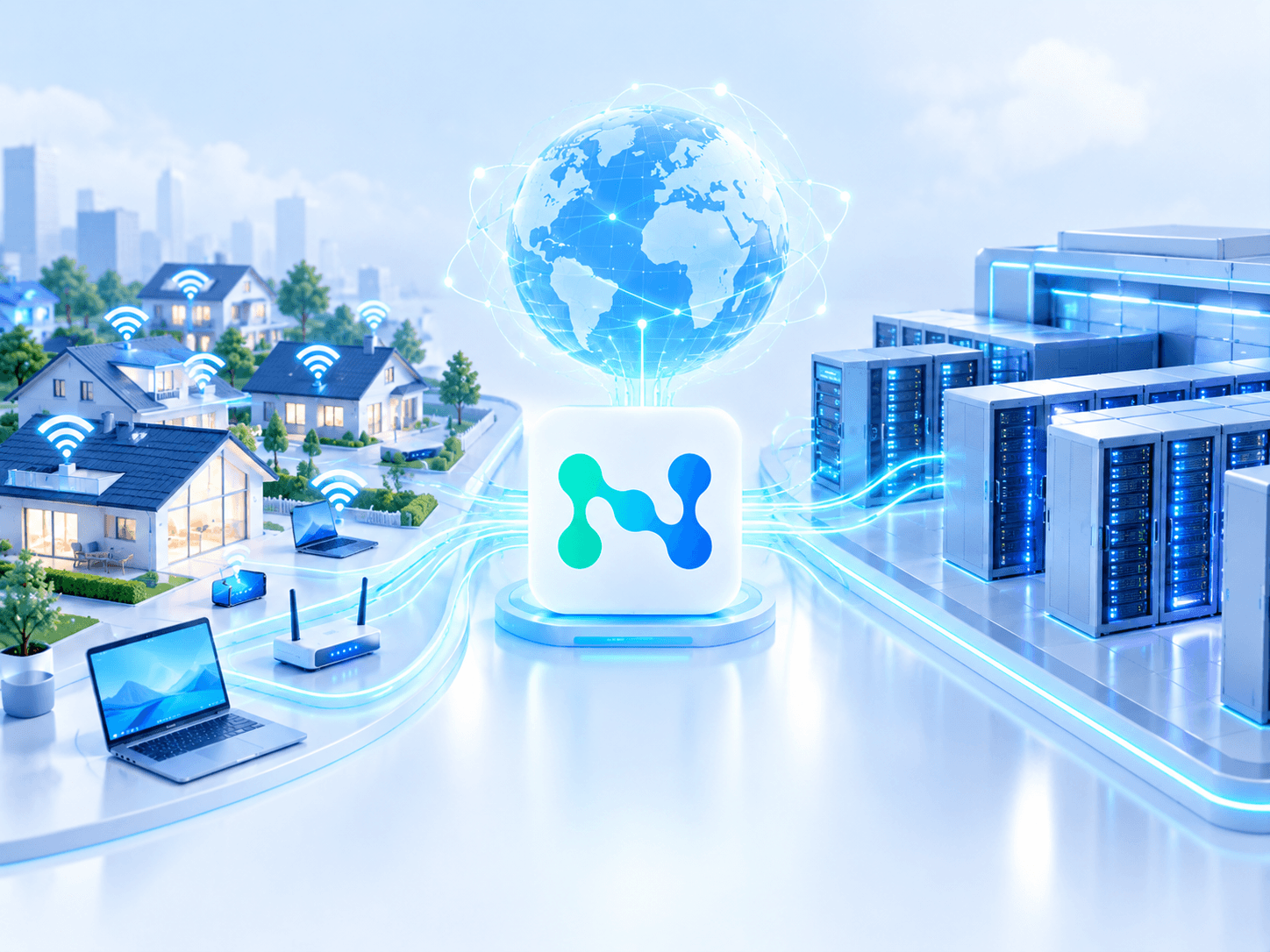
Datacenter proxies and residential proxies solve the same basic problem: they route requests through an intermediate IP address. That is where the similarity almost ends. From there, the differences begin, and they directly affect speed, resistance to blocks, cost, geolocation accuracy, and predictability in a project.
In practice, the choice between these proxy types comes down to which one better matches the requirements of a specific workload. For some tasks, high throughput, stability, and clear economics matter more. For others, trust from the target website, a wide choice of geolocations, and a higher chance of successful access are more important. That is why they should be compared not by a single feature, but by a combination of factors.
What Are Datacenter Proxies
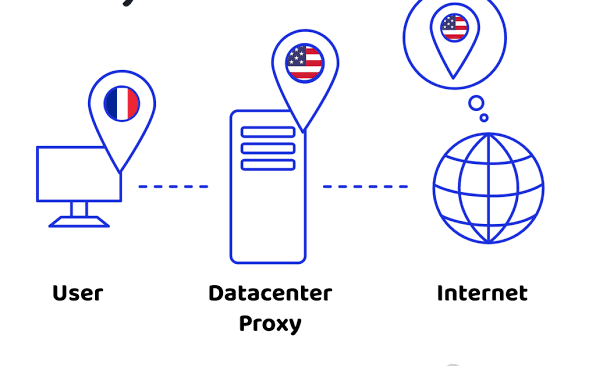
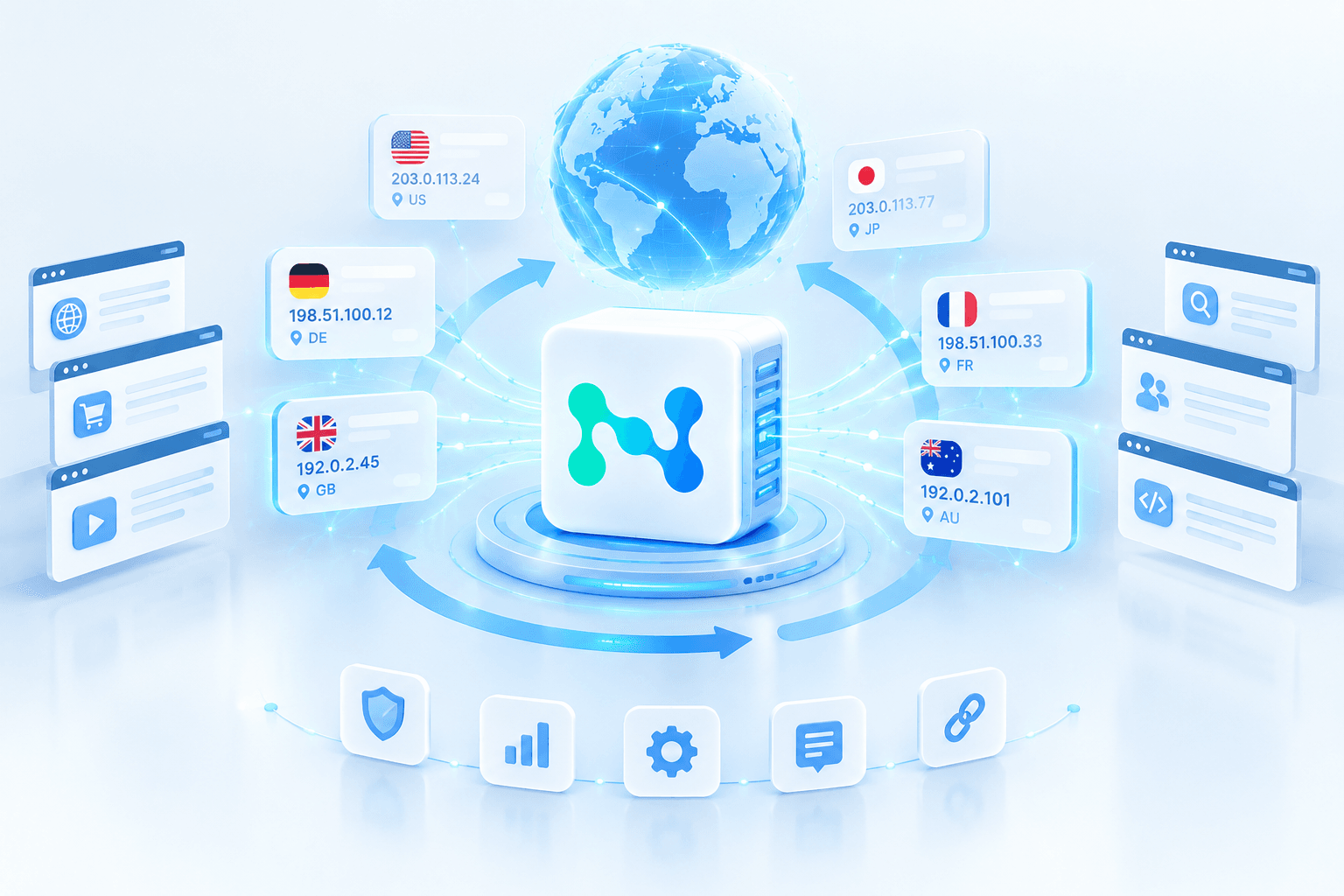
Datacenter proxies use IP addresses issued by cloud providers, hosting companies, or datacenter infrastructure. These IPs are not tied to the home or mobile connections of real users. The request passes through server infrastructure and appears to the website as traffic coming from a datacenter.
From a technical point of view, this provides several practical advantages. Datacenter proxies run on powerful server infrastructure and usually offer low latency, high data transfer speeds, and more stable behavior under load. They are well suited for tasks where scalability, high request frequency, and predictable connection behavior are important.
However, this origin of the IP also has a downside. Target websites can usually determine that the request is coming not from a regular subscriber connection, but from a server network. As a result, datacenter IPs are more often subject to restrictions, CAPTCHA challenges, and blocks, especially on resources with strict anti-bot protection.
What Are Residential Proxies
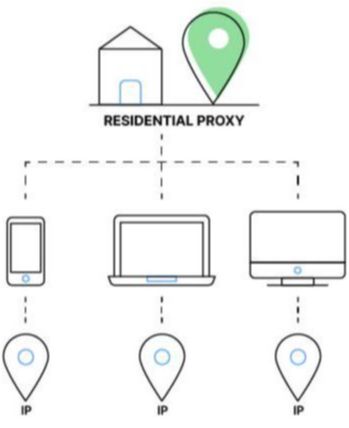
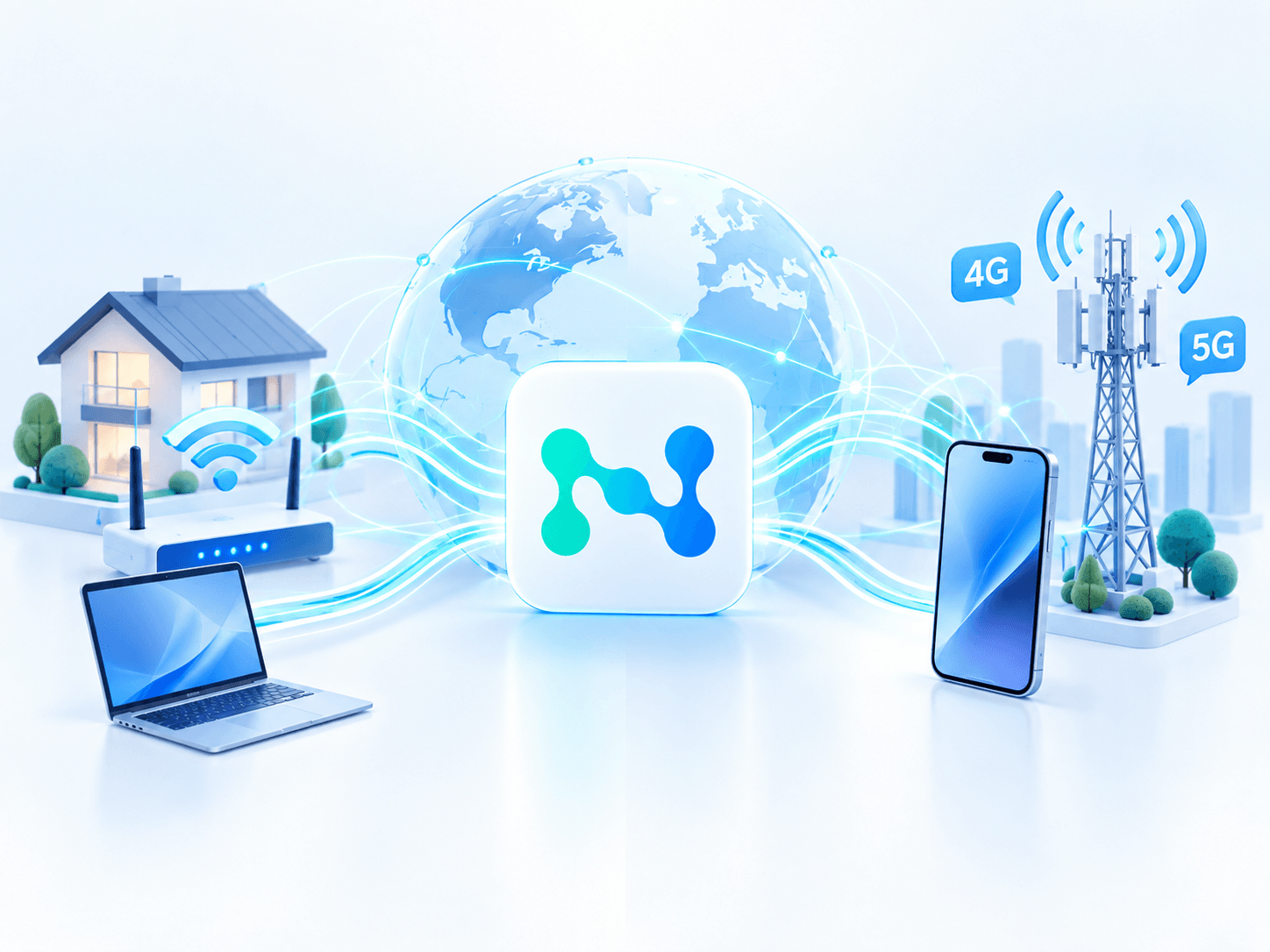
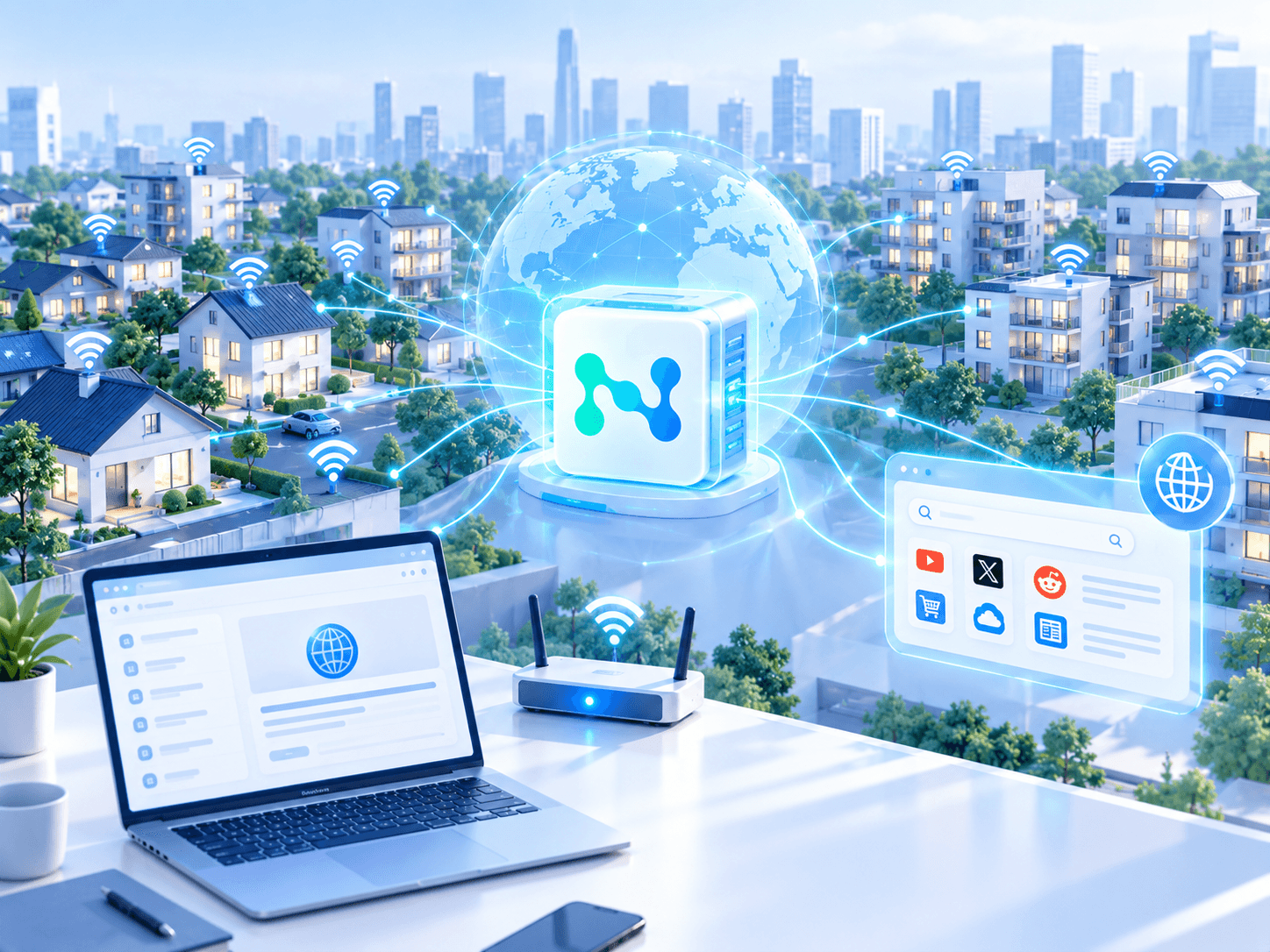
Residential proxies use IP addresses assigned by internet service providers to real home or mobile devices. To the target website, such traffic looks like ordinary user activity coming from a specific region, provider, and consumer network.
It is precisely the IP source that makes residential proxies noticeably more resilient in scenarios where a website distinguishes between server and user traffic. Requests through such addresses are more often perceived as natural, so the likelihood of an immediate block is lower. This is especially important where access depends on trust in the traffic source, geography, and behavioral plausibility.
But this comes at another cost. Residential proxies are usually slower than datacenter proxies because they depend on the quality of home or mobile networks. In addition, they are more expensive and are more often billed by traffic volume rather than by the number of IPs, which makes total costs less predictable under intensive data loads.
Residential and Datacenter IPv4 Proxies
Choose the right proxy type for different tasks and use cases.
The Main Difference: IP Source and Its Consequences
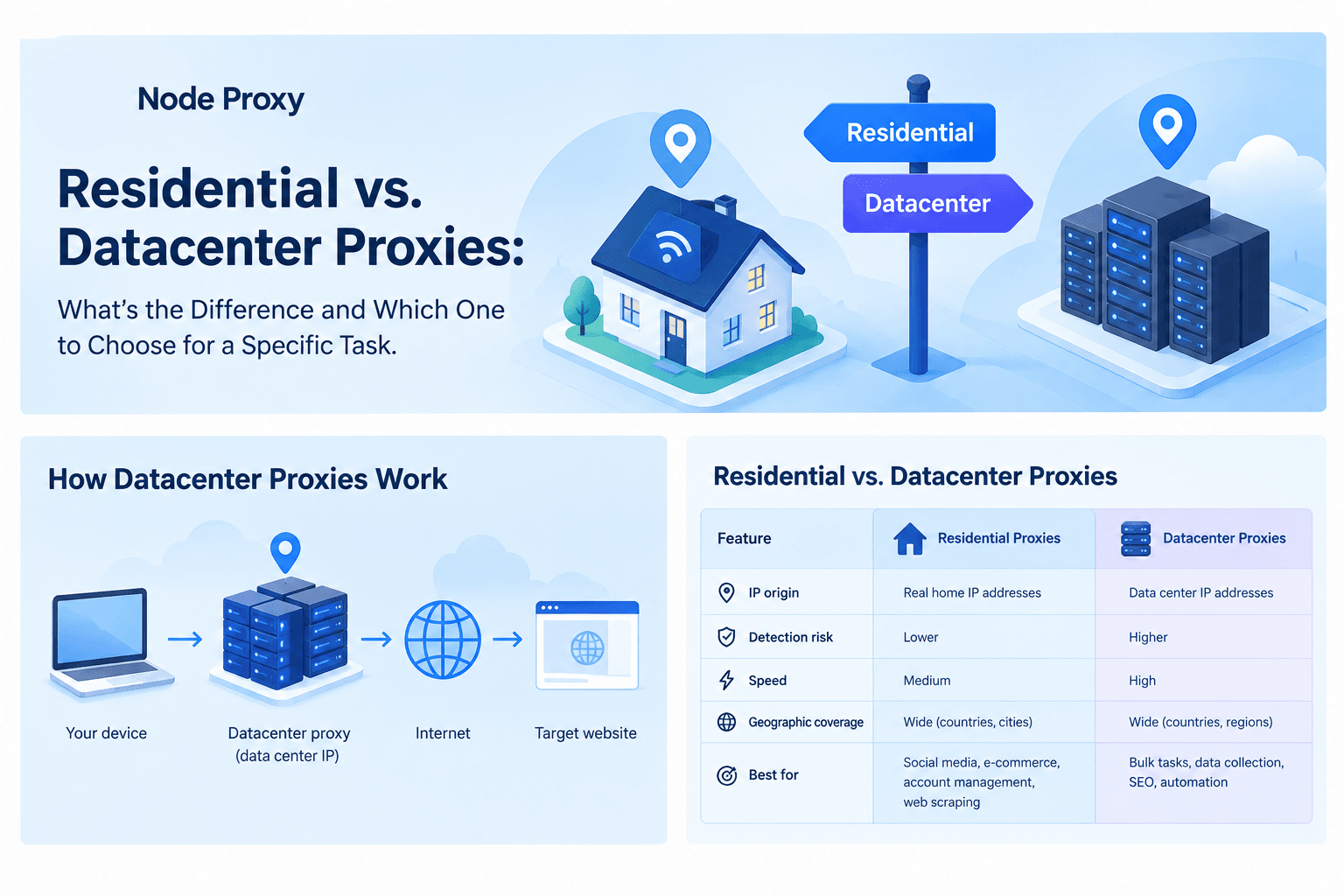
The key divide between the two proxy types is the origin of the IP address. Everything else follows from that.
Datacenter IPs are formed within server infrastructure. They are fast, convenient for large-scale automation, and easier from the standpoint of infrastructure control. But they are also easier to identify as non-user IPs.
Residential IPs come from ISP networks and are associated with real devices. This increases trust from websites and reduces the risk of immediate restrictions, but at the same time introduces instability that depends on the condition of end-user networks and increases cost.
That is why datacenter proxies usually outperform in terms of performance, while residential proxies tend to perform better in terms of successful access on sensitive resources.
Speed, Latency, and Throughput
In terms of speed, datacenter proxies are almost always in a more favorable position. They operate on server hardware, in networks with good connectivity, and with lower network overhead. This makes them convenient for tasks that require fast transmission of large volumes of data: crawling pages at scale, downloading heavy content, performing frequent checks, or executing automated actions across a large number of threads.
Residential proxies are slower on average. Their performance depends on the quality of the home or mobile connection through which the traffic is passing at a given moment. It can be affected by the provider’s characteristics, network congestion, and even the behavior of other devices on the same connection. As a result, throughput and latency are less predictable with such proxies.
Therefore, for tasks where speed itself is critical, datacenter infrastructure is usually the more rational choice.
Resistance to Blocks and Access Success Rate
If we look not at speed but at the likelihood of successfully getting through restrictions, the advantage usually shifts to residential proxies. Their IPs look to the website like ordinary user addresses assigned by an internet provider. Because of this, such requests are less likely to arouse suspicion, especially on websites that track IP origin and actively filter server ranges.
Datacenter proxies are noticeably easier to detect. Even with good configuration, they more often encounter CAPTCHA challenges, limits, the need for rotation, and the risk that part of the pool already has a damaged reputation. This is especially noticeable when working with targets whose anti-bot mechanisms analyze not only request frequency, but also network type, IP origin, and range repetition.
That is why the same task can behave differently depending on the proxy type. Where a datacenter IP provides high speed, a residential IP often delivers a higher percentage of successful responses.
Cost and Pricing Model
From a budget perspective, datacenter proxies are almost always simpler. They are cheaper to purchase, are often sold at a fixed rate per IP or per plan, and make it possible to estimate expenses in advance. This is convenient for projects where a clear resource volume is needed and economic predictability matters.
Residential proxies are usually more expensive. Their cost is driven by the more complex IP source, the maintenance of a large distributed network, and the specifics of obtaining such addresses. In addition, they are often paid for based on traffic. In practice, this means that the final cost can increase significantly in projects with a large number of requests, heavy pages, images, or PDFs.
That is why the question of price cannot be reduced to the nominal rate alone. You need to calculate the overall economics of the task. In some cases, more expensive residential proxies are justified because they reduce the number of blocks, retries, and time losses. But in low-risk scenarios, datacenter proxies are usually more cost-effective.
IP Pool Size and Geographic Coverage
Residential proxies usually offer a broader address pool and more diverse geography. This is because their IPs come from a large number of real connections across different countries, cities, and provider networks. This format is convenient for tasks where precise location, regional search results, local advertising, or checks in specific cities and with specific telecom operators matter.
Datacenter proxies can also have fairly large pools, but geographically they are usually limited by the locations of available datacenters. In practice, this means less variability and less precise coverage, especially if rare regions or specific local points are needed.
If a project depends on broad geography and a diversity of IP sources, residential proxies usually provide more flexibility.
Connection Stability
In terms of stability, datacenter proxies look stronger. They run on infrastructure with controlled resources, high availability, and predictable behavior under load. For long sessions, persistent tasks, and services where a steady channel without sharp changes is important, this is a serious advantage.
Residential proxies are less stable by their very nature. They depend on whether the end devices are available, whether the IP has changed, whether the network has disconnected, and how a specific channel behaves. In some scenarios this is not critical, especially with proper rotation. But where a long uninterrupted session or repeatable connection behavior is required, this instability can become a limitation.
For this reason, for long and interruption-sensitive sessions, an intermediate option is often considered — ISP proxies, which combine the properties of residential IPs with server-level stability.
Where Datacenter Proxies Work Better
Datacenter proxies are a reasonable choice in cases where the main task is to get maximum speed, throughput, and scale on a moderate budget.
They are well suited for large-scale data collection from less protected resources, regular price monitoring, SEO monitoring, website and application testing, high-frequency automated actions, and other scenarios where target websites do not immediately block server traffic or allow it with proper configuration.
Their strong side is performance. If a project is constrained by volume, frequency, and cost rather than by the complexity of bypassing protection systems, a datacenter pool is often the most practical option.
Where Residential Proxies Work Better
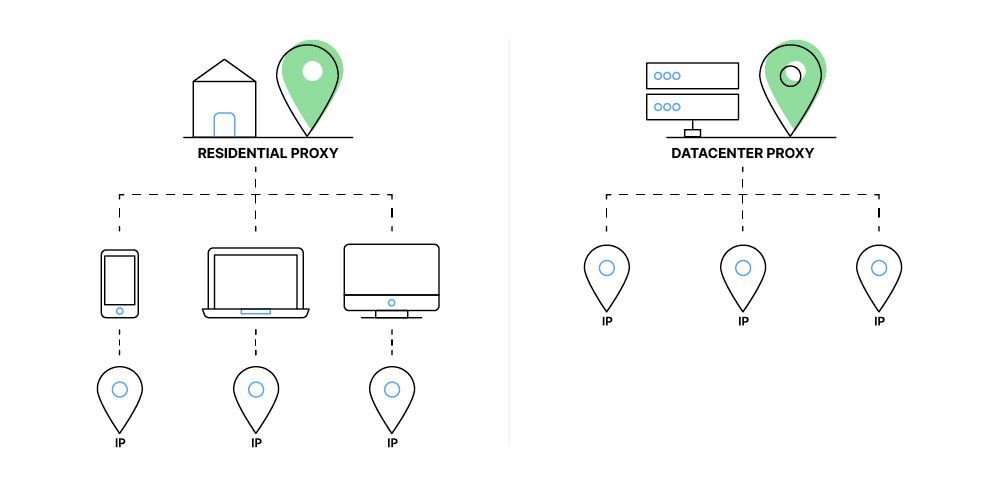
Residential proxies make sense where successful access matters more than maximum speed. They usually perform better on websites that are sensitive to IP origin, actively restrict datacenter ranges, use geo-dependent output, or require a high degree of traffic plausibility.
Such proxies are suitable for tasks involving precise geotargeting, checking ad display in real regions, e-commerce monitoring, SEO tasks that take local search results into account, data collection from resources with complex anti-bot protection, and other scenarios where a server IP itself becomes a source of problems.
Here, their advantage lies not in speed, but in the fact that they reduce the number of failures, repeated requests, and access denials.
We wrote about which proxy type is best for making money online in one of our previous articles.
Dedicated and Shared Proxies: Why This Also Matters
When comparing them, another layer is often overlooked — the IP usage model. Datacenter proxies can be shared or dedicated. Shared ones are cheaper, but their quality depends more heavily on the behavior of other users because IP reputation is shared. Dedicated proxies provide more control, predictability, and stability, especially in projects where address cleanliness and the absence of third-party load are important.
With residential proxies, the logic is usually different: the key role is played by pool size, rotation quality, geography, and the method of network access. Here, the choice is more often built around the usage scenario — whether short sessions are needed, long IP retention, mobile addresses, precise location, or broad regional coverage.
That is why comparing only two broad classes of proxies is not enough. The final result is also affected by the IP allocation model, the rotation strategy, and how sensitive the project is to address reputation.
What to Consider When Choosing
The choice of proxies should begin with the parameters of the task.
If a project is sensitive to blocks, depends on precise geolocation, and works with resources that distinguish between user and server traffic, residential proxies usually deliver better results.
If the workload is large-scale, high-volume, less sensitive to IP origin, and requires high speed within a controlled budget, it is more logical to look toward datacenter proxies.
It is also important to consider the traffic type. If you need to load heavy pages, images, documents, or work at large scale, the traffic-based pricing model of residential proxies can make the project significantly more expensive.
In some cases, the optimal solution is not to choose one type, but to combine them. For example, the baseline task volume is handled through datacenter proxies, while more sensitive stages are handled through residential proxies. This approach makes it possible to balance cost and successful request rate.
ISP Proxies as an Intermediate Option
ISP proxies should also be mentioned separately, as they are often considered a compromise between the two models. They use IPs associated with internet providers, while at the same time being able to provide more stable performance than classic residential networks. In practice, they are chosen for long sessions and scenarios where a higher level of trust in the IP is needed without completely sacrificing the stability of server infrastructure.
This is not a universal replacement for both proxy types, but for some projects this option turns out to be more convenient than a rigid choice between datacenter speed and residential network variability.
Conclusion
The difference between residential and datacenter proxies is determined not by marketing labels, but by the properties of their IP source. Datacenter proxies provide speed, stability, and lower cost. Residential proxies provide a higher level of trust from websites, better geographic variability, and greater resistance to restrictions.
That is why there is no universal answer here. For large-scale and technically straightforward tasks, datacenter proxies are more often suitable. For sensitive scenarios where precise geography, the probability of successful access, and work under stricter filtering matter, it is more rational to use residential proxies.