Sticky and Rotating Proxies: How to Choose the Right Mode for the Task
 ·July 30, 2026·5 min read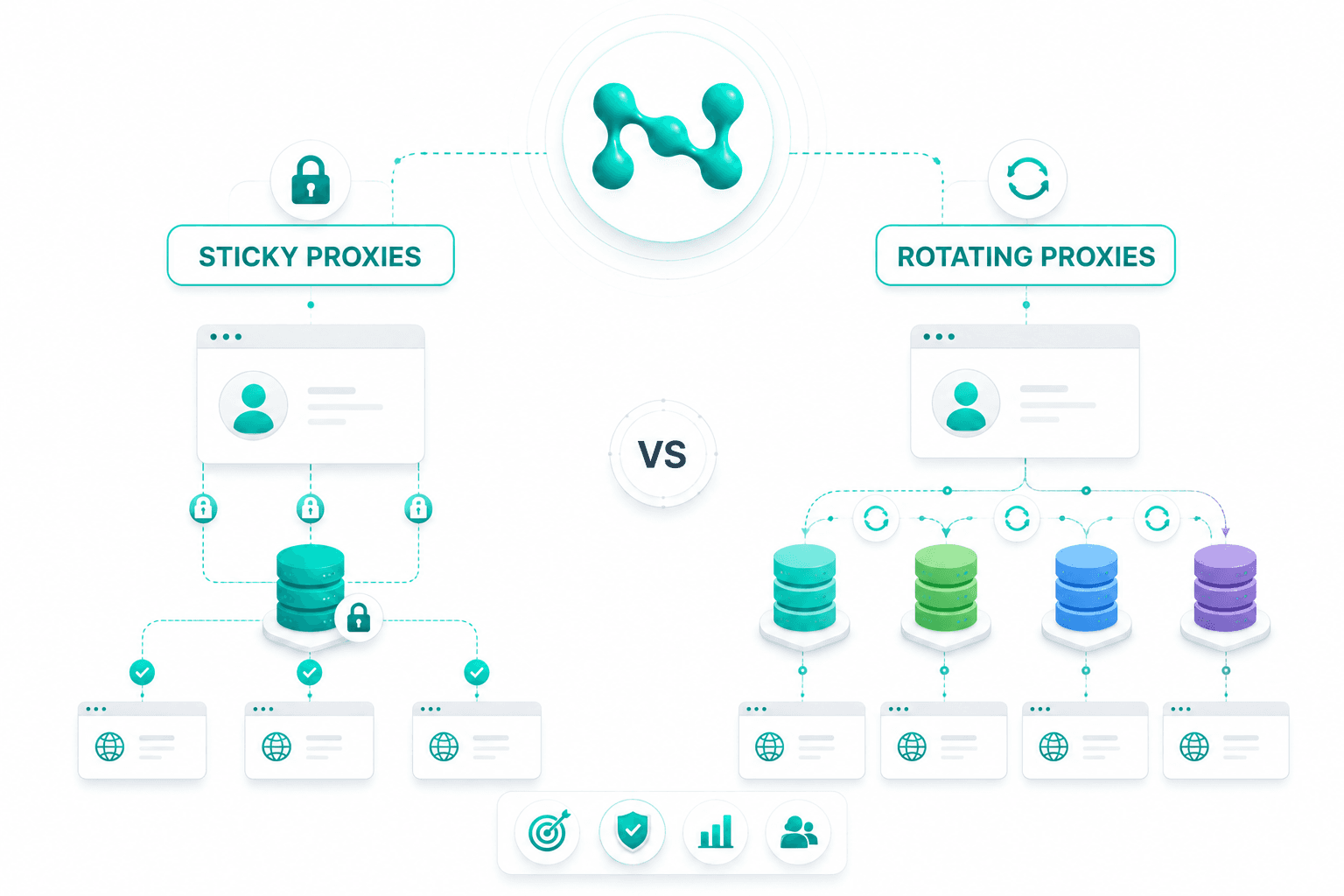
What distinguishes sticky proxies from rotating ones
The difference between these modes comes down to how long the client works with the same IP address.
- Rotating proxies assign a new IP for each request or at a specified interval. For the website, such traffic looks like a series of requests coming from different network nodes.
- Sticky proxies keep one IP within a session: for example, for several minutes or longer, depending on the provider’s settings. As long as the session remains active, all requests go through the same address.
At the same time, a sticky proxy is not the same as a static one. A static address may remain unchanged for weeks or months, whereas a sticky session is always limited in time and depends on the availability of a particular node in the proxy pool. Even if a provider advertises a long session, this does not mean there is an absolute guarantee that the IP will not change earlier.
How it works in practice
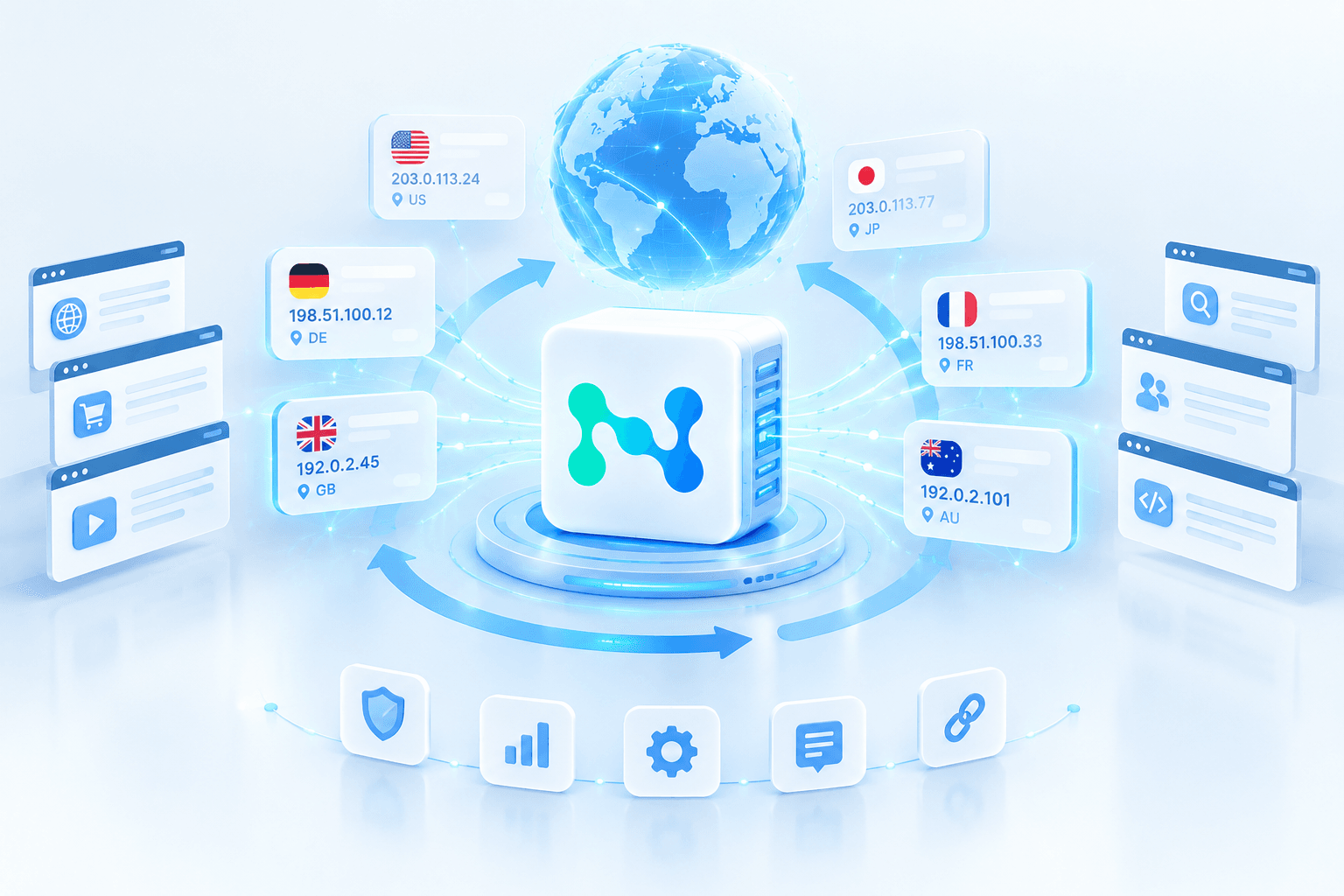
Both modes are usually built through a shared gateway that connects the client to the provider’s address pool. The user does not work with a long list of separate proxies, but with a single entry point—an address or hostname through which the system itself selects the IP.
The difference begins at the moment addresses are assigned:
• in rotation mode, the gateway substitutes a new IP regularly or for every request;
• in a sticky session, the gateway binds one IP for a specific period of time;
• if multiple independent sticky sessions need to be launched, different ports or session identifiers are usually used.
This approach is convenient because it does not require manual management of large address lists. But it also means that proxy behavior is determined not only by the client’s settings, but also by the logic of the provider’s own network.
Sticky or Rotating? Get Both.
Reliable residential proxies with flexible connection modes for every task.
When it is better to use rotating proxies
Rotation is needed where the task consists of a large number of similar requests and does not require keeping one session active for a long time.
This primarily applies to scenarios in which the site limits the number of requests from one IP. If too many requests come from one address in a short period of time, the system begins to slow responses, present CAPTCHA challenges, or block access. Rotation distributes the load across different IPs and reduces the likelihood of quickly running into limits.
The rotating mode is especially useful for tasks such as these:
Collecting data across large sets of pages
If you need to sequentially retrieve information from product cards, search results, catalogs, pages with prices, or stock availability, constantly changing the IP makes it possible to avoid concentrating all traffic on one address.
Monitoring dynamic data
When a system regularly checks changes in prices, rankings, search results, or other parameters, rotation helps carry out many short requests without long-term attachment to a single session.
Mass one-step requests
If the scenario is simple—open a page, retrieve data, move on to the next one—the rotating mode is usually more effective. It does not require preserving state between requests and handles high intensity better.
Limitations of rotating proxies
Rotation has an important drawback: it is poorly suited to processes in which the site expects consistent behavior within a single user session.
If the IP changes in the middle of a chain of actions, this can lead to failure. Typical consequences include a form reset, broken authorization, loss of intermediate state, repeated verification, or a return to the previous step.
For this reason, rotating proxies are inconvenient for:
• logging into accounts and working after authorization;
• multi-step forms;
• placing orders;
• long sequential actions within an interface;
• scenarios where the site links user state to the IP.
In addition, frequent address changes can themselves look unnatural to some platforms. Even if there is no direct block, this increases the likelihood of additional checks.
When it is better to use sticky proxies
A sticky session is needed where continuity matters. If the task consists not of independent requests, but of a series of interconnected actions, keeping a constant IP for a specified period reduces the risk of process interruption.
This mode is suitable for situations where state must be preserved between steps:
Working with an authorized session
Many services monitor whether actions after login continue from the same network context. If the address changes too abruptly, the system may terminate the session or request repeated verification.
Multi-step forms and sequential scenarios
Registration, filling out questionnaires, moving through interface steps, confirming parameters, processing a shopping cart—all of this is sensitive to an IP change in the middle of the process.
Checking localized content within a single session
If it is important to maintain one region and one network profile throughout a series of actions, the sticky mode provides a more predictable result than frequent rotation.
Scenarios where stability matters more than volume
When the key goal is not to send as many requests as possible, but to complete a sequence of actions correctly, a sticky session usually has the advantage.
Limitations of sticky proxies
The stability of sticky proxies comes at the cost of a higher load on a single IP. If too many requests pass through it during the session, the website notices anomalous activity more quickly and applies restrictions.
The main disadvantages here are as follows:
Higher risk of hitting limits
As long as the IP does not change, all activity goes through one address. For sites with strict rate limiting, this means faster accumulation of suspicious load.
Lower suitability for large-scale data collection
The sticky mode is not designed for large volumes of similar requests. It is useful for maintaining a stable session, but not for intensive traversal of a large number of pages.
A long session makes behavior more noticeable
The longer one IP is used and the higher the request frequency, the easier it is for the system to link all actions into one continuous sequence.
That is why sticky proxies work better where there are relatively few actions, but those actions depend on one another.
What affects the choice besides the session type
In practice, it is not enough simply to choose a sticky or rotating mode. Additional parameters also matter.
Session length
A sticky session that is too short may end before the required process is completed. One that is too long increases the load on a single IP. The optimal duration depends on the specific scenario.
Request frequency
Even rotation does not solve the problem if the system sends requests too aggressively. And in sticky mode, frequency is especially critical because the entire flow goes through one address.
Website logic
Some platforms primarily track request intensity, others the continuity of the user session, and still others a combination of several factors at once. Therefore, the same scheme will not work equally well everywhere.
A practical rule for choosing
If the task can be broken down into independent short requests, it is usually more reasonable to choose rotating proxies.
If the task requires going through several steps in a row without changing the network context, it is more logical to use sticky proxies.
In simplified form, the choice looks like this:
• rotating proxies — for a large number of separate requests;
• sticky proxies — for sequential actions within one session.
Conclusion
Sticky and rotating proxies solve different problems, and there is no universal option between them. Rotation is better suited to high-volume scenarios where distributed load matters and there is no dependency between requests. A sticky session is more useful where it is necessary to preserve the integrity of the process and not lose state between steps.
Therefore, the choice should be based not on the general description of the service, but on the mechanics of the specific task. If the process is sensitive to IP changes, the priority should go to a sticky session. If the main problem is restrictions on the number of requests from one address, rotation works more effectively. It is this difference, rather than the formal name of the proxy, that determines the result in real-world use.
You can purchase high-quality residential proxies on our website at node-proxy.com.