Collecting Data from Wildberries: Product, Price, and Assortment Scraping with Residential Proxies
 ·October 5, 2026·5 min read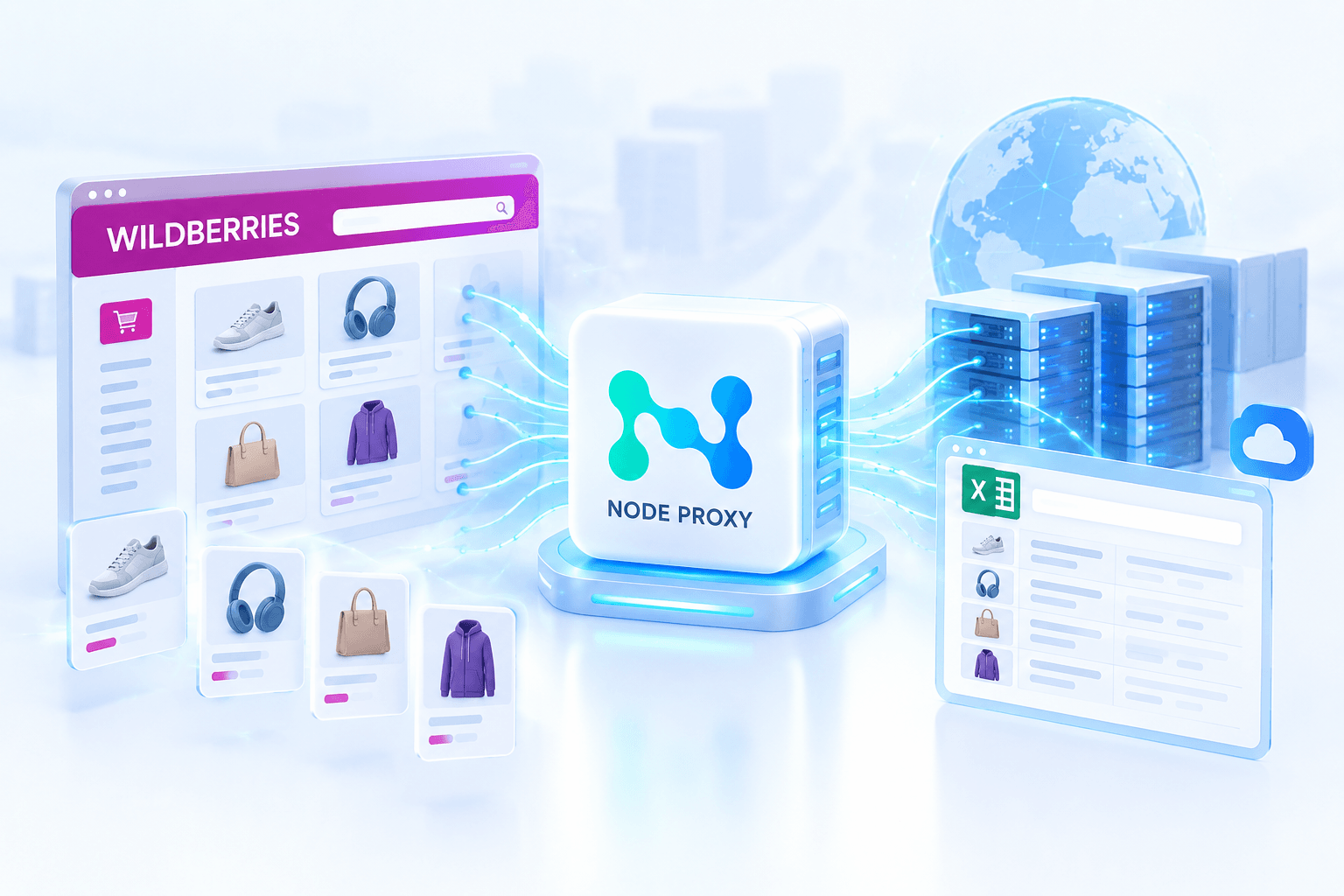
Wildberries is one of the major marketplaces where prices, product availability, assortment, ratings, and other product parameters are constantly changing. Monitoring these changes manually can quickly become time-consuming, even when working with a relatively small amount of information.
Automated scraping makes it possible to collect the required data regularly and save it for further analysis. For example, a scraper can be used to collect product information, compare competitors' prices, track new products, or monitor changes in search results.
When a large number of requests is involved, the way network connections are organized also becomes important. In such scenarios, residential proxies can be used as an intermediary between the application sending requests and Wildberries.
What Data Can Be Collected from Wildberries?
Before configuring a scraper, it is worth determining exactly what information the project requires. There is little point in collecting every available parameter if only a few fields are needed for further analysis.
Depending on the task, it is possible to collect, for example:
- product name;
- product URL;
- article number;
- price;
- discounted price;
- discount information;
- product specifications;
- category and product type;
- brand;
- rating;
- number of reviews;
- seller information;
- product availability;
- variants and sizes;
- search result data;
- images and image links;
- other available page parameters.
Prices and availability are particularly useful for assortment and competitor monitoring. At the same time, marketplace data can change quite quickly, so a single export does not always provide a complete picture.
Wildberries itself provides sellers with tools for working with analytics. For example, the seller portal allows users to analyze prices, ratings, reviews, stock levels, and other product-related information. (seller.wildberries.ru)
With independent data collection, the task can be broader: you can create your own data structure, save historical changes, and compare information from different periods.
Collect Data Without Unnecessary Limits
Node Proxy residential proxies for stable web data collection.
How Does Wildberries Scraping Work?
The application generates a request to a specific page or group of pages, receives a response, extracts the required fields, and saves the results.
For example, a scraping task may look like this:
- Get a list of URLs or product articles.
- Pass them to the scraper.
- Open the Wildberries pages.
- Extract the price, name, rating, and other required parameters.
- Validate the collected values.
- Save the results to CSV, JSON, Excel, or a database.
- Move to the next product.
- Repeat the process after a specified interval.
If the goal is not simply to obtain current values but to monitor changes over time, the results can be saved together with the check timestamp. This makes it possible to compare several records for the same product.
This approach makes it possible to build a price history and track other parameters instead of relying on a single export.
Why Use Proxies for Scraping?
If a scraper sends a large number of requests directly from a single IP address, the network side of the project needs to be considered separately. This is particularly relevant for regular collection of large amounts of data.
In this setup, requests are routed through a proxy server, while the external IP address is determined by the proxy being used.
Residential proxies can be useful when a project requires a pool of IP addresses associated with regular user connections. When creating a list in Node Proxy, you can select the required connection parameters and IP operating mode.
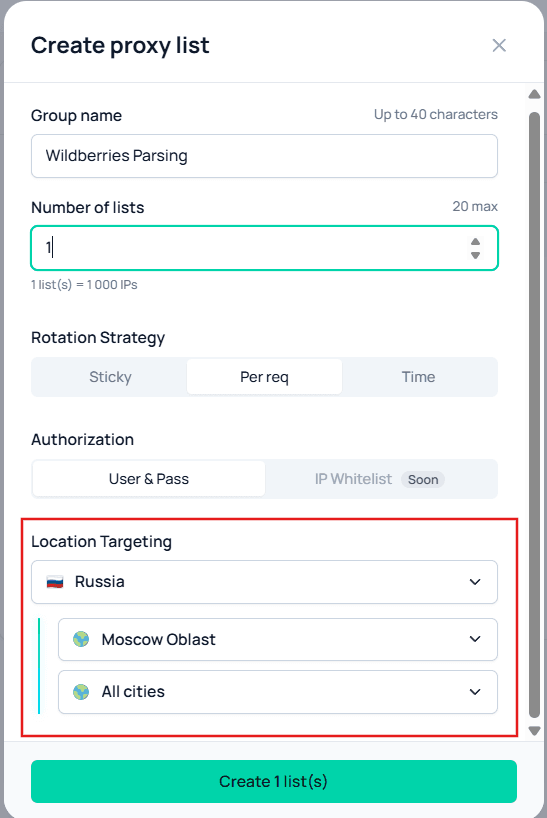
IP rotation makes it possible to automatically change the IP address according to a specified rule. This can be useful when processing a large number of independent requests where maintaining the same IP throughout the entire session is not required.
At the same time, proxies themselves do not perform the scraping. They are responsible only for the network route. The scraper handles data extraction and processing.
IP Rotation During Data Collection
Different tasks may require different IP rotation strategies.
For example, when creating a residential proxy list in Node Proxy, you can select the appropriate rotation mode.
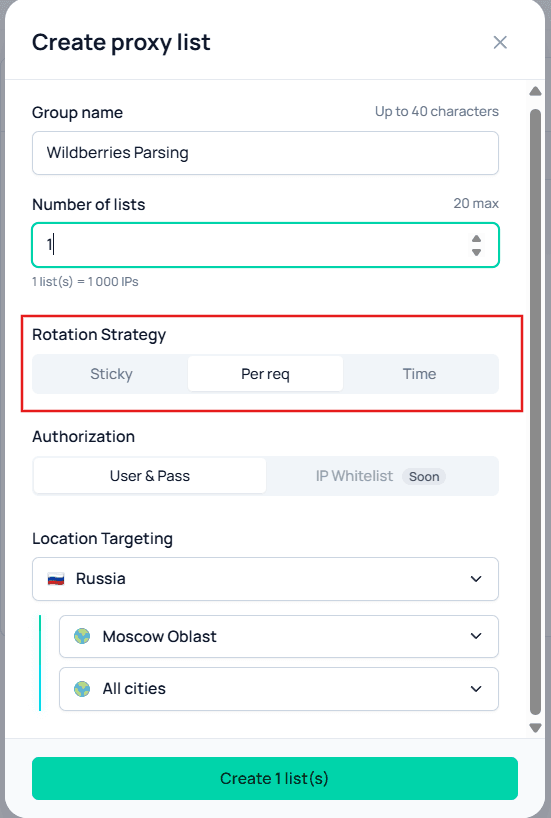
Depending on the scenario, you can use:
- time-based rotation — the IP changes after a specified interval;
- rotation by request — a new IP is requested directly by the application;
- Sticky — the same IP is retained for as long as possible while the selected strategy allows it.
The appropriate mode depends on how the data collection process works.
If every request is independent from the previous one, rotation can be used to distribute connections across different IP addresses. If several requests need to be performed within the same logical session, changing the IP too frequently may be undesirable. In such cases, Sticky can be more appropriate.
At the same time, rotation should not be considered a way to automatically solve every website restriction. Request frequency, the number of simultaneous connections, repeated requests to the same pages, and the overall scraping logic also matter.
How to Connect a Residential Proxy to a Scraper
After creating a proxy list, you need to obtain the connection parameters supported by the application you are using.
These usually include:
- IP address or hostname;
- port;
- username;
- password;
- connection protocol.
The exact configuration process depends on the scraper. If the application supports HTTP or SOCKS5, you can use the corresponding Node Proxy connection method.
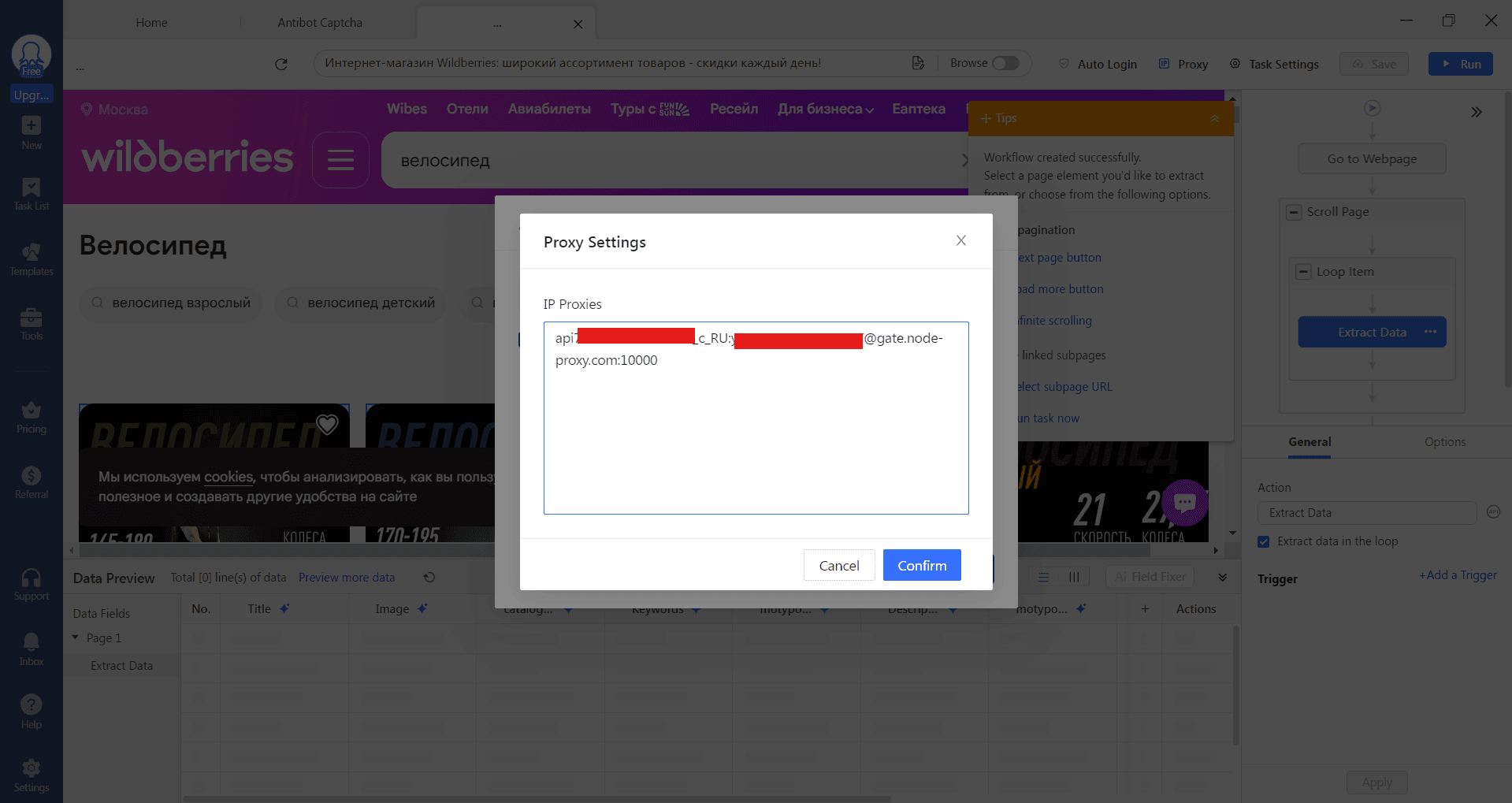
The proxy details are entered into the application's settings, after which the scraper uses this address for its network requests.
Before launching a large scraping task, it is better to test the connection with a small number of URLs. This helps verify that:
- the proxy is actually being used;
- the authentication details are correct;
- the application supports the selected protocol;
- requests are sent through the required IP;
- the collected results are processed correctly.
This preliminary test helps distinguish network connection problems from issues in the scraper's own logic.
What Can a Scraper Collect from Wildberries?
Once the proxy and extraction rules have been configured, the data collection process can be started.
For example, the application can process several hundred product pages and generate a table containing the required parameters.
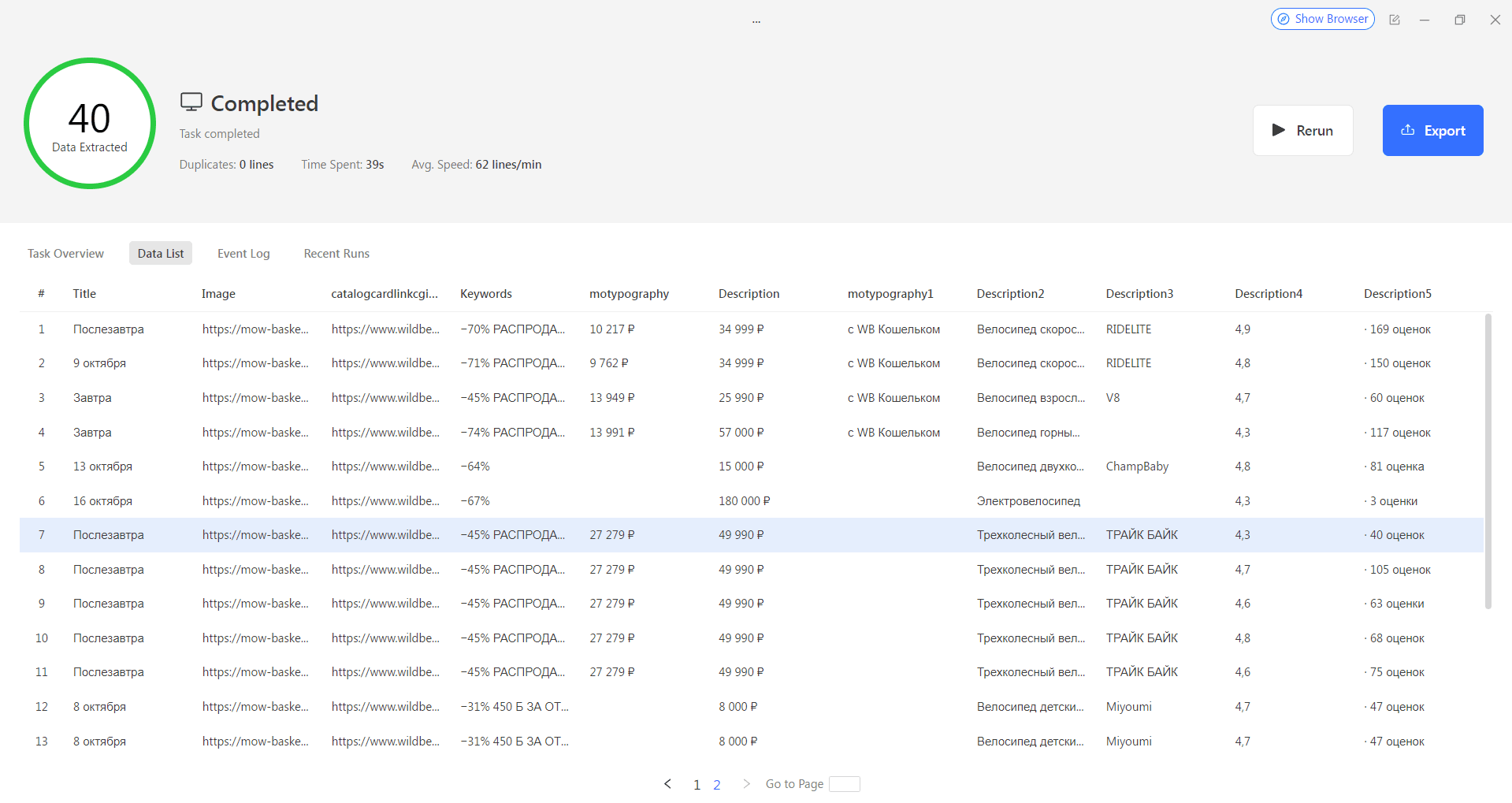
The collected values can then be cleaned, converted into a consistent format, and saved to the required storage system.
For example, it is useful to store prices as numerical values and the check time in a separate field. This makes subsequent analysis and visualization easier.
How Can the Collected Data Be Used?
Collected information can be used for more than just a one-time export.
One common scenario is competitor price monitoring. By regularly checking the same product pages, you can track price changes and build a historical price database.
Another option is assortment monitoring. A scraper can periodically check a predefined list of products and record when particular items appear or disappear.
The data can also be used for:
- category analysis;
- comparing sellers' assortments;
- search result monitoring;
- tracking ratings and reviews;
- price change analysis;
- preparing regular reports;
- transferring data to BI systems;
- building a custom product database.
Wildberries also provides sellers with its own analytics tools. For example, official reports can be used to analyze warehouse stock, product movement, and various sales-related metrics. (seller.wildberries.ru)
Independent scraping, however, makes it possible to create a custom data structure and store a history of exactly the parameters required for a particular project.
How to Account for GEO When Collecting Data
For some tasks, not only the IP address itself but also its geographic location can matter.
This is particularly relevant when a project involves analyzing regional differences in prices, product availability, search results, or other parameters that may depend on the user's location.
When creating a residential proxy list in Node Proxy, you can select the required GEO.
The scraper can then make connections through IP addresses associated with the selected location.
When working with regional data, it is advisable to verify the actual GEO of the IP being used separately. This helps confirm that the network connection corresponds to the requirements of the task.
At the same time, a proxy's GEO does not guarantee that every element of a page will be different between regions. Other request parameters, service settings, and the logic used to generate search results may also affect the displayed information.
How to Build a Stable Data Collection Process
A simple program that opens URLs and saves the received responses may be sufficient for small experiments. As the project grows, however, it is better to plan the architecture of the scraping system in advance.
It may include the following components:
- Scheduler — determines when the next collection cycle should start.
- Task list — stores URLs, product articles, search queries, or other objects to process.
- Scraper — sends requests and extracts the required values.
- Proxy Manager — manages proxy selection and rotation.
- Data processor — validates and normalizes the collected values.
- Database — stores current and historical results.
- Analytics module — generates reports and comparisons.
This approach is easier to scale than a single script that performs all operations sequentially.
What to Consider When Scraping Wildberries
Even with correctly configured proxies, the quality of the results depends on more than the IP address.
It is worth monitoring several parameters:
- request frequency;
- number of parallel tasks;
- response timeout;
- retry attempts;
- connection errors;
- correctness of collected data;
- availability of the requested URLs;
- rotation behavior;
- historical data storage;
- number of successfully processed pages.
It is useful to maintain a scraper log. If some requests fail, the log can contain the URL, request time, proxy used, and the reason for the failure.
It is also important to validate the collected results. If the application receives an empty value or an error instead of a price, the record should not be stored as a valid result.
This is particularly important for regular monitoring: otherwise, a technical failure could be mistaken for an actual price change or product disappearance.
Proxies and the Wildberries API Are Not the Same Thing
When working with Wildberries, it is important to distinguish between scraping publicly displayed information and using official tools intended for sellers.
Wildberries provides APIs and its own reports for working with seller data. For example, prices and discounts can be managed through the seller portal, XLSX files, or the API depending on the number of products and the specific operation.
A residential proxy solves a different problem: it provides the network route used by a request through a selected IP address.
Therefore, these tools are not interchangeable:
API provides programmatic access to the data and operations available through the official interface.
Scraper extracts information from the pages or interfaces available to it.
Proxy handles the network connection between the application and the website.
Depending on the project, these components can be used separately or together. The appropriate approach depends on what data needs to be collected and how that data is made available.
Conclusion
Wildberries scraping can be organized as a simple collection of a predefined list of product pages or as a full-scale monitoring system that runs on a regular basis.
For a small task, it may be enough to define the required URLs, configure the fields to extract, and save the results. As the workload increases, it becomes necessary to manage the request queue, handle errors, store historical data, and monitor network connections.
Residential proxies from Node Proxy are one part of this network infrastructure. They allow you to select a GEO, use a pool of residential IP addresses, and configure different IP rotation strategies. The scraper itself remains responsible for collecting and processing the data.
By properly separating these components, it is possible to build a system that regularly collects Wildberries product data and transfers it to a custom database, spreadsheet, or analytics tool. When organizing data collection, it is important to take the rules and limitations of the service into account and avoid placing excessive load on its infrastructure.