How Proxies Help Scale Data Collection for Data Mining


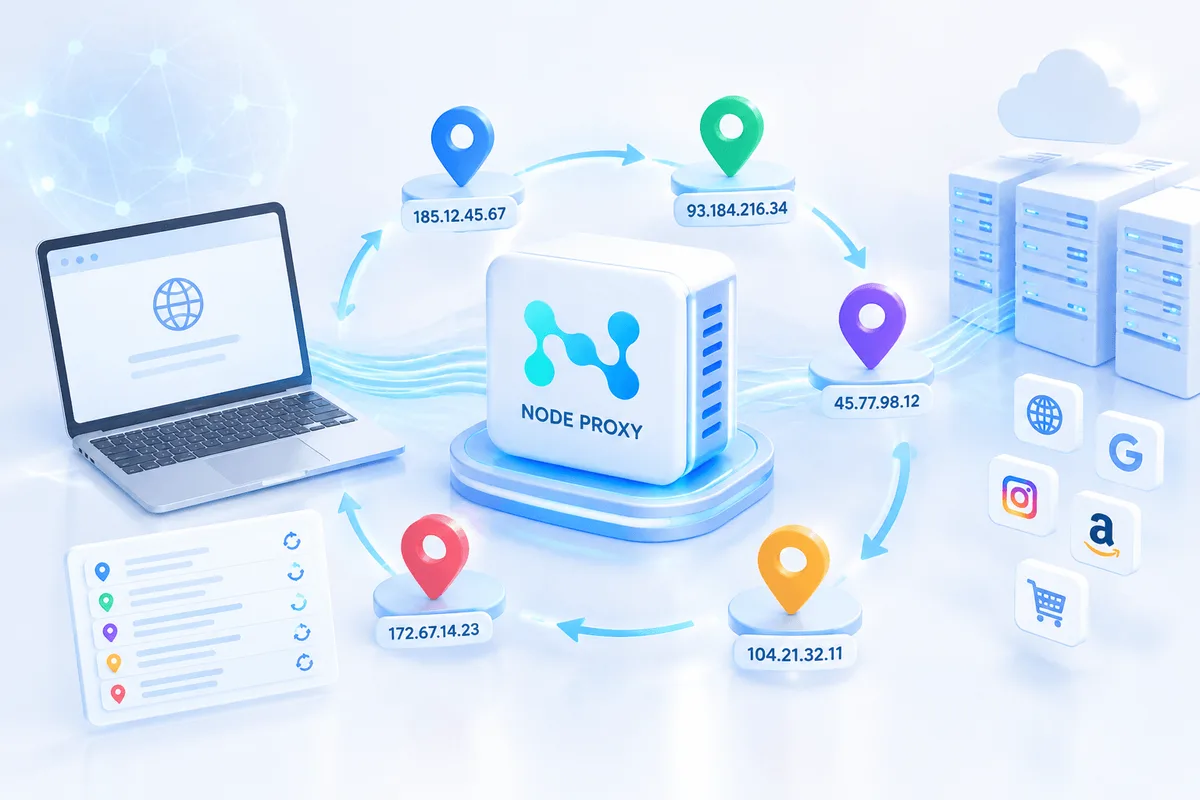
Proxies help data mining by distributing requests across many IP addresses, giving access to regional versions of websites, and keeping large-scale data collection stable. Data mining does not begin with a model or an algorithm, but with data. If the data stream is incomplete, unstable, or poorly structured, the quality of analysis quickly declines. That is why, in practice, the task is broader: first, it is necessary to organize the collection, cleansing, transformation, and control of incoming information, and only then move on to identifying patterns.
This is especially noticeable in projects where data comes not only from a company’s internal systems, but also from external sources: marketplaces, news websites, catalogs, open services, social platforms, and industry portals. In such scenarios, proxies become not an auxiliary detail, but part of the collection infrastructure. They help distribute requests, work with regional versions of pages, and maintain stability under large volumes of requests.
What Is Data Mining
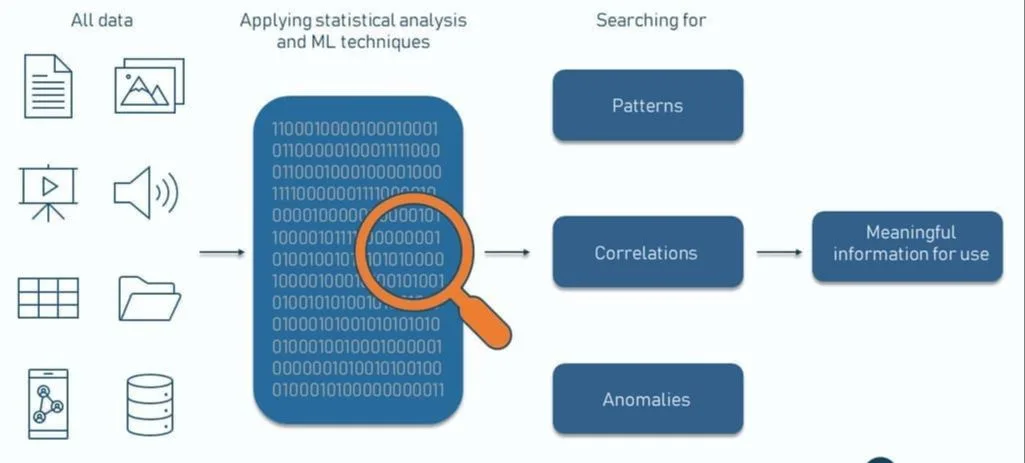
Data mining is the search for stable patterns, dependencies, and deviations in large data sets. Its task is not limited to simply viewing tables or building charts. It involves the systematic processing of information that makes it possible to find recurring behavioral patterns, identify relationships between events, forecast future values, and detect atypical situations.
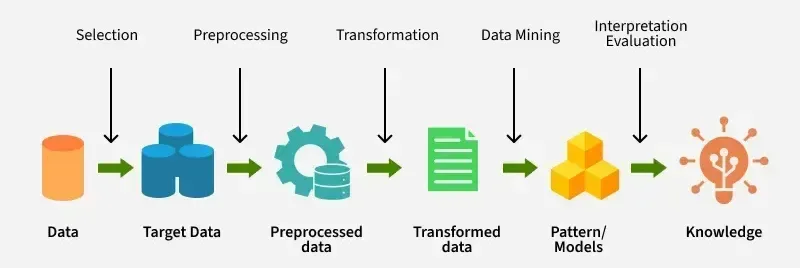
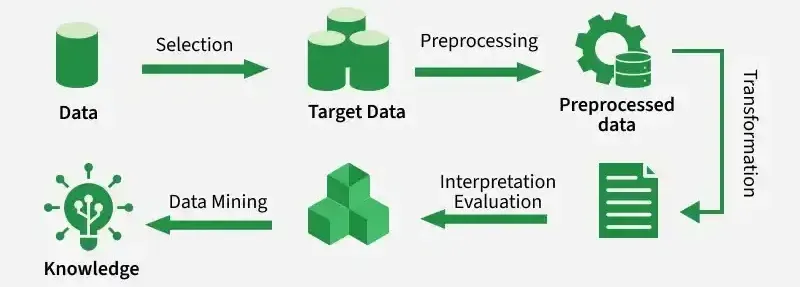
In practice, the process is usually built as a sequential pipeline.
First comes data collection from available sources: internal databases, APIs, logs, CSV files, CRM systems, sensors, websites, and other channels. Then the data is cleansed: duplicates are removed, format errors are corrected, missing values are filled in, and values are normalized. After that, transformation is performed: features are created, dimensionality is reduced, tables are merged, and the information is brought into a form suitable for analysis. Only then are models applied — classification, clustering, regression, association rule mining, or anomaly detection. The final stage is the evaluation of the result and the implementation of the findings in real processes.
This approach is important for one reason: a useful result in analytics depends not only on the algorithm, but also on the quality of the entire chain from the source to the report.
An IP from the Location You Need
Connect through residential proxies and choose the right GEO.
What Tasks Data Mining Solves
The choice of method depends on the question that needs to be answered.
Classification is used where objects need to be assigned to predefined categories. This may include application segmentation, assessing the probability of customer churn, determining the type of inquiry, or filtering unwanted messages.
Clustering is needed in cases where the structure is not known in advance. It helps identify groups with similar behavior: for example, customers with the same demand patterns or users with similar interaction scenarios with a service.
Regression is used to forecast numerical values. It can be used to estimate future revenue, delivery time, the probability of demand growth, price changes, or system load.
Association rules show which events or actions frequently occur together. This approach is useful in analyzing shopping baskets, transition chains, and recurring combinations of actions.
Anomaly detection helps identify outliers and atypical cases: sharp spikes in activity, equipment failures, suspicious transactions, and errors in data streams.
In practice, these methods rarely exist separately. A single project may use several approaches at once: for example, clustering first to identify segments, followed by classification to automatically assign new objects to the discovered groups.
Why Data Collection Often Becomes the Main Constraint
In many projects, the analytical part turns out to be simpler than organizing the data flow itself. Internal sources are usually manageable: the structure is known, formats are standardized, and access is predictable. External sources behave differently.
Websites limit request frequency, some content depends on region, pages may be built with JavaScript, data changes its markup, and individual resources return different results depending on the device, time, interface language, or entry point. If you try to collect large volumes of information through a single channel and from a single network point, the process quickly runs into technical limitations.
Because of this, collecting external data becomes an engineering task. It is necessary not only to retrieve a page, but to do so at the required scale, at the required frequency, without losses in quality, and with control over infrastructure costs.
Where Proxies Are Used in This Scheme
In this context, a proxy server is an intermediary node through which requests to external resources pass. For data mining and web scraping, it is useful primarily as a mechanism for distributing load and managing network access.
When a system sends a large number of requests to public sources, proxies make it possible not to concentrate all traffic at a single point. This reduces the risk of failures during collection, helps work with local versions of websites, and makes the process more resilient when scaling.
Put simply, if a project needs to regularly collect data from dozens or hundreds of resources, proxies help turn a chaotic flow of requests into a manageable system.
What Tasks Proxies Solve in Data Collection Projects
The first task is request distribution. If all requests go through a single IP address, the resource’s restrictions are triggered more quickly. When requests are distributed across a pool of addresses, data collection proceeds more steadily and scales better.
The second task is working with regional content. Many websites display different assortments, prices, banners, texts, delivery terms, and even page structures depending on the country or city. For market analysis, catalog monitoring, and comparison of local versions of a website, this is critical.
The third task is increasing pipeline resilience. In systems where data is collected regularly, what matters is not one-time access, but a repeatable process. If some nodes are temporarily unavailable or certain addresses stop working, a properly configured proxy pool makes it possible to redirect the load and continue collection.
The fourth task is supporting different page-loading scenarios. For simple HTML pages, lightweight HTTP requests are sometimes sufficient. For dynamic websites with JavaScript, filters, infinite scroll, and asynchronous content loading, it is often necessary to use headless browsers. In this mode, the network and proxies become part of the overall rendering and data extraction architecture.
Which Types of Proxies Are Used Most Often
The choice depends on what exactly needs to be collected, at what speed, and with what level of resilience.
Datacenter Proxies
Datacenter proxies are a fast and relatively affordable option. They are convenient for large-scale tasks where response speed, low latency, and a high request volume are important. Most often, they are used where the website does not impose overly strict requirements on the origin of traffic. For simple and medium-complexity scenarios, this can be a basic solution.
Residential Proxies
Residential proxies are usually better suited to websites with stricter restrictions and greater sensitivity to the type of request source. They are useful when it is necessary to improve the stability of access to complex platforms, regional storefronts, or catalogs protected against mass requests. Their downside is higher cost and less predictable performance compared to datacenter options.
We discussed the differences between sticky and rotating modes in detail in our article Sticky and Rotating Proxies: How to Choose the Right Mode for the Task.
Mobile Proxies
Mobile proxies are used less often, but can be useful in tasks where it is important to obtain content specifically in its mobile presentation or to check how a service behaves on a mobile network. This is relevant for certain advertising, media, and mobile scenarios, but for most typical data mining tasks, they are not the first choice.
ISP Proxies
This is an intermediate option between datacenter and residential solutions. They are chosen when it is necessary to combine stability, high speed, and a more “natural” network-origin profile. In a number of projects, this turns out to be a convenient compromise in terms of quality and cost.
Why Address Rotation Matters More Than the Mere Presence of Proxies
A single proxy does not by itself solve the scaling problem. The key role is played by the rotation scheme, which is why large projects often use rotating proxies that change the address automatically.
If the address changes according to rules — for example, on every request, on every session, or at a specified interval — the system can distribute requests more evenly, reduce the load on individual points, and maintain a higher percentage of successful responses. If, however, even a large volume of requests goes through the same address for a long time, the benefits quickly diminish.
That is why, for large projects, not only the proxy type matters, but also the logic of pool management: the frequency of address changes, session binding, retry rules, exclusion of slow nodes, load redistribution, and error control.
What This Looks Like in Practice
The use of proxies is especially noticeable in tasks where data must be collected regularly and from different regions.
In e-commerce, this may include monitoring prices, availability, product cards, discounts, and catalog structure across many platforms. Without request distribution, such collection quickly becomes unstable, especially if the data is retrieved frequently.
In the travel segment, it may involve comparing fares, conditions, and local offers across countries and markets. Here, it is important not only to retrieve the page, but to see the version available to a user in a specific region.
In media analytics, it may involve checking local versions of publications, ad placements, regional notifications, and differences in content between countries.
In market research, it may involve collecting open data on product positioning, assortment, promotions, the frequency of product card updates, and changes in the competitive environment.
In all these cases, proxies are useful not on their own, but as part of a reproducible data collection loop.
How to Choose a Solution for a Specific Task
In practice, it is useful to look not at the list of features, but at the project’s actual constraints.
If the task is small and the team wants to quickly assemble a prototype, it is reasonable to start with a simple tool and a clear processing scenario. If the project grows, scalability, source integration, logging quality, access management, and automation become more important.
For data collection infrastructure, this means choosing between faster and more resilient proxy types, configuring rotation, evaluating the geography of addresses, and calculating traffic costs.
For the analytical part, it means understanding who exactly will work with the result: an analyst, marketer, researcher, data scientist, or business team. This determines whether a visual interface, coding environment, collaboration, dashboards, or BI integration is needed.
What Most Often Prevents a Good Result
The main problem in most projects is not the lack of algorithms, but weak discipline in working with data.
If the data is incomplete, contradictory, or collected irregularly, even a strong model will produce mediocre results. If there is no quality control over sources, duplicates, biases, missing values, and gaps in time series quickly appear. If the collection system does not scale, analytics begins to depend not on reality, but on which data happened to be obtained on a particular day.
There are also organizational difficulties: integration of different systems, support for legacy infrastructure, changes in source formats, rising processing costs, and difficulties in interpreting models. The larger the project, the more important pipeline transparency becomes: where the data came from, when it was collected, how it was cleaned, and why the model made a particular decision.
Why Proxies Do Not Replace Architecture, but Complement It
Proxies are sometimes perceived as a universal solution for any external data collection. In practice, they are only one component.
For a project to operate reliably, other elements are also needed: a task queue, request rate limiting, retries, caching, timeout control, rendering of dynamic pages, quality monitoring, storage of raw and cleaned data, deduplication, logging, and result validation.
It is precisely in combination with these mechanisms that proxies produce a tangible effect. They do not replace pipeline design, but they make it more flexible and more suitable for working with a large number of external sources.
Proxies for Data Mining FAQ
How do proxies help data mining?
Proxies spread requests across many IP addresses, so websites do not limit collection as quickly. They also let you see regional versions of pages and keep a large data collection pipeline running when some addresses fail.
How do proxies help organizations achieve secure data collection?
Proxies hide the company's own infrastructure from target websites and separate collection traffic from internal networks. Combined with rate limits, logging and access control, they make external data collection more controlled and predictable.
Which proxy type is best for data mining?
Datacenter proxies suit fast, high-volume collection from websites with mild restrictions. Residential proxies are better for protected platforms and regional storefronts, while mobile proxies are needed mainly for mobile versions of content.
Do I need rotating proxies for data mining?
For large-scale collection, usually yes. Rotation spreads requests evenly across the pool, while sticky sessions are better when a website requires the same IP for a sequence of pages.
Conclusion
Data mining delivers results when a company knows not only how to analyze data, but also how to obtain it consistently. Within this connection, proxies perform an important function: they help scale collection, distribute requests, obtain regional versions of content, and maintain the resilience of the external data perimeter.
For small tasks, this may not be necessary. But if a project depends on the regular collection of information from websites, open services, and distributed sources, proxies become part of the working infrastructure alongside parsers, storage systems, and analysis tools. You can compare proxy plans on our pricing page.