Rotating Proxies: How They Work, How They Differ, and What Tasks They Are Suitable For
 ·October 3, 2026·5 min read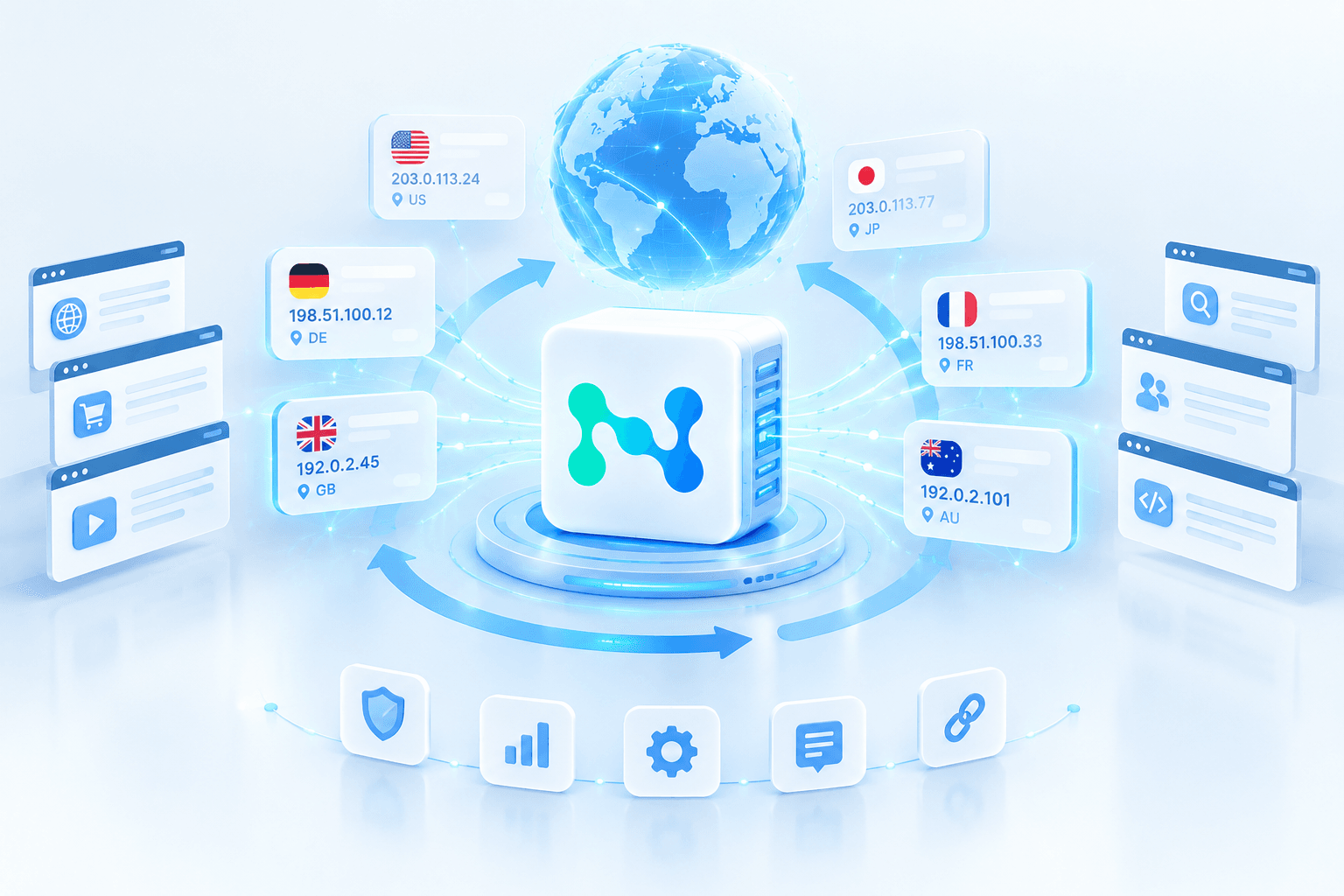
Rotating proxies are proxy servers that automatically assign different IP addresses from a shared pool to requests. The address can change with each new request, per session, or at a set interval. This approach is useful in situations where the same IP quickly runs into limits, gets blocked, or reduces the stability of access to data.
In practice, rotation solves not just one but several tasks at once. It distributes the load across addresses, reduces the likelihood of operations stopping because of restrictions on the website side, and makes it possible to scale processes that require many repetitive requests to the same resource. That is why rotating proxies are used in data collection systems, search results monitoring, ad placement verification, price analysis, and testing of digital products in different regions.
How rotating proxies work
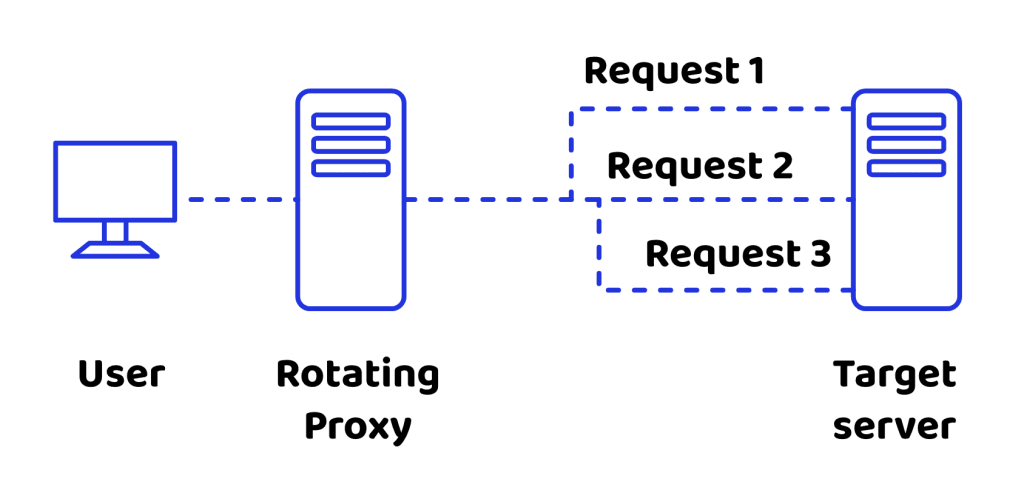
The mechanism is fairly simple: the user connects not to one fixed intermediary server, but to a provider access point behind which there is a pool of IP addresses. The provider then determines which address to use for a specific connection. Depending on the settings, this may be a new IP for each request, a separate address for a session, or a timed rotation.
For the client, this is convenient because there is no need to independently collect a list of addresses, monitor their condition, and write switching logic. It is enough to connect a single endpoint or proxy port and route traffic through it. The rotation takes place on the provider’s side.
This format is especially useful in tasks where continuity of operation matters. If some of the addresses stop working, traffic can continue to be sent through other IPs from the same pool. This significantly simplifies operation compared to manually managing a set of proxies.
Three Proxy Rotation Modes
Time-based, per-request, or Sticky — choose the right mode in Node Proxy.
Where rotating proxies are really needed
The main area of use is large-scale work with websites and web interfaces where many requests have to be sent in succession. First and foremost, this applies to data collection.
Web scraping
When parsing one website or a group of websites, the system often makes hundreds or thousands of requests in a short period of time. If all of them come from a single address, the resource quickly starts restricting access. Rotation makes it possible to distribute requests across different IPs and thereby maintain more stable process operation.
You can learn more about the role proxies play in web scraping in our article dedicated to this topic.
Price and assortment monitoring
Online stores, marketplaces, and aggregators regularly change prices, availability, and product listings. Tracking these changes at scale requires a stable flow of requests. Rotating proxies help collect such data without the constant need to replace addresses manually.
SEO monitoring and search results work
When a company tracks positions, snippets, ad blocks, or search result features in different regions, there is a need to repeatedly access search engines and related pages. Here, rotation reduces the risk that the process will stop quickly because of request frequency limits.
Ad verification
Advertising campaigns often need to be checked in different countries, cities, on different devices, and across different networks. Rotating proxies make it possible to reproduce such scenarios flexibly, without being tied to a single connection channel.
Testing websites, applications, and APIs
Developers use proxies not only for data collection, but also to monitor product behavior in different regions and network conditions. This is useful when testing content, localization, traffic routing, access restrictions, and API response specifics.
Main types of rotating proxies
The difference between types of rotating proxies is determined not so much by the rotation itself as by the nature of the IP addresses in the pool. This affects speed, cost, resistance to filters, and typical use cases.
Rotating datacenter proxies
These are addresses assigned to servers in datacenters. Their key advantage is performance. As a rule, such proxies are faster, easier to scale, and cheaper than other options. They are well suited for tasks where speed and cost per request come first.
But there is also a limitation: datacenter addresses are easier to recognize than addresses assigned to end-user devices. Therefore, on platforms with strict filters, their effectiveness may be lower. Nevertheless, for large-scale data collection, price monitoring, technical checks, and some SEO tasks, this is often a rational option.
Rotating residential proxies
In this case, IP addresses assigned by internet service providers to ordinary user connections are used. Such addresses fit better into a normal network profile, and therefore often work more reliably on resources with stricter protection systems.
Residential proxies are usually more expensive, but they often perform better where not only speed matters, but also the quality of request delivery. They are chosen for complex web scraping, ad verification, local content analysis, and other tasks where the platform actively filters traffic.
Rotating mobile proxies
These proxies use addresses from mobile networks. They are used less often, but in certain scenarios they are very useful: for example, when testing mobile services, advertising scenarios, or applications oriented toward mobile traffic.
The disadvantages of mobile proxies are the same as their advantages: they are more expensive, often slower, and not always needed for typical tasks. If a project does not specifically require a mobile environment, residential or datacenter solutions are usually sufficient.
How rotating proxies differ from static ones
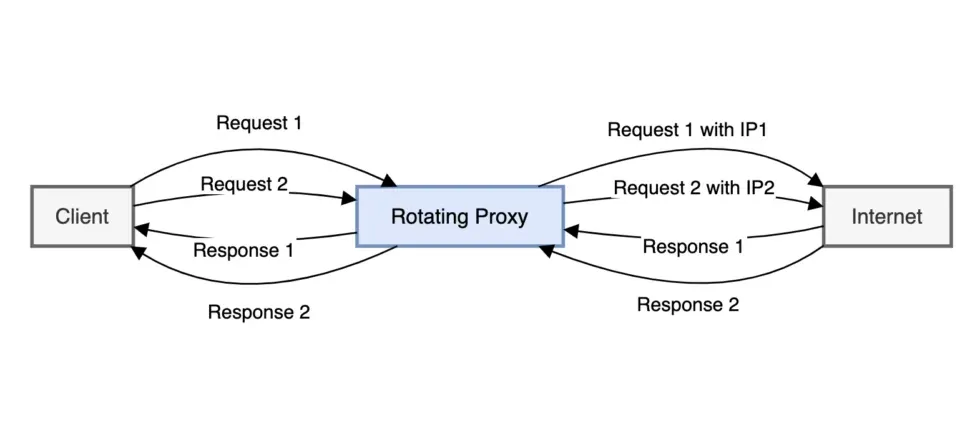
A static proxy keeps one IP address throughout the entire session. A rotating proxy, by contrast, changes the address according to preconfigured logic. At first glance, the difference seems technical, but in practice it affects the entire usage scenario.
A static proxy is better suited to situations where a predictable and continuous session is needed: a long account login, a persistent connection, testing the behavior of one user, or working with services that are sensitive to sudden IP changes.
A rotating proxy has an advantage elsewhere: when many requests, broad coverage, parallel work, and reduced dependence on a single address are required. Therefore, the choice between static and rotating is not a question of “what is better in general,” but a question of the specific task.
When rotation is useful and when it gets in the way
Rotation does improve scalability, but it is not a universal mode for all cases.
It is justified if you need to:
• collect large volumes of data;
• work with multiple regions;
• distribute requests across many addresses;
• reduce the impact of per-IP limits;
• support long-running processes of automated access to websites.
But there are scenarios where automatic IP changes create unnecessary problems. This applies to sticky sessions, where the same address must be maintained throughout the session. For example, if an application tracks the consistency of one user’s behavior or the website logic is sensitive to an address change within one sequence of actions, constant rotation will interfere.
That is why good providers usually offer a choice: rotation on every request, per session, or by timer. The more flexible these settings are, the easier it is to adapt proxies to the real load.
Advantages of rotating proxies
Rotating proxies have several strong points that have made them a standard tool in data collection and monitoring tasks.
First, they are better suited for work at scale. When a process needs to send a large volume of requests, one address quickly becomes a bottleneck. An IP pool solves this problem.
Second, rotation simplifies the infrastructure. The user does not need to independently collect and update a list of proxies, monitor failed addresses, or design the logic for distributing the load among them.
Third, such proxies make it possible to work with regional targeting more precisely. If the provider offers selection by country, city, or network type, more realistic monitoring and testing scenarios can be built.
Fourth, rotating proxies are convenient when the load grows. When a project moves from dozens of requests to thousands, a system with an IP pool usually scales much more easily than working through one or several static addresses.
Disadvantages to keep in mind
Rotating proxies also have limitations that are often underestimated at the start.
The first is cost. The higher the quality of the pool and the greater the requirements for geography, speed, and IP type, the more expensive the service becomes. This is especially noticeable with residential and mobile solutions.
The second is reduced session predictability. If a project requires a stable address throughout the entire chain of actions, rotation may break the interaction logic with the website.
The third is uneven IP quality within the pool. Even with strong providers, some addresses may work better and some worse, especially on sensitive platforms. Therefore, in practice, not only the size of the pool matters, but also its quality.
The fourth is a potential decrease in speed. Rotation itself does not necessarily mean slow performance, but compared to good static proxies it may deliver less consistent performance, especially in the case of residential or mobile addresses.
How to connect rotating proxies
Usually, the provider supplies a host, port, username and password, or an API endpoint. The proxy is then connected at the level of the application, script, or system settings. After that, traffic begins to pass through the address pool automatically.
The setup process usually looks like this:
1. Obtain the connection parameters from the provider.
2. Choose the rotation mode: per request, per session, or per interval.
3. Connect the proxy in the application, script, or parser.
4. Check how the external IP changes during repeated requests.
From a technical standpoint, integration is not difficult: most languages and libraries support proxies in just a few lines of code. The harder part is not the connection itself, but choosing the right operating mode for the specific task.
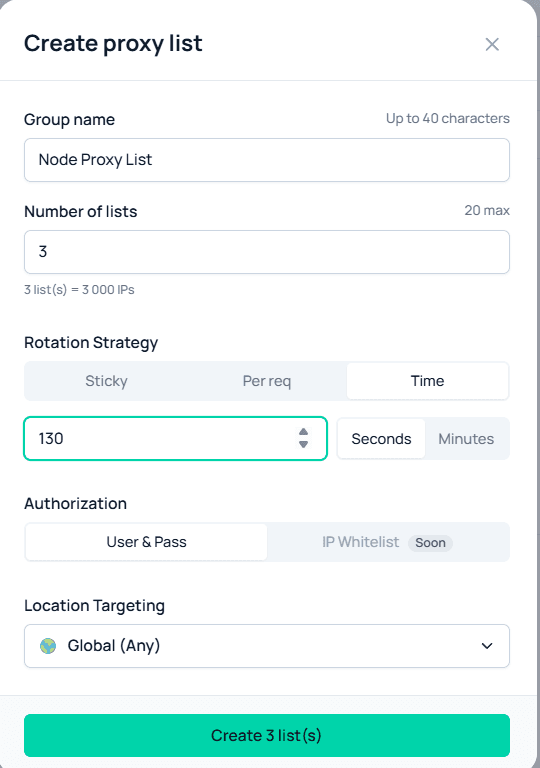
Node Proxy supports time-based, per-request, and Sticky rotation.
How to choose a provider
When choosing a service, it is important to look not only at the price and the promised pool size. Several other criteria have practical importance.
Pool size and quality
A large pool is useful, but by itself it guarantees nothing. What matters is that the addresses are functional, sufficiently diverse, and not overloaded.
Geography
If the project is related to local search results, advertising, pricing, or country-based testing, it is necessary to check in advance which regions are available and how precisely the location can be selected.
Rotation control
A good provider makes it possible to change the operating mode: rotation on every request, fixed session, timer, binding to a country, or address type. Without this, even a large pool may turn out to be inconvenient.
Speed and stability
For production tasks, not only peak indicators matter, but also consistent performance throughout the day, as well as a clear level of service availability.
What alternatives exist
Rotating proxies are not always the only or the best option.
Static proxies are suitable when a constant IP and a predictable session are needed.
Proxy rotators can be used as a separate management layer on top of a set of static addresses. This provides more control, but requires additional setup.
There are also services that combine proxies, rotation, header selection, restriction handling, and other mechanisms in one API. This approach is convenient when the task is not proxy management as such, but obtaining data with minimal in-house infrastructure.
Conclusion
Rotating proxies are a tool for tasks where one IP quickly becomes a limitation. They make it possible to distribute requests across a pool of addresses, simplify scaling, and make collection, monitoring, and testing processes more resilient.
The choice of a specific type depends on what matters more for the project: speed and price, request delivery quality, or operation in a mobile environment. Datacenter proxies are usually more cost-effective and faster, residential proxies are often better suited to more difficult platforms, and mobile proxies are needed in narrower scenarios.
The main principle of choice here is simple: first determine the nature of the load, the session requirements, the geography, and the request volume, and only then select the type of rotation and the IP class. In that case, proxies become not a fallback tool “just in case,” but a working part of the infrastructure that genuinely solves the task.