Russian Proxies: Where to Buy Them and How to Choose a Provider

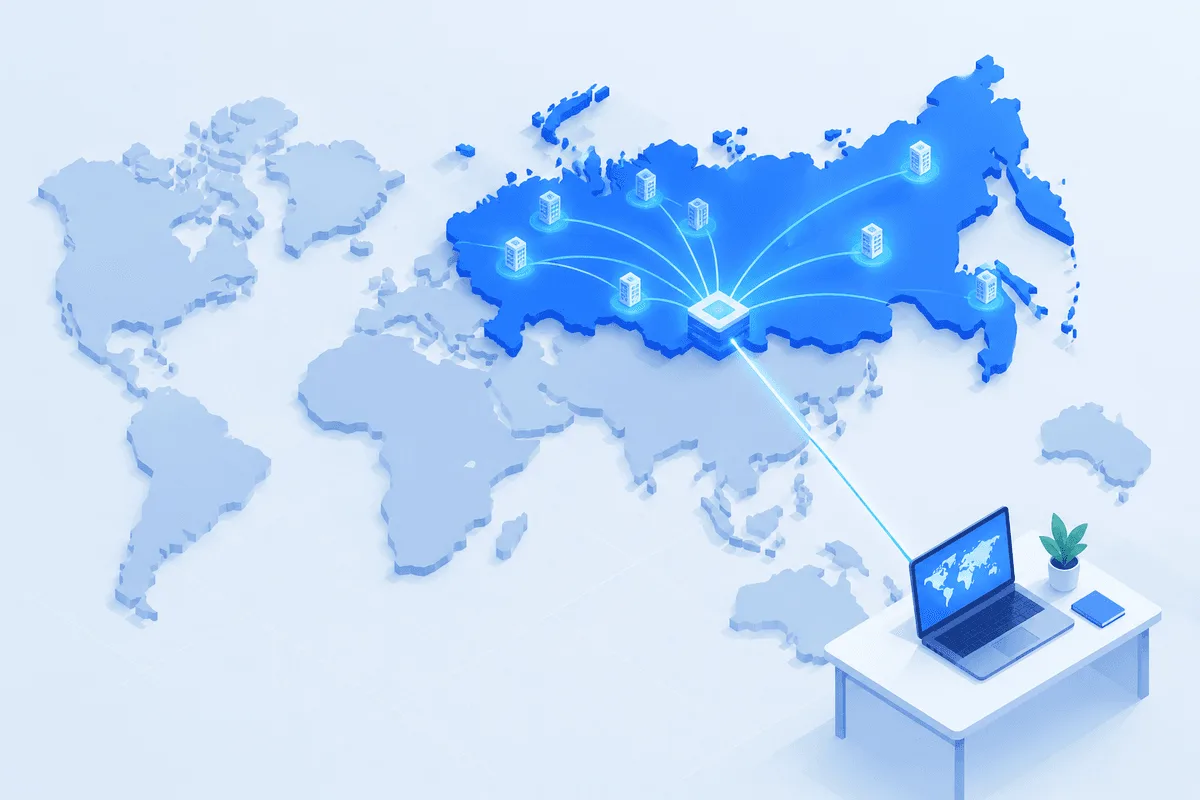
A Russian proxy is an intermediate server with an IP address registered to a Russian network, so websites treat your request as if it came from inside Russia. The best option depends less on the brand than on the job: residential IPs for search results and marketplaces, static addresses for long sessions in one account, and datacenter IPs for fast bulk checks of tolerant sites.
Most pages on this topic stop at a definition and a buy button. This guide goes further: which legitimate tasks actually require a Russian address, which local operators and ISPs stand behind the IPs, how the main proxy types behave on Russian sites, and a checklist for comparing providers before you pay.
Proxies with Russian IPs
Residential proxies with country and city targeting for regional search, marketplaces and ad checks
Why You May Need a Russian IP Address
Many Russian services adapt content, prices and access rules to the visitor's location. A foreign address either shows a different version of the page or gets refused altogether. Typical lawful scenarios:
- Local search results. Yandex and the Russian version of Google rank pages differently by region. SEO specialists check positions in Moscow, Kazan or Novosibirsk without travelling there. The SEO proxies overview explains how regional rank checks are organised.
- Marketplace analytics. Wildberries, Ozon and Avito show prices, delivery terms and stock that depend on the region. Sellers and analysts collect this public data to monitor competitors and their own listings.
- Ad verification. Agencies confirm that a campaign appears in the right city and that landing pages open correctly for local users.
- Russian services from abroad. People living or travelling outside the country sometimes find that banking portals, government websites or streaming catalogues refuse foreign connections or behave differently. A Russian address helps them reach their own accounts, as long as the service's terms allow it.
- Testing of apps and websites. QA teams check geo-redirects, localised payment pages and content restrictions the way a customer in Russia sees them.
What a Russian IP does not do: it does not make you anonymous to the services you sign in to, and it does not override the terms of a platform or the laws of any country involved. Treat it as a location tool, not a disguise.
Who Owns Russian IP Addresses
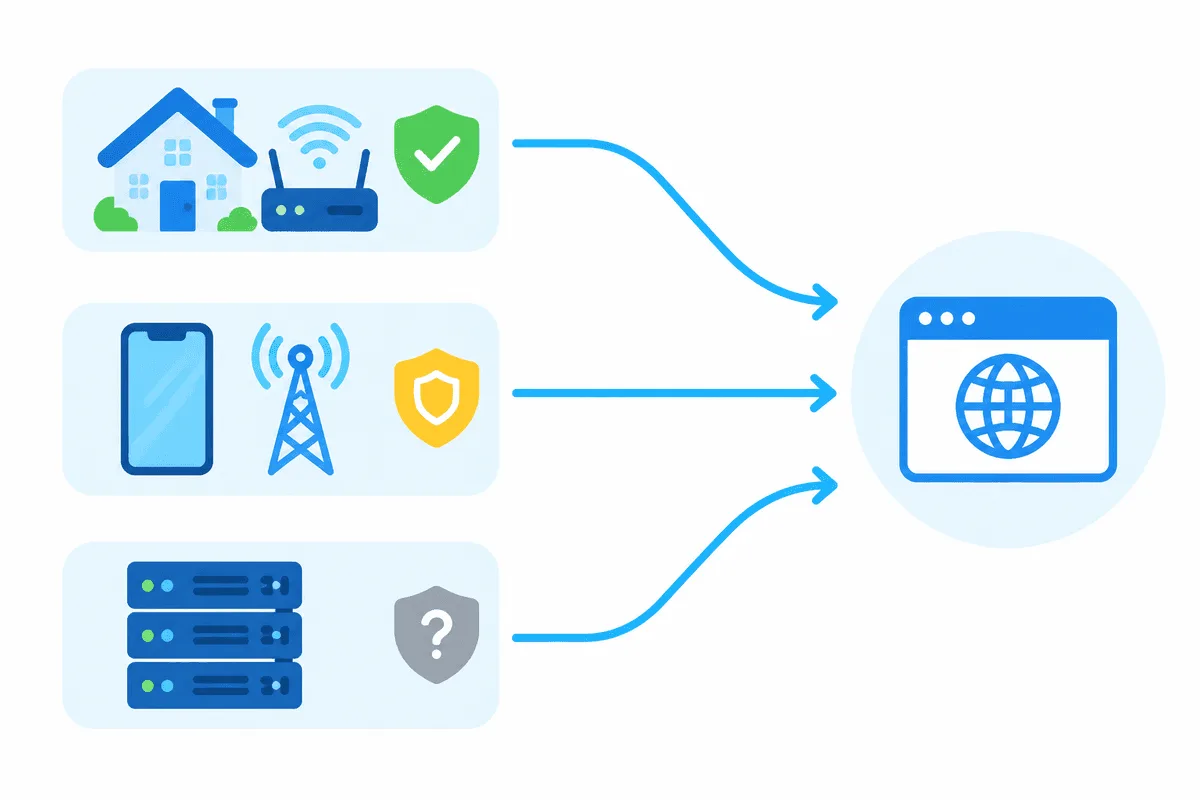
Websites read more than the country. Anti-fraud systems check the autonomous system (ASN) of the IP and classify it as a home broadband line, a mobile network or a hosting company. That is why the origin of the address matters.
| Source of IP | Typical owners | How sites see it |
|---|---|---|
| Home broadband | Rostelecom, ER-Telecom (Dom.ru), home internet arms of MTS and Beeline, regional ISPs | Ordinary household user, highest trust |
| Mobile carriers | MTS, MegaFon, Beeline, T2 (former Tele2) | Phone user behind carrier NAT, many people share one address |
| Hosting and datacenters | Russian and foreign hosting companies with Russian ranges | Server traffic, often flagged on marketplaces and banks |
Two practical details follow from this. First, an IP from a regional ISP usually geolocates to the right city more reliably than a hosting range that the databases place by the company's registered office. Second, mobile IPs rotate inside the carrier network on their own, so they suit short tasks better than accounts that expect one stable address. Our guide to IP geolocation explains how databases assign a city to an address and why they disagree.
Types of Russian Proxies and What They Suit
Residential
Residential exits come from home connections of real users who agreed to share bandwidth. They work best on demanding targets: Yandex search, marketplaces, classified ads, ticketing. Billing is usually per gigabyte, and the address can rotate on every request or stay fixed for a sticky session of several minutes. If you need many regional exits, residential proxies with city targeting are the usual starting point.
Static (ISP and IPv4)
Static proxies keep one address for weeks or months. That consistency suits a single business account, a seller cabinet or a long manual session where a sudden IP change triggers extra verification. Check whether Russia is among the countries offered for static IPs before you buy, since providers keep a shorter country list here than for residential traffic.
Datacenter
Datacenter IPs are fast and cheap, but marketplaces, banks and social networks spot them easily. They are a sensible choice for tolerant targets: checking site availability, downloading public files, monitoring your own resources.
Mobile
Carrier addresses enjoy high trust because hundreds of subscribers sit behind each one. They are useful for checking mobile apps and mobile ad placements. Not every provider sells them for Russia, and pricing is usually per port or per day rather than per gigabyte.
Use Case to Proxy Type: a Quick Map
| Task | Recommended type | Session mode |
|---|---|---|
| Yandex positions by city | Residential with city targeting | Rotating per request |
| Price and stock monitoring on Wildberries or Ozon | Residential | Rotating or short sticky |
| Working in one seller or business account | Static ISP | Same IP for weeks |
| Ad placement checks in several regions | Residential or mobile | Short sticky |
| Availability monitoring of your own site | Datacenter | Any |
| Reaching personal accounts on Russian services from abroad | Static or sticky residential | Long sticky |
For marketplace work specifically, the Wildberries proxies page lists the settings that matter on that platform.
How to Choose a Russian Proxy Provider
Prices and pool sizes on landing pages are hard to verify. These criteria can be checked during a short trial:
- Real Russian geography. Ask for a few exits in the cities you need, then confirm them in two or three independent IP databases. A pool advertised as Russian sometimes holds addresses that resolve to Kazakhstan or the Netherlands.
- Network type. Look up the ASN of a sample IP. If you paid for residential traffic, the owner should be an ISP, not a hosting company.
- Targeting depth. Country only, region, city or operator. Regional SEO needs at least city level.
- Session control. Can you keep the address for 10, 30 or 60 minutes? How is the session set: in the username, through a port range or via the provider's panel?
- Protocols. HTTP(S) covers browsers and scrapers; SOCKS5 is needed for some desktop apps and messengers.
- Payment and invoicing. Not every international provider accepts Russian bank cards, and not every Russian provider issues invoices to foreign companies. Check this before the trial ends.
- Rules and sourcing. A serious provider publishes acceptable use terms and explains how residential IPs are obtained, with consent of device owners.
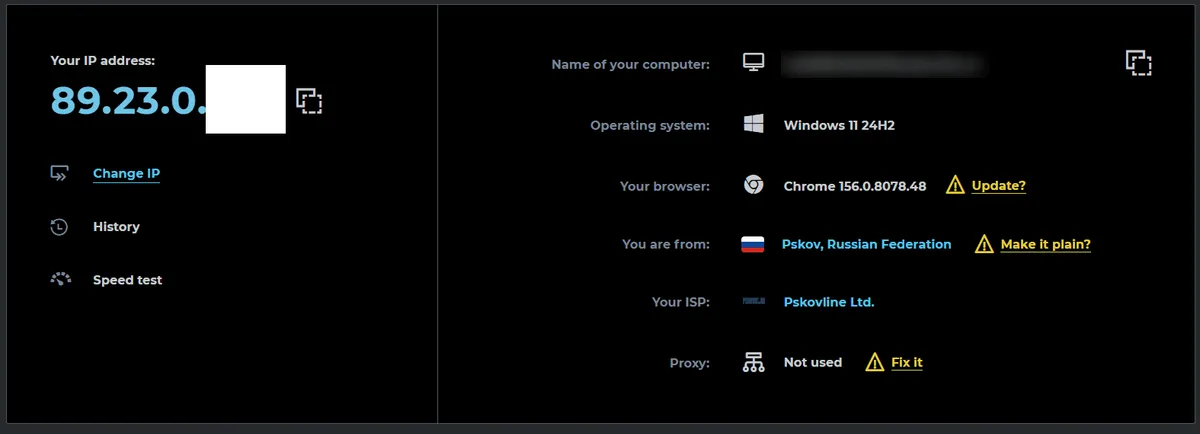
After you set up the proxy, verify the exit: the proxy geolocation check walks through the services that show the country, city and ISP of the current address.
Where to Buy Russian Proxies
Two groups of sellers cover this market.
International providers with large residential networks include Russia among many locations. Their strengths are documentation, flexible targeting and API access; the weak spot for Russian users can be payment methods. Node Proxy belongs here: residential traffic can be targeted to Russia down to the city level, and the dedicated Russia proxy page lists the available options.
Local Russian sellers mostly offer static IPv4 and mobile proxies on Russian carriers, pay in roubles and support Russian-language invoices. Pools tend to be smaller, residential rotation is less common, and terms vary widely, so read them carefully.
Whichever group you pick, start with the smallest package and test the exact task you need.
Common Mistakes
- Buying datacenter IPs for marketplaces. Cheap addresses get CAPTCHAs or empty results on the platforms that matter most.
- Ignoring city accuracy. A Moscow exit that databases place in another city distorts regional search positions and delivery terms.
- Rotating IPs inside one account. Logging in to a single account from a new address on every page view looks suspicious. Use a static or sticky exit.
- Forgetting about DNS and WebRTC leaks. A browser can reveal your real location even when traffic goes through the proxy. Check both after configuring.
- Assuming the proxy settles legal questions. Local rules, platform terms and data protection law still apply to what you do through it.
Russian Proxies FAQ
Are Russian proxies legal to use?
Using a proxy server is legal in most countries, including for reaching Russian websites. What matters is the activity itself, the platform's terms and the laws of the countries involved, so stay within them.
Which type of Russian proxy is best for Yandex rank tracking?
Residential proxies with city targeting give the most realistic local results, because Yandex personalises rankings by region. Rotating the address on each query also lowers the chance of CAPTCHAs during bulk checks.
Can I access Russian banks or government portals from abroad with a proxy?
A Russian IP often helps when a portal limits foreign connections, but some services add other checks, such as SMS confirmation or device recognition. Use a stable static or sticky address for such sessions and sign in only to your own accounts.
Why does my Russian proxy show another country?
IP databases update at different speeds and sometimes place an address by the owner's registered office. Check the exit in several databases, and if most of them disagree with the advertised location, ask the provider for another address.
Should I choose a Russian or an international provider?
International providers usually win on targeting, documentation and residential pool size, while local sellers are convenient for rouble payments and mobile proxies on Russian carriers. Test both on your real task and compare the cost per successful request.