Residential vs Server Proxies: How to Choose for Work Tasks


Proxy servers solve different tasks, but there is no universal option here. Residential proxies use IP addresses of home internet users and look more natural to websites, while server (datacenter) proxies use data center IPs and are faster and cheaper. One type is better suited to stable and cost-effective work with large volumes of requests, while another is more appropriate for scenarios where precise geography, a broad IP pool, and a higher level of trust from target websites matter. That is why the correct choice depends not on a general description of proxies, but on the environment in which they will be used and the constraints of a specific project.
Residential vs server proxies: the main difference
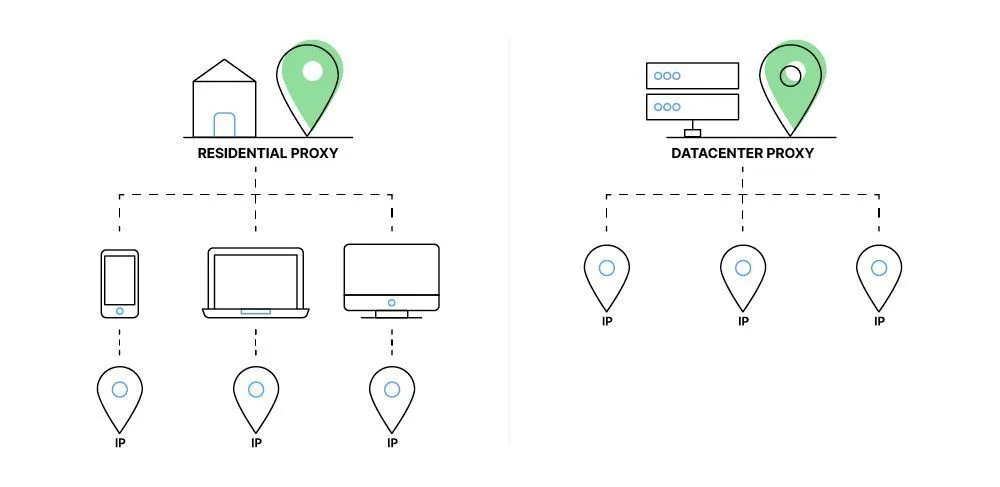
The main difference between these types of proxies is related to the origin of their IP addresses.
Residential proxies operate on the basis of IP addresses that belong to internet provider networks and are identified as the addresses of ordinary users. Because of this, such connections appear more natural to external systems. In addition, residential proxies usually offer a wider choice of locations and greater geographic accuracy: in some cases, you can choose not only a country, but also a region, a city, and sometimes even a provider.
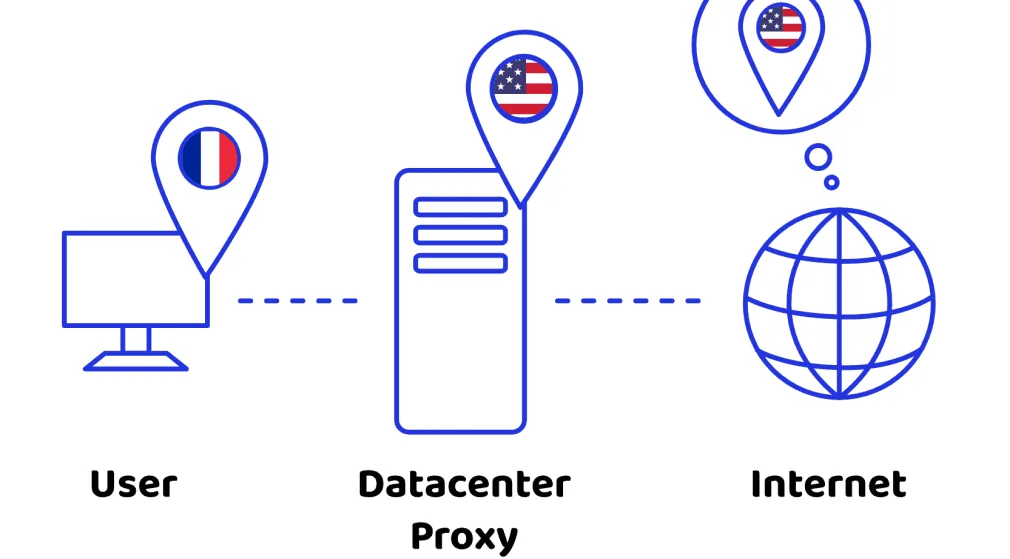
Server proxies, or datacenter proxies, use IP addresses that belong to hosting providers and data centers. They are built on server infrastructure, which is why they usually perform better in terms of speed, stability, and traffic cost. However, the origin of such IPs is much easier to determine, which means that on some platforms they are treated with greater caution.
It is this difference that determines the practical usage scenario: residential proxies are stronger where the naturalness of the connection and precise location matter, while server proxies are better where performance, predictability, and cost savings are the priority.
Residential Proxies for Global Work
Get an IP from the location you need, wherever you are.
How residential proxies work
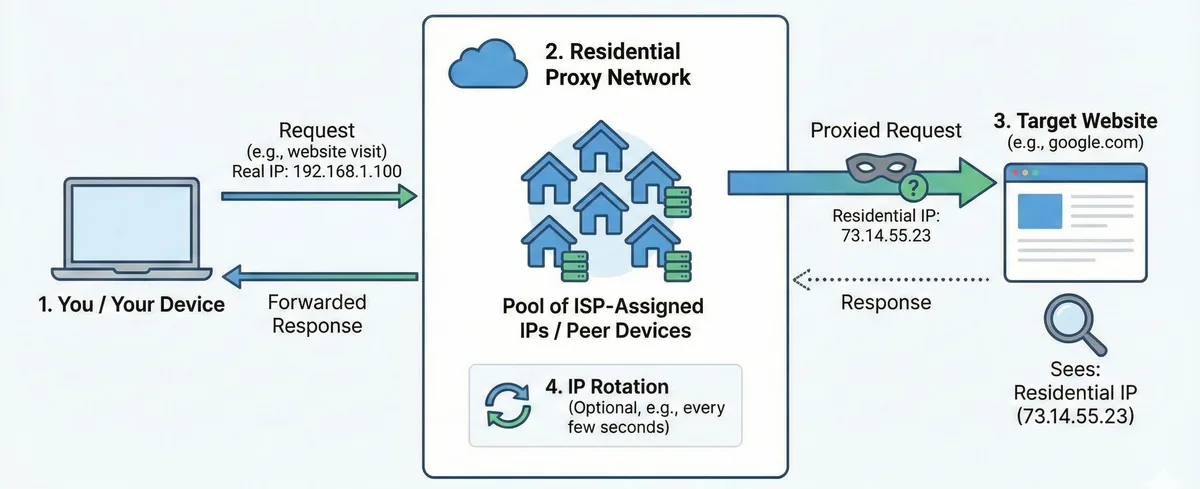
A residential network is built around IP addresses associated with home or user connections. In practice, this means that some of the addresses may change, and the availability of individual nodes does not always remain constant. For this reason, residential proxies often use a rotation mechanism.
There are two basic ways to organize such a network. In the first case, the client receives specific IPs and ports and independently manages their replacement as needed. In the second, an intermediate node is used, through which traffic is distributed across the entire network. This setup is more convenient for work tasks: it makes it possible to change outbound IPs according to a given logic, balance the load, and use addresses from the required regions without manually controlling each connection point.
From a practical standpoint, this makes residential proxies useful in projects where scalability, geotargeting, and flexible request distribution are important.
How server proxies work
Server proxies are launched on virtual or dedicated servers within datacenter infrastructure. Because of this, they provide what other types of proxies often lack: stable uptime, high connection speed, and predictable behavior under load.
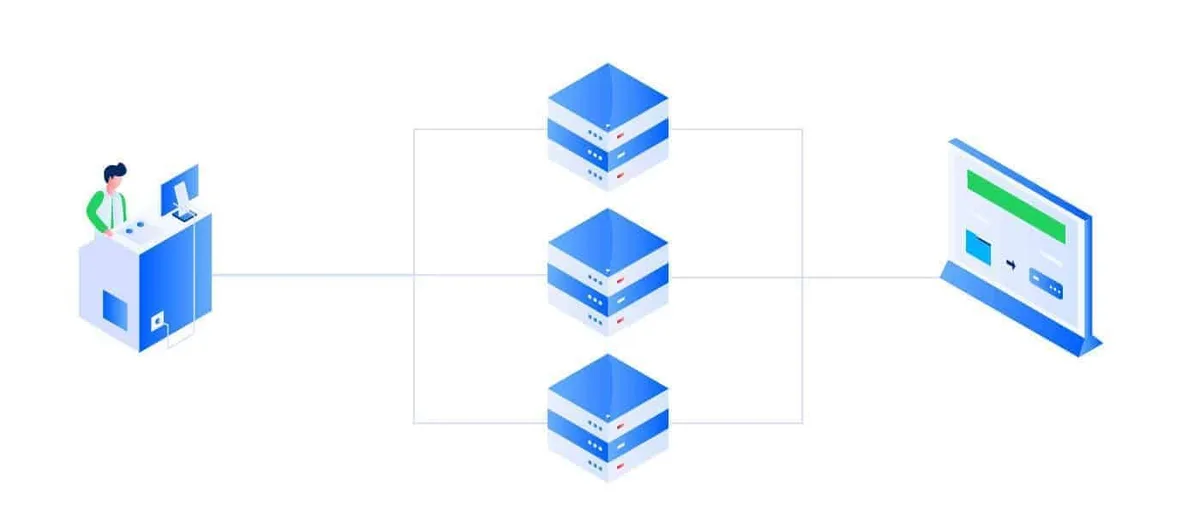
If the provider has a sufficiently large address pool, server proxies can also support rotation. In terms of usage logic, they then come closer to rotating residential solutions, but they retain the main difference: their IP addresses still belong to data centers and are therefore easier for external systems to identify.
That is why server proxies are well suited to technically straightforward tasks where there are no elevated requirements for the IP type and no need for ultra-precise geography.
Comparison by key parameters
Speed and stability
Here, the advantage usually remains with server proxies. They run on datacenter infrastructure, where hardware performance is higher and communication channels are broader. This is especially noticeable under intensive load, mass requests, and continuous operation without interruptions.
Residential proxies can also provide acceptable speed, but their quality depends on the specific node and the current network load. In addition, some addresses may periodically drop out of the pool, so without rotation and automatic management, stability will be lower.
Level of trust from websites
By this criterion, residential proxies usually have the advantage. IP addresses from user networks are perceived by protection systems as more natural than datacenter addresses. This reduces the likelihood of restrictions, additional checks, and other signs of suspicious activity.
Server proxies are weaker in this respect: their origin is easier to determine, which means that some addresses may already be on blacklists or may encounter captchas and restrictions more often.
Geographic accuracy
If a project needs to work precisely with a specific country, region, or city, residential proxies usually provide more options. Thanks to a broad distributed network, they are better suited to tasks where it is necessary to see a website or service through the eyes of a user from a specific location.
Server proxies also make it possible to choose geography, but the range is usually narrower and the level of detail is lower. In many cases, this means a country or a major city, without more granular targeting.
Cost
From a pricing standpoint, server proxies are more often the more cost-effective option. Their traffic is cheaper, their stability is higher, and their infrastructure costs are lower. If the target websites do not impose strict requirements on the IP type, datacenter solutions often provide the best balance between price and result.
Residential proxies are more expensive. However, in projects with complex restrictions, their use may prove economically justified: fewer failures, fewer repeated requests, and less time lost on bypassing restrictions and replacing non-working addresses.
When residential proxies are truly justified
Residential proxies are worth considering where the IP type directly affects the result. First of all, this concerns tasks that are sensitive to geography and projects where it is important to gain access to data or interfaces the way they are seen by an ordinary user in a specific country or region.
Another scenario is monitoring websites, prices, product ranges, advertising materials, and page availability in different locations. Here, residential proxies are useful because they make it possible to reproduce the real picture for a local user more accurately.
Large-scale data collection is also worth noting separately. If a project involves competitor analysis, regular monitoring of a large number of pages, and work across different regions, residential proxies provide two important advantages: a large address pool and more flexible rotation. This reduces the load on individual IPs and makes the process more stable.
Read how residential proxies are used for account management and workflow automation in our article about SMM proxies.
When it makes more sense to choose server proxies
Server proxies are a rational choice for tasks where speed, stability, and budget come first. They are suitable for projects that do not require high geolocation accuracy and do not need to use IPs from user networks.
They are convenient for standard integration scenarios, background requests, automation, processing large volumes of traffic, and other processes where performance matters more than the specifics of the IP address origin.
If the target resources operate without strict limitations and do not impose elevated requirements on the connection type, server proxies usually make it possible to solve the task more simply and at lower cost.
Residential vs Server Proxies FAQ
What is the difference between residential and server proxies?
Residential proxies use IP addresses that internet providers assign to home users. Server proxies use IP addresses of hosting providers and data centers, so they are faster and cheaper but easier for websites to recognize.
Are residential proxies better than datacenter proxies?
Not always. Residential proxies are better when trust and precise geography matter, while datacenter proxies win on speed, stability and price for tasks without strict IP requirements.
Why are residential proxies more expensive?
Their IP addresses come from real home connections spread across many locations, which costs more to provide than server infrastructure. In return, they get fewer blocks and checks on strict websites.
What is the difference between a residential and a private proxy?
Residential describes where the IP address comes from. Private means the proxy is used by only one client. A proxy can be both residential and private at the same time.
Conclusion
The choice between residential and server proxies is a choice between two different tools for different conditions. For a detailed side-by-side comparison, see our guide to residential vs. datacenter proxies.
If a project requires high speed, stability, and minimal cost, it usually makes sense to start with server proxies. If the task requires precise geography, a broad address pool, and a more natural connection profile, it is more practical to use residential proxies.
There is only one sound working approach here: base the decision not on general characteristics, but on the specific load, the requirements of the target websites, and the acceptable cost of an error. It is precisely within this combination that it becomes clear which type of proxy is truly suitable for the task. You can compare plans for Node Proxy residential proxies on the pricing page.