SMM Proxies: Account Management and Workflow Automation


Social media has long become a working environment for marketing, customer communication, content publishing, and audience response analysis. As the number of accounts, advertising campaigns, and repetitive operations grows, the workload on the team increases as well. At that point, businesses usually move from managing pages manually to a systematic approach with automation.
One of the technical tools used in such an infrastructure is a proxy. It helps build a more stable operating model for working with social platforms, distribute the load across tasks, organize publications by region, and reduce the risk of disruptions during intensive activity. Below is an overview of how proxies are used in SMM, what tasks they solve, and what to look at when choosing a solution.
Why SMM Proxies Are Needed in Social Media Management

When working with social platforms, companies face several typical tasks: they need to manage multiple accounts, publish materials on schedule, run automated scenarios, collect public data, adapt campaigns for different countries, and maintain stable access to working services.
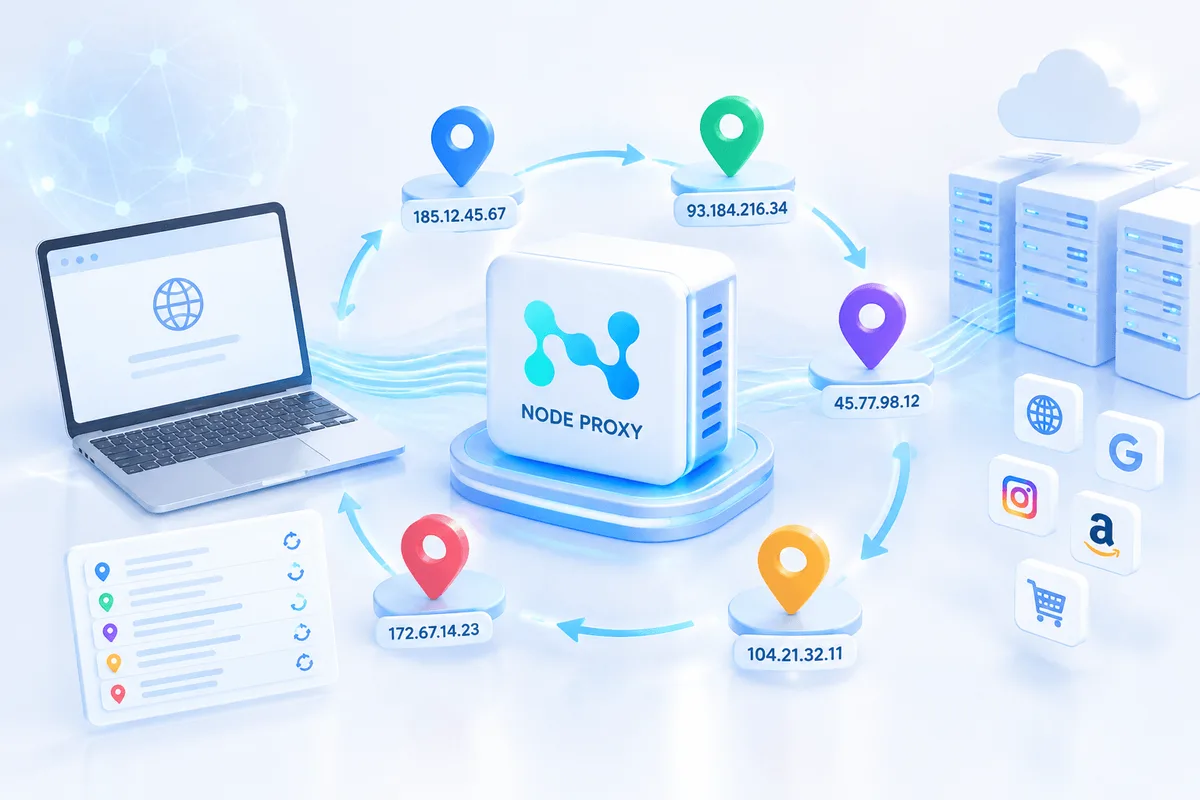
A proxy server is placed between the user or work tool and the social platform. Requests pass through an intermediate server, and the external system sees its network parameters instead. In practice, this makes it possible to separate work actions from the main connection, distribute traffic flexibly, and use addresses from the required regions.
For SMM, this matters not in itself, but as part of a normal operational model. When a team manually manages one page, additional infrastructure is usually not required. But when it comes to many accounts, regular publishing, public data scraping, moderation, or work across several geographic segments, processes quickly become unstable without technical organization.
Residential Proxies That Fit Your Workflow
Choose the IP, GEO, and rotation method that fits your needs.
What Tasks Proxies Solve in SMM
Managing Multiple Accounts
The more accounts are involved in the work, the higher the requirements for technical discipline. Proxies help separate activity between accounts and build a predictable access model for different working scenarios. This is especially important for agencies, e-commerce projects, franchises, international brands, and teams that manage several platforms at the same time. See also our guide on how to safely manage multiple social media accounts for business.
Automating Repetitive Actions
Publication schedulers, monitoring tools, comment processing systems, and other automated solutions create a regular load. If all processes go through one connection point, the risks of restrictions and disruptions increase. Proxies make it possible to distribute such operations and make the infrastructure more resilient.
Publishing and Scheduled Work
For businesses, it is important not just to publish content, but to release it on time according to the content plan. When a company works across different time zones and several platforms, manual posting becomes inefficient. In combination with automation tools, proxies help organize stable content publication and campaign support without constant manual control.
Geographic Adaptation of Campaigns
Social media marketing is increasingly built with the region in mind: offers, creatives, language, publication time, format availability, and audience response differ. Proxies with addresses in the required countries or cities make it possible to build workflows for specific markets and check how content or advertising materials look in different locations.
Collecting Public Data
Public data from social networks is used for content analysis, mention tracking, competitor monitoring, and audience research. Under intensive information collection, the load grows quickly. Proxies help organize such a process more steadily and without constant failures, especially if the task involves long-term or large-scale data collection.
Platform-Specific Setups
Each social network has its own rules for logins, automation, and multiple accounts. For platform-specific recommendations, see our pages on Instagram proxies and Facebook proxies, and our guide to proxies for TikTok.
How Proxies Benefit Workflows
The benefit of proxies in SMM is not limited to one function. Their value lies in helping build a manageable technical environment for marketing tasks.
- First, they simplify scaling. When a business expands its presence on social media, manual methods quickly stop working. A need for standardization appears: which accounts are connected to which tools, how publications are organized, and which channels are responsible for analytics, moderation, and data collection.
- Second, proxies improve process resilience. If all activity is concentrated at one point, any disruption has a stronger impact on the team’s work. Separating tasks across individual connections makes the system more predictable.
- Third, they help configure regional scenarios more precisely. For international campaigns, this is no longer an additional option, but a practical necessity: businesses need to see the platform and content in the same form as the target audience in a specific country sees them.
How to Choose an SMM Proxy Service
The choice of a solution depends not on a provider’s loud promises, but on how well the service matches the working tasks. What should be evaluated is not an abstract “best proxy,” but a specific set of parameters.
Provider Reputation and Stability
Service reliability is verified not by advertising language, but by the length of time the provider has been operating, reviews, transparency of terms, and the quality of support. If the provider does not give clear information about proxy types, countries, pricing, and replacement rules, that is already a reason to be cautious.
Choice of Locations
For SMM, this is one of the key criteria. If a project works with specific markets, it is important to make sure in advance that the provider offers the required countries and a sufficient choice of addresses. Otherwise, the technical solution will become useless already at the campaign launch stage.
Fit for the Tasks
Different scenarios require different infrastructure. For one project, the stability of long sessions is more important; for another, scalability; for a third, the geography of addresses. Therefore, before purchasing, it is worth determining exactly what the proxies will be used for: publishing, analytics, account network management, public data scraping, or combined work.
Support Quality
Technical issues in this area are inevitable: address replacement, parameter clarification, help with connection, and investigation of unstable performance. Support should respond quickly and substantively. For businesses, this is not a secondary bonus, but part of the service’s operational reliability.
Cost
What should be compared is not just the price of a package, but the ratio of cost to quality. Very cheap solutions often turn out to be limited in resources, location choice, or stability. Overpaying is also not always justified if the business uses only a basic set of functions. The optimal option is a plan that covers real tasks without excessive costs.
Why Random Free Solutions Are Not Suitable for Business Tasks
For occasional access to individual websites, free tools are sometimes seen as a temporary workaround. But they are not suitable for systematic work with social networks. Businesses have different requirements here: stability, clear parameters, replacement options, technical support, and predictable connection quality are needed. We explain the risks in Are Free Proxies Safe?
If publications, activity processing, data collection, or management of multiple accounts depend on proxies, service instability immediately affects the result. That is why, in a professional environment, paid solutions with transparent terms and a clear technical foundation are usually used.
For SMM tasks, Node Proxy offers residential proxies with IP addresses in many countries and mobile proxies for platforms that expect connections from smartphones.
How to Integrate Proxies into the Workflow
The setup depends on the specific tool: a browser, environment, SMM platform, parser, publishing system, or corporate infrastructure.
First, technical parameters are obtained from the provider: server address, port, and, if necessary, authorization data. Then these parameters are entered into the tool through which the work will be carried out. After that, the connection is checked for correctness, and only then is it moved into production use.
It is important not to limit the process to formally adding a proxy in the settings. After connection, it is necessary to verify how each individual task works: publishing, account login, post scheduling, comment monitoring, data collection, switching between regions. It is at this stage that it most often becomes clear whether a specific configuration is suitable for real processes.
Practical Recommendations for Use
For proxies to actually be useful, they need to be integrated into a system rather than used chaotically.
First of all, it is worth distributing roles in advance: which proxies are used for publishing, which for analytics, and which for individual accounts or regions. This simplifies control and reduces the likelihood of confusion.
Next, it is important to regularly check the quality of operation: speed, stability, availability of the required platforms, and the correctness of geography. If these parameters are not monitored, problems are usually noticed only after publication failures or automation errors.
Another important point is updating addresses and using rotating proxies in the scenarios where IP rotation is really needed. If the infrastructure remains static for too long, it adapts worse to changing loads and platform requirements.
Finally, it is worth periodically reviewing the tools in use. As a project grows, tasks change: new countries are added, the number of accounts increases, the content plan becomes more complex, and analytics expand. What was suitable at the start does not always remain optimal a few months later.
What Problems Arise Most Often
Even with careful setup, disruptions may appear in operation: unstable connection, authorization errors, incorrect functioning of individual features, speed drops, problems with specific platforms, or issues with address geography. Such situations should not be treated as exceptions—they are a normal part of technical operation.
When Proxies Are Especially Useful
Proxies provide the greatest practical value where work with social networks has already gone beyond manual management. This applies to agencies, marketing teams, e-commerce projects, international brands, media platforms, and services that manage multiple accounts, work according to a content plan, use automation, and analyze public data. The same applies to traffic arbitrage in social media, where specialists work with many accounts and campaigns at once.
In such scenarios, proxies become not an auxiliary option, but part of the operational infrastructure. They help systematically organize access, reduce the number of technical disruptions, and maintain predictable operation of the tools on which daily marketing depends. Other scenarios are covered in our overview of where proxies are useful in business.
SMM Proxy FAQ
What are SMM proxies?
SMM proxies are proxy servers that marketers and agencies use to work with social media: managing several accounts, scheduling posts, collecting public data, and checking campaigns in different regions.
Which proxies are best for social media?
Residential and mobile proxies, because their IP addresses belong to real internet providers and mobile operators. Datacenter proxies are faster and cheaper, but social platforms restrict them more often.
How many accounts can I run on one proxy?
The safest practice is one account per IP address or one IP address per browser profile. Sharing one address between many accounts links them together and increases the risk of restrictions.
Can I use free proxies for SMM?
No. Free proxies are slow, unstable, and shared with strangers, and social networks have often blocked their addresses already.
Conclusion
Proxies in SMM are not a standalone tool, but a technical layer that helps build manageable work with social networks. They are used where scalability, stability, regional campaign configuration, publication automation, and work with public data are important.
The practical value of proxies depends not only on the service itself, but also on how competently it is integrated into the processes. If the tasks are defined in advance, the usage model is thought through, and the provider is chosen according to real criteria, proxies help make social media management more stable and predictable.