How to Scrape Customer Reviews: Marketplaces, Maps and Review Sites With Proxies


Review scraping is the automated gathering of openly published buyer feedback from shops, map listings and rating platforms, followed by converting stars, dates and comment bodies into a table that analysts can query. The technical core is simple: find where the page loads its reviews from, walk through every page or cursor, store each review once, and spread the requests over a sensible pace and, when needed, several IP addresses.
The legal and ethical side deserves equal attention. Reviews are written by real people, platforms set their own rules for automated access, and some of them sell this data through official channels. Below you will find where reviews live and how each source delivers them, a data model that keeps personal data to a minimum, pagination code, incremental updates, proxy settings and a first pass at sentiment analysis.
Residential proxies for review monitoring
Country-targeted residential IPs with sticky sessions for paginated review feeds
Ground Rules Before You Collect Anything
Treat these as part of the project scope, not an afterthought:
- Public reviews only. Stick to content an anonymous visitor is shown. Signing in to reach extra data, or getting around paywalls, access controls or CAPTCHAs, is out of bounds.
- Read the terms and robots.txt. Many platforms restrict automated collection in their terms of service. Where an official API or data licence exists, it is usually the safer route. When in doubt, ask a lawyer about your jurisdiction and use case.
- Personal data caution. Author names, profile URLs and avatars may count as personal information under European, Russian, Californian and comparable privacy rules. Store only the fields you need, pseudonymise author identifiers and set a retention period.
- Read, never write. A review scraper only reads. Posting, editing, voting on or generating reviews is outside the scope of this guide, and fake reviews are illegal in many countries.
- Respect capacity. Keep request rates low and stop when a site signals that you are too fast.
Where Reviews Live and How They Load
| Source type | Examples | How reviews usually arrive | Official alternative |
|---|---|---|---|
| Marketplaces | Amazon, eBay, Ozon, Wildberries | Separate review pages or JSON calls with page numbers | Seller programmes expose reviews of your own listings |
| Map listings | Google Maps, Apple Maps, 2GIS | Lazy loading on scroll, cursor tokens in XHR responses | Google's place endpoints expose a small sample; the owner-side profile interface covers only listings you manage |
| Review aggregators | Trustpilot, Yelp, Tripadvisor, G2 | Server-rendered pages with a page parameter, sometimes embedded JSON | Business APIs, mostly for reviews of your own company |
| App stores | Google Play, App Store | Paginated feeds or JSON calls | Developer consoles show reviews of your own apps |
Exact limits of each official API change over time, so check the current documentation of the platform before you plan around them. If an API gives you everything you need for your own products, use it and skip scraping entirely.

What to Store: a Lean Review Record
Decide on the schema before writing code. A compact record keeps the dataset useful and limits how much personal data you hold:
| Field | Example | Note |
|---|---|---|
source | aggregator-x | Platform label |
item_ref | product or place ID | Links the review to what was rated |
review_ref | platform review ID or a hash | Used for de-duplication |
rating | 4 | Normalise to a 1–5 scale |
posted_at | 2026-09-14 | Convert to ISO dates |
body | comment text | Strip HTML, keep line breaks |
lang | en | Detected language |
author_key | salted hash | Never the raw name or profile URL |
verified | true | Only if the page shows it |
Skip avatars, profile links and any contact details. If the text itself contains phone numbers or e-mail addresses, mask them during cleaning.
Step 1. Find the Real Source of the Reviews
Open a product or place page, press F12, switch to the Network tab and filter by Fetch/XHR. Now click the next page of reviews or scroll the review panel. A new request usually appears that returns JSON with ratings and texts. Note three things:
- the URL and which parameter changes between pages (
page,offset,cursor,pageToken); - the headers the request needs, for example a language header or a referer;
- where the response tells you that there is nothing left (an empty list, a missing cursor, a
hasMoreflag).
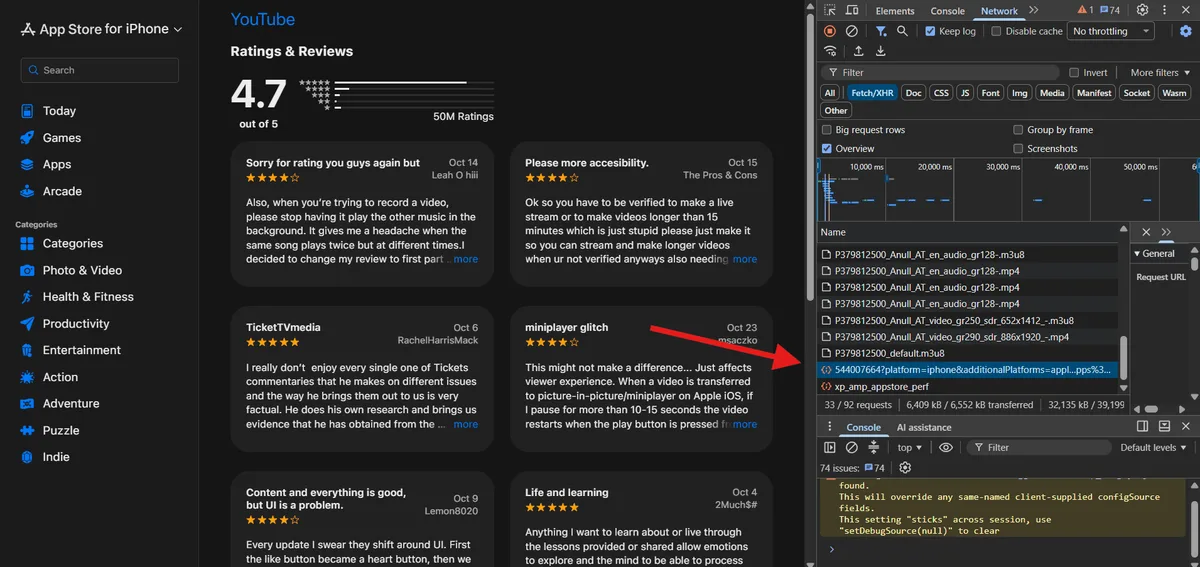
When the network log shows nothing like that, the comments ship with the initial HTML, occasionally as a JSON blob tucked into a script element. Parsing that JSON is far more stable than chasing CSS classes, which change with every redesign.
Step 2. Walk Through Pages or Cursors
Most review feeds use one of two pagination styles. Numbered pages are easy: increase the counter until the list comes back empty. With cursors, each response carries an opaque marker for the following batch, and the loop echoes it back until the marker goes missing. The sketch below targets a placeholder endpoint in cursor mode; rename the fields to match the payload you inspected.
import os, time, random, hashlib
import requests

GATEWAY = os.environ["GATEWAY_URL"]          # http://user:pass@host:port
SALT = os.environ["AUTHOR_SALT"]
FEED = "https://reviews.example.com/v1/items/{item}/reviews"

session = requests.Session()
session.proxies = {"http": GATEWAY, "https": GATEWAY}
session.headers.update({
    "User-Agent": "Mozilla/5.0 (Windows NT 10.0; Win64; x64)",
    "Accept": "application/json",
    "Accept-Language": "en-US,en;q=0.8",
})

def mask_author(raw_name: str) -> str:
    return hashlib.sha256((SALT + raw_name).encode()).hexdigest()[:16]

def pull_reviews(item_id: str, newest_known: str | None = None):
    token, batch_no = None, 0
    while True:
        params = {"sort": "newest", "limit": 20}
        if token:
            params["cursor"] = token
        reply = session.get(FEED.format(item=item_id), params=params, timeout=30)
        if reply.status_code == 429:
            time.sleep(int(reply.headers.get("Retry-After", 60)))
            continue
        reply.raise_for_status()
        payload = reply.json()
        for entry in payload.get("reviews", []):
            if entry["id"] == newest_known:
                return
            yield {
                "review_ref": entry["id"],
                "rating": entry.get("stars"),
                "posted_at": entry.get("date"),
                "body": entry.get("text", "").strip(),
                "author_key": mask_author(entry.get("author", "")),
            }
        token = payload.get("nextCursor")
        batch_no += 1
        if not token:
            return
        time.sleep(random.uniform(1.5, 4.0))
Pay attention to two choices here. Ordering by date together with the newest_known comparison makes repeat runs incremental, because collection halts at the first already stored item. The 429 handler, in turn, sleeps for the period the server requested rather than hammering it again at once.
Step 3. Store, De-duplicate and Update
Give the storage table a composite unique constraint over source and review_ref. Where a platform hides review identifiers, hash the rating, date and first 200 characters of text and use that as the key. Reviews can be edited or removed, so for long-running monitoring keep a last_seen date and periodically re-read the most recent pages rather than the whole history. For exports, JSON Lines keeps nested data intact and CSV opens directly in spreadsheets.
Step 4. Proxies: When You Need Them and Which Kind
A few hundred reviews for one product rarely need anything beyond polite pacing. Proxies become relevant in three situations:
- Volume. Monitoring thousands of products or places means many requests per day, and per-IP limits kick in.
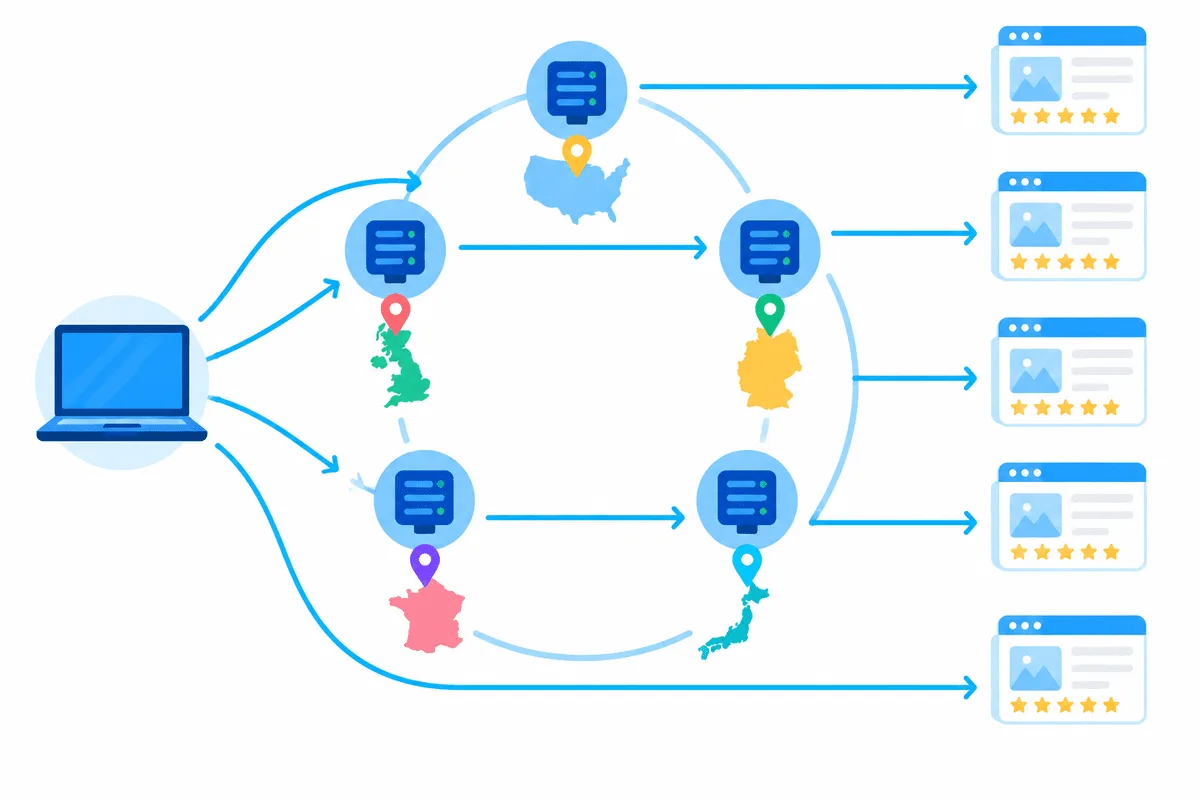
- Geography. Map listings and marketplaces often show different reviews, languages or sort orders depending on the visitor's country. An exit IP in the target market gives you the view local customers have.
- Stability. Datacenter ranges are flagged quickly by large consumer platforms, so requests from them fail more often.
For review feeds, residential proxies with country targeting are the usual choice. Keep one sticky session for the whole cursor chain of a single item, because some feeds bind the cursor to the session, and rotate between items. Our article on sticky vs rotating proxies explains the trade-off, and the guide to proxies in web scraping covers pacing and headers in more depth. For Google properties specifically, see our page on proxies for Google.
Step 5. From Text to Insight: Sentiment and Topics
Star ratings alone hide most of the signal. Three steps turn raw comments into something a product or marketing team can act on:
- Language detection and cleaning. Separate languages before analysis, remove markup and mask personal details.
- Sentiment scoring. For English, the VADER lexicon in the
vaderSentimentpackage gives a quick compound score from −1 to 1. Multilingual transformer models are more accurate for other languages but need more compute. - Aspect grouping. Count how often phrases about delivery, size, battery, staff or price appear in negative versus positive reviews. That shows what drives low ratings.
from vaderSentiment.vaderSentiment import SentimentIntensityAnalyzer

scorer = SentimentIntensityAnalyzer()

def tone(text: str) -> str:
    value = scorer.polarity_scores(text)["compound"]
    if value >= 0.05:
        return "positive"
    if value <= -0.05:
        return "negative"
    return "neutral"
Combined with prices and stock data, review trends are a staple of competitor research; the article on proxies in market analytics shows how teams set up such monitoring.
Common Problems
| Symptom | Likely cause | What to do |
|---|---|---|
| The page shows reviews, the HTML does not | Reviews load via XHR after render | Use the JSON request from DevTools |
| Cursor stops working after a few pages | Cursor tied to session or IP | Keep one sticky session per item |
| Same review appears twice | Overlapping pages while new reviews arrive | Unique key on review ID or content hash |
| 403 or a challenge page | Flagged IP, missing headers, too fast | Slow down, browser-like headers, residential exits; never solve challenges automatically |
| 429 Too Many Requests | Rate limit | Honour Retry-After, reduce parallelism |
| Different reviews than a colleague sees | Country, language or sort differs | Fix the exit country and send an explicit language header |
Review scraping FAQ
Is it legal to scrape customer reviews?
The answer varies with jurisdiction, each platform's rules and the purpose of the dataset. Many companies analyse openly visible feedback, yet contractual terms, protection of databases and privacy statutes may restrict the practice, so review every source's conditions and consult counsel before any commercial use.
Can I collect reviewer names?
Avoid it unless you have a clear legal basis. Names and profile links are usually personal data, so store a salted hash instead, which still lets you group reviews by author without keeping their identity.
Why does the Google API return so few reviews?
The public place endpoints were designed to show a short selection per listing rather than the full history, and Google can adjust that cap, so confirm it in the current reference. Complete lists are offered through the owner-side Business Profile tools, and only for listings you control.
Do I need proxies to scrape reviews?
Not for small, slow jobs. They help when you monitor many products or places, need reviews as customers in a specific country see them, or keep hitting per-IP limits; residential proxies with sticky sessions suit most review feeds.
How do I keep a review dataset up to date?
Sort the feed by newest, remember the latest review ID you stored for each item and stop the crawl when you reach it. Re-read recent pages from time to time to catch edits and removals.