American Proxy Servers: How They Work and What Tasks They Are Suitable For
 ·July 30, 2026·7 min read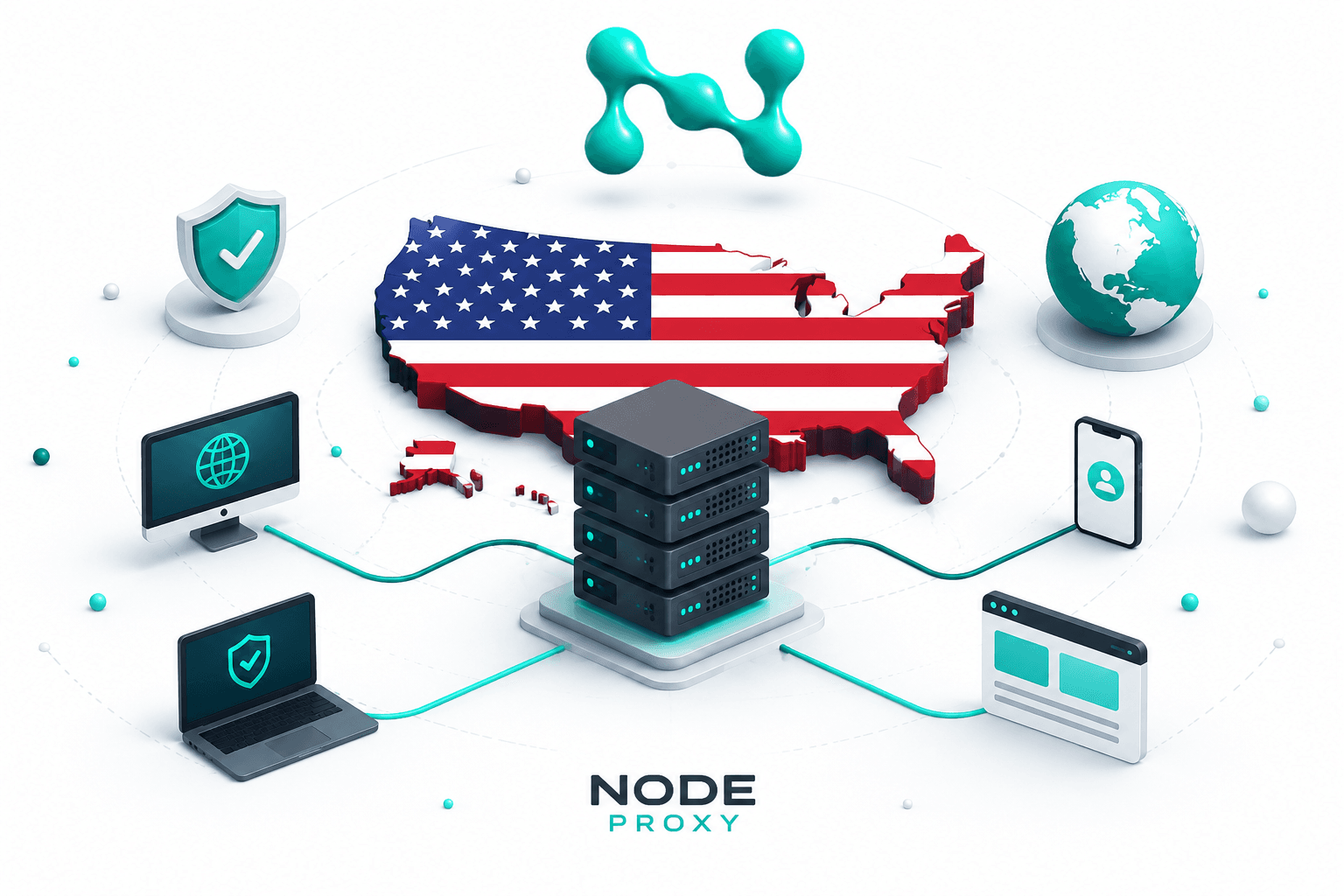
How a Proxy Server Works
The operating mechanism is fairly straightforward. A user device sends a request not directly to the website, but to the proxy server. The proxy receives it, processes it according to the specified rules, and forwards it to the destination resource. The response returns along the same path — first to the proxy, then to the user’s device.
This architecture is convenient because it makes it possible to control the traffic route, define request processing rules, use caching, filtering, and load distribution. In essence, the proxy becomes a manageable layer between the client and the internet resource.
Why U.S. Proxies Are Used Specifically
U.S. proxies are in demand where working with services focused on the U.S. market is important. The reasons are usually practical.
First, this is website and web application testing. If a company is developing a product for an American audience, it is important for it to see how the website, user account area, advertising, prices, registration forms, and content are displayed to a user from the United States.
Second, this is marketing and analytical work. SEO specialists, contextual advertising specialists, content teams, and digital analysts often need to check local search results, page behavior, variations in the display of ad blocks, and the specifics of how services operate in a particular country.
Third, this is work with international platforms and accounts where the connection region affects available functions, interfaces, or authorization scenarios.
Fourth, these are research tasks. For analyzing the American segment of the internet, monitoring local websites, studying competitors, and checking user experience in the United States, it is more convenient to use the appropriate IP address than to rely on indirect data.
Looking for US proxies?
Get residential IPs across 195+ regions.
What Tasks U.S. Proxies Solve
The range of applications for such solutions is broader than it may seem at first glance.
Product and Localization Testing
A U.S. proxy is useful when launching or maintaining digital products intended for users in the United States. It helps verify how a website works in the target region, which interface elements are displayed, how prices are formed, whether the necessary sections are available, and whether user scenarios are processed correctly.
SEO and Marketing Analytics
For specialists working with search results, advertising ads, and landing pages, the connection region matters. U.S. proxies make it possible to view results the way an audience in the United States sees them, and based on that, assess positions, competitors, and the specifics of the local market more accurately.
Working with Multiple Environments
Proxies are often used to separate network scenarios: for example, when it is necessary to separate workflows across different IP addresses, test several accounts, check service behavior under different conditions, or organize separate access channels for teams and tools.
Collection and Processing of Open Data
In research and analytical tasks, proxies are used for the stable retrieval of data from open sources. An important role here is played not only by the geography of the IP, but also by the ability to manage request frequency, routing, and load distribution across addresses more flexibly.
Main Types of Proxies
Proxy servers differ by protocols and by usage model.
HTTP Proxies
These are primarily suitable for working with web pages and standard HTTP requests. This is a basic option for browser-based tasks, website checking, and part of analytical scenarios.
HTTPS Proxies
These are used for secure connections. This option is relevant in cases where correct operation with modern websites, personal accounts, web services, and other resources operating via HTTPS is important.
SOCKS Proxies
This is a more versatile type. SOCKS can be used not only for web traffic, but also for other network tasks. Such proxies are more often chosen where flexibility and support for different types of applications are required.
Paid and Free Solutions
In practice, there is a noticeable difference between free and paid proxies.
Free servers may be suitable for one-time and simple tasks when there are no high requirements for speed, stability, and predictability of operation. But under постоянная нагрузка, regular access to services, and in work scenarios, they usually fall short in quality.
Paid proxies, especially dedicated ones, are used where manageability is required: fixed connection parameters, more stable operation, predictable performance, separate access, and support from the provider. For business, team tasks, testing, and analytics, this is a more practical option.
What Affects Speed
Users often notice that when working through a proxy, speed may decrease. This is explained by the data transmission model itself: traffic passes through an additional node, which means the route becomes longer.
Performance is affected by several factors: the distance between the user and the server, channel quality, proxy load, protocol type, and the characteristics of the destination resource. If the device is located far from the United States and the server itself is overloaded, delays become more noticeable. Therefore, when choosing a proxy, it is important to look not only at the IP country, but also at the quality of the infrastructure, the provider’s reputation, and actual response metrics.
Additional Technical Capabilities
Proxy servers are useful not only as a way to change the network exit point. They also have other functions.
One of them is caching. If the same content is requested frequently, the proxy can store it locally and deliver it faster, reducing channel load and speeding up repeated requests.
Another function is load balancing. In some setups, proxies distribute requests among several servers, which helps maintain system stability under a large number of requests.
Proxies can also be used as an element of network policy: for routing, filtering, access control, and separation of working environments.
How to Choose a Proxy for a Task
The choice depends not on the name of the country, but on the specific task that needs to be solved.
If the matter concerns browser-based work and website testing, HTTP or HTTPS proxies are usually sufficient. If a broader range of network scenarios is needed, it is more reasonable to look toward SOCKS.
For one-time checks, a basic solution is sometimes enough. For ongoing work with analytics, marketing, open-data parsing, or corporate tools, it is better to use paid dedicated proxies with clear access parameters and stable technical support.
It is also important to consider the quality of the IP pool, response speed, the availability of authorization, the format in which addresses are provided, and the possibility of scaling if the task grows over time.
Conclusion
U.S. proxies are not a narrowly specialized tool, but a practical network solution for tasks where connection geography, stable request routing, and traffic manageability are important. They are used in testing digital products, marketing analytics, working with regional services, researching the American segment of the internet, and organizing separate working environments.
You can purchase high-quality residential proxies on our website node-proxy.com.