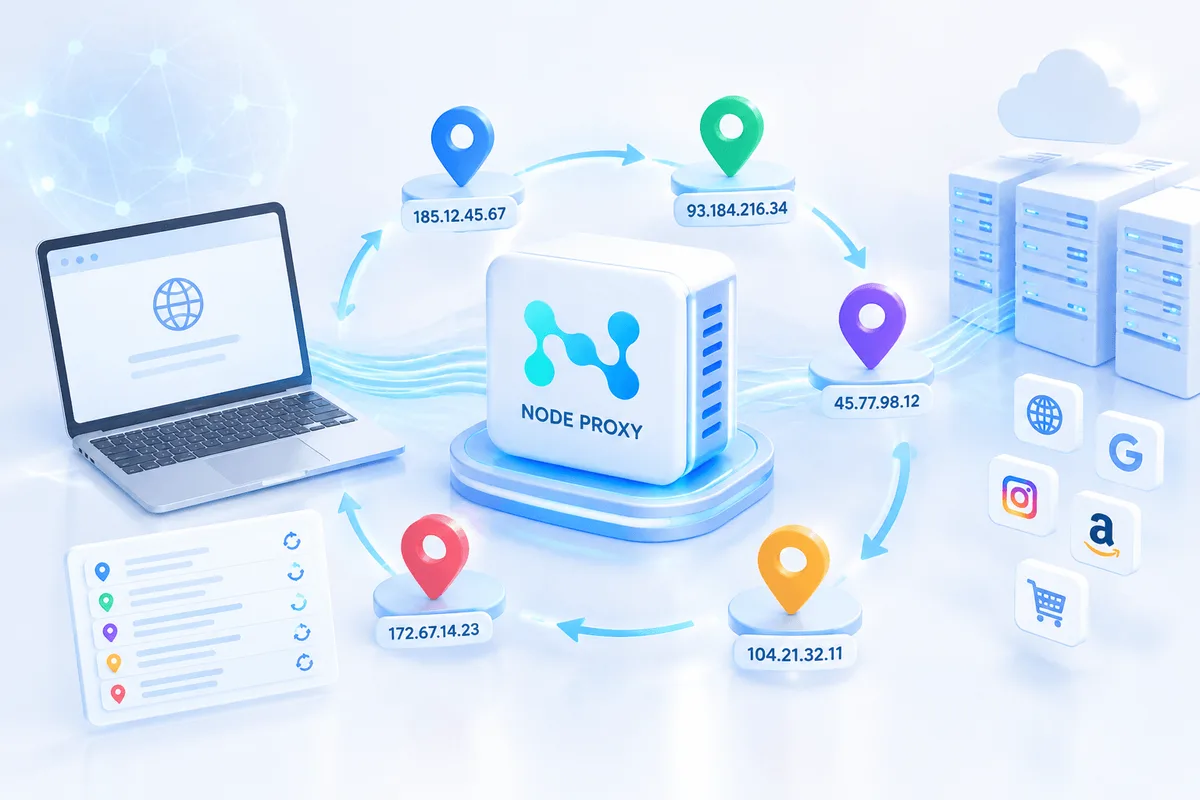
What Is a Proxy Server? How It Works, Types and How to Choose One


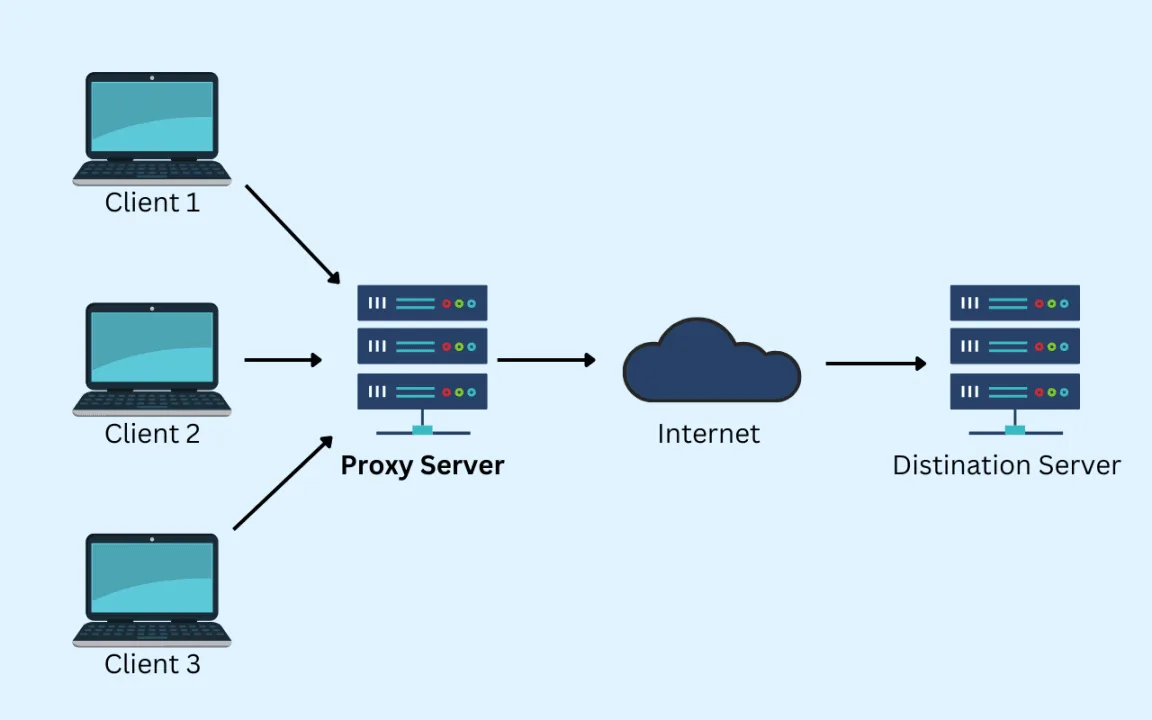
A proxy server is an intermediate node through which a user’s request to a website, service, or other network resource passes. Instead of connecting directly to the required address, the device first sends the request to the proxy, which then interacts with the destination endpoint and returns the response.
This mechanism is needed not only to substitute the visible IP address. In practice, proxies are used to manage network access, cache content, distribute load, filter traffic, and build additional layers of protection. That is why proxies are in demand in corporate infrastructure, in user scenarios, and in the architecture of web services themselves.
What a Proxy Server Does
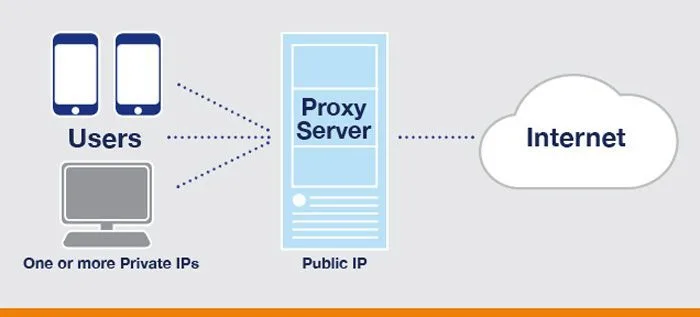
When a connection is made without an intermediary, the website receives the request directly from the user’s device. When operating through a proxy, an additional link appears between the client and the external resource. It accepts the outgoing request, forwards it on its own behalf, receives the response, and returns it to the client.
From the outside, the source of the request is the proxy server rather than the user’s device itself. At the same time, a proxy can perform not just one but several functions at once. Depending on its settings, it may simply forward traffic, or it may analyze it, restrict access to certain websites, store frequently requested data in cache, check requests against internal rules, and help redistribute load.
Residential Proxies That Fit Your Workflow
Choose the IP, GEO, and rotation method that fits your needs.
How a Proxy Works
How it works:
- The user sends a request to open a page or retrieve data.
- This request goes not directly to the required resource, but to the proxy server.
- The proxy connects to the target website using its own address.
- The web resource processes the request and sends the response back to the proxy.
- The proxy forwards the result to the user.
Externally, nothing changes for the client: they still receive a page, a file, or a service response. The difference is that a separate intermediate node now stands between them and the destination resource, and this node can conceal the original address, filter connections, and affect traffic processing.
At the same time, it is important to understand that a proxy alone is not enough to completely prevent user identification. In practice, cookies, browser parameters, network behavior, and other technical indicators also matter.
What Proxy Servers Are Used For
Proxies are used for different tasks, and the set of purposes depends on the environment in which they are used.
Access Control and Traffic Filtering
In organizations, proxies are often implemented as a network policy tool. They can be used to allow or block access to certain categories of websites, restrict external connections, and centrally define rules for working with the internet.
Reducing Load and Speeding Up Repeated Requests
If the same content is requested repeatedly, a proxy can store a copy of it and deliver it again without continuously requesting the original resource. This reduces the load on the channel and shortens response time within the local network.
An Additional Security Layer
A proxy can be used as an intermediate barrier between internal infrastructure and external resources. In such a setup, it helps conceal internal nodes, filter some of the connections, and organize network exchange.
Operational and Infrastructure Tasks
For businesses, a proxy is also a technical tool. It is used for testing services under different conditions, for centralized work with multiple systems, in balancing mechanisms, and in scenarios where controlled traffic routing is important.
Where Proxies Are Used in Practice
In a corporate environment, proxy servers are often responsible for regulating employees’ access to external resources, accelerating the loading of frequently used pages, caching, enforcing security rules, and monitoring internet activity.
In the infrastructure of websites and online services, a proxy often operates on the server side. In this case, it accepts incoming requests, distributes them among several nodes, reduces the load on the main system, and helps speed up content delivery.
For technical specialists, a proxy is useful as a working tool in testing, network configuration, data collection, and building a predictable access scheme to external platforms.
Types of Proxy Servers
Proxies differ according to several criteria: their role in the network scheme, the nature of IP rotation, the level of access, and the type of addresses used. For a more detailed breakdown, see our guide to types of proxy servers.
Classification by Role in the Network
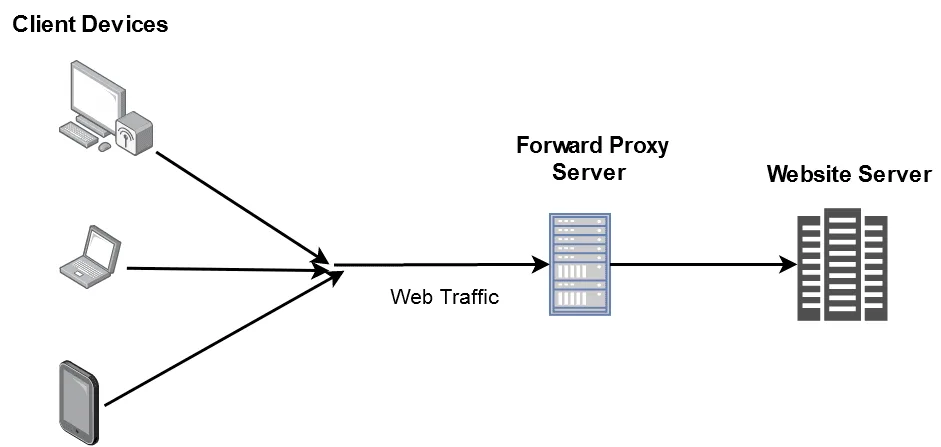
Forward Proxy
This is the standard model in which the intermediary server stands between the user and an external internet resource. It receives user requests and passes them further on. This type is used for filtering, caching, and controlling outgoing traffic.
Reverse Proxy
In this scheme, the intermediary is located not in front of the client, but in front of the web server. Users connect to the proxy, which then distributes requests among internal servers. Reverse proxies are widely used on high-load websites and in service infrastructure where traffic needs to be distributed and the internal architecture concealed.
Classification by IP Address Rotation
Static Proxies
Static proxies operate with a permanent IP during a specified period. They are convenient where a stable session, a predictable address, and an unchanging connection point are required.
Dynamic or Rotating Proxies
Such solutions change the IP by time interval or by number of requests. This makes it possible to distribute requests across several addresses and reduce dependence on one specific IP. This is how rotating proxies work.
Classification by Access Level
Public Proxies
They are available to a wide range of users, often without payment or registration. Their weak points are low stability, high load, unpredictable speed, and increased risks to data security. Read more in our guide to the public proxy server.
Private Proxies
They are provided to authorized users and usually operate on a paid model. As a rule, they are more stable, faster, and better suited for regular use in work-related tasks.
Classification by Hosting Type
Datacenter Proxies
Such addresses are hosted in data centers. Their advantages are availability, relatively high speed, and moderate cost. Their disadvantage is that addresses from data centers are often recognized by systems as proxies. Node Proxy offers such addresses as datacenter proxies.
Residential Proxies
They operate through IP addresses associated with home or user networks. From the point of view of external services, such traffic looks more natural, which is why such solutions are often less noticeable.
You can read more about the difference between server and residential proxies in our article Residential vs. Server Proxies.
Mobile Proxies
They use addresses of mobile operators. For external platforms, such traffic also looks like ordinary activity of mobile users, which makes mobile proxies a separate class of solutions with its own area of application.
Main Proxy Protocols
The functionality of a proxy directly depends on the protocol it uses.
HTTP Proxy
Suitable for standard web traffic. It is used for working with websites, can cache pages, and can speed up repeated content loading. At the same time, by itself it is not intended for reliable protection of sensitive data.
HTTPS Proxy
Functionally close to an HTTP proxy, but it works with a secure connection. This option is better suited for cases where it is important to transmit data over an encrypted channel.
SOCKS Proxy
A more universal format. It can handle not only web requests but also traffic from various applications. A SOCKS proxy usually does not cache content and does not interfere with the data structure, but simply forwards the data further on. The most common version is considered to be SOCKS5.
Advantages of Proxy Servers
The main value of a proxy lies in the fact that it solves several network tasks at once rather than being limited to a single function.
The main advantages include:
- the ability to filter traffic;
- caching of frequently requested content;
- acceleration of repeated page loading;
- centralized access management;
- load distribution between nodes;
- an additional intermediate layer of protection;
- flexible configuration for different protocols and work scenarios.
For organizations, manageability, scalability, and the ability to integrate a proxy into the existing network infrastructure are especially important.
What Risks Need to Be Considered
A proxy server should not be regarded as an automatically secure solution. Its reliability is determined by its configuration, the type of service, and the provider’s policy.
Storage of Traffic Data
If the provider keeps activity logs, a significant volume of information about user requests passes through it. For this reason, it is important to understand in advance whether the service stores logs and exactly how it handles such data.
Insufficient Connection Protection
Not all proxies provide encryption. If traffic passes without additional protection, some of the transmitted data may be more vulnerable.
Speed Drops and Instability
The operation of a proxy depends on the quality of the infrastructure, the geography of the server, the level of load, and the number of users. Speed issues occur especially often with mass public solutions.
An Unreliable Provider
If the service is non-transparent, the user risks facing not only poor performance but also unsafe traffic handling. Therefore, choosing a proxy based only on a low price is a weak strategy.
How to Choose the Right Proxy
The choice depends not on a general description of the service, but on the specific task. One type of proxy is suitable for ordinary web work, another for applications, and a third for infrastructure processes.
First of all, it is necessary to determine the goal. If work with web pages is required, HTTP or HTTPS is usually considered. If compatibility with different programs and traffic types is important, SOCKS5 is more often chosen.
Next, the access model should be taken into account. Public proxies are suitable only for simple and irregular scenarios where there are no strict stability requirements. For constant work, it is more reasonable to use private solutions with authorization and clearly defined service parameters.
The next criterion is the type of addresses. Datacenter proxies are usually cheaper and faster, while residential and mobile proxies are less noticeable to external systems. The choice here depends on what exactly matters more: cost, speed, the natural appearance of traffic, or connection stability.
The geography of the server must also be assessed separately. The closer the node is to the user or the target resource, the lower the latency and the better the response. For example, U.S. proxy servers are used when a task requires American IP addresses.
Finally, the provider’s reputation is of great importance. Before connecting, it is worth checking the terms of service, logging policy, availability of support, pricing transparency, and the possibility of testing.
Proxy Server FAQ
What is a proxy server in simple terms?
A proxy server is an intermediary between your device and the internet. Your request goes to the proxy first, the proxy sends it to the website on its own behalf and returns the response, so the website sees the IP address of the proxy.
What are the main types of proxy servers?
By role in the network, proxies are forward or reverse. By IP behavior, they are static or rotating. By access level, they are public or private, and by address type, they are datacenter, residential or mobile.
What is the difference between a forward and a reverse proxy?
A forward proxy stands in front of users and forwards their requests to external websites. A reverse proxy stands in front of web servers and distributes incoming requests among them.
Does a proxy server make me anonymous?
Not completely. A proxy hides your IP address from the website, but cookies, browser parameters and behavior can still identify you, and not every proxy encrypts traffic.
Conclusion
A proxy server is not just an intermediate address for accessing the network, but a full-fledged traffic management tool. It makes it possible to cache data, apply access rules, redistribute load, and build an additional layer of network protection.
The effectiveness of a proxy is determined not by the name of the technology, but by how correctly its type has been selected for a specific task. Therefore, when choosing, it is important to look not only at the cost, but also at the protocol, access model, the nature of IP addresses, the geography of the nodes, and the reliability of the provider. If you need high-quality residential proxies, you can get them from Node Proxy.